Compensatory hallucinogenesis across three neuropsychiatric disorders: a Bayesian account
Raina Vin, Jordan Galbraith, Rashina Seabury, Hae Young Yi, Gabriela Hernández-Busot, Lucas Oland, Boris Epie, Anne Trainer, Carolyn Fredericks, Albert R Powers

TL;DR
This paper proposes that visual hallucinations in three neuropsychiatric disorders arise from a compensatory over-reliance on prior knowledge when sensory input is degraded.
Contribution
The paper introduces a unified Bayesian framework to explain hallucinogenesis across diverse disorders with distinct sensory disruptions.
Findings
Visual hallucinations in Charles Bonnet syndrome, dementia with Lewy Bodies, and psychosis can be explained by compensatory Bayesian inference.
Discrete sensory disruptions in these disorders lead to distinct hallucination characteristics and neural circuit involvement.
A computational framework unites these observations to guide future subgroup identification and treatment development.
Abstract
Emerging evidence suggests that hallucinations may arise because of an over-reliance on prior knowledge during perception. While best established in psychosis-spectrum illness, data also support the presence of this abnormality in other hallucination-prone neuropsychiatric illnesses that vary in their association with disruption of sensory circuits. In this piece, we ask whether an over-weighting of expectations may be conceived of as a compensatory response to degraded incoming sensory information. We make the case that visual hallucinogenesis across a wide array of neuropsychiatric disorders can be captured within a common Bayesian computational framework, as a compensatory response to sensory signal disruptions at different levels of the visual processing hierarchy. We focus on three specific disorders (Charles Bonnet syndrome, dementia with Lewy Bodies and psychosis) with prominent…
Genes, proteins, chemicals, diseases, species, mutations and cell lines named across the full text — each resolved to its canonical identifier and authoritative record.
Click any figure to enlarge with its caption.
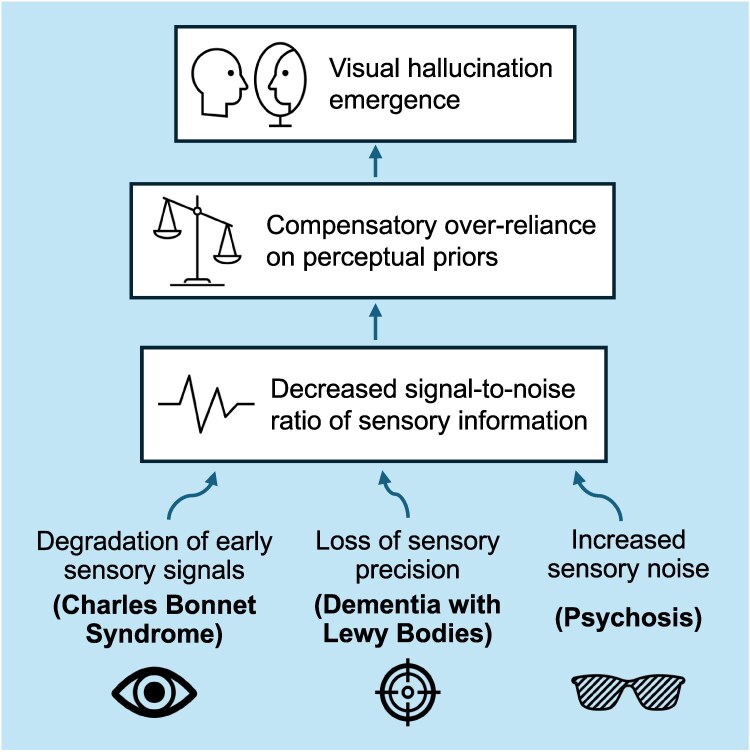 Figure 1
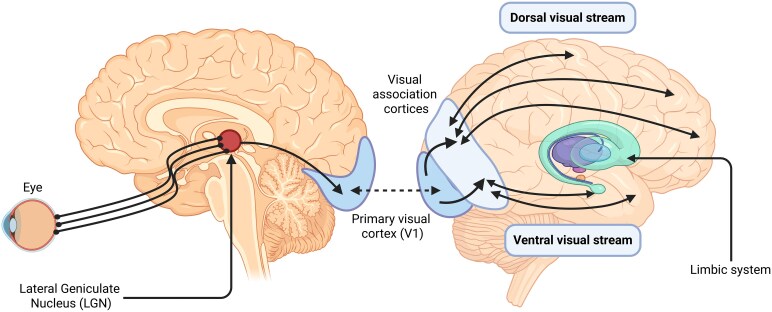 Figure 2
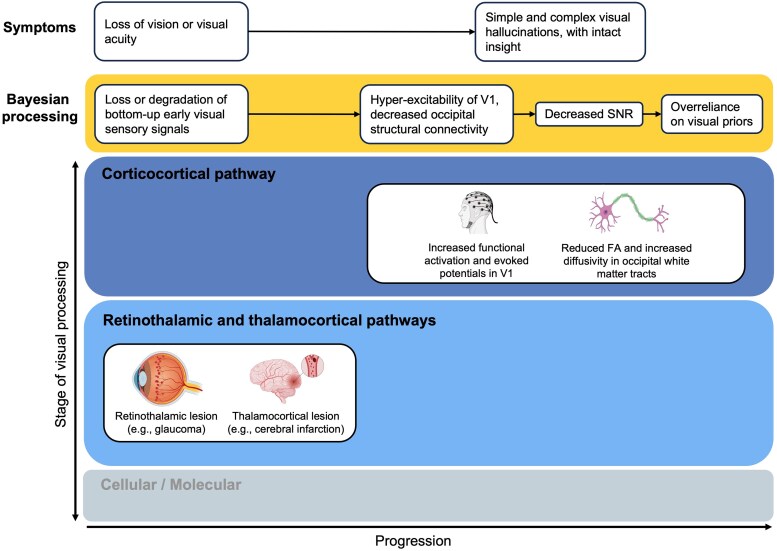 Figure 3
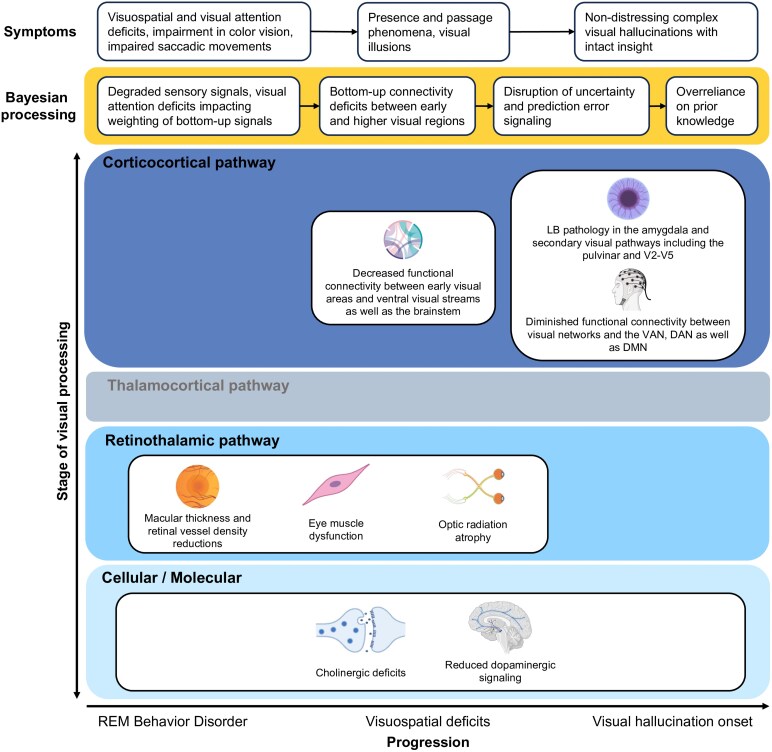 Figure 4
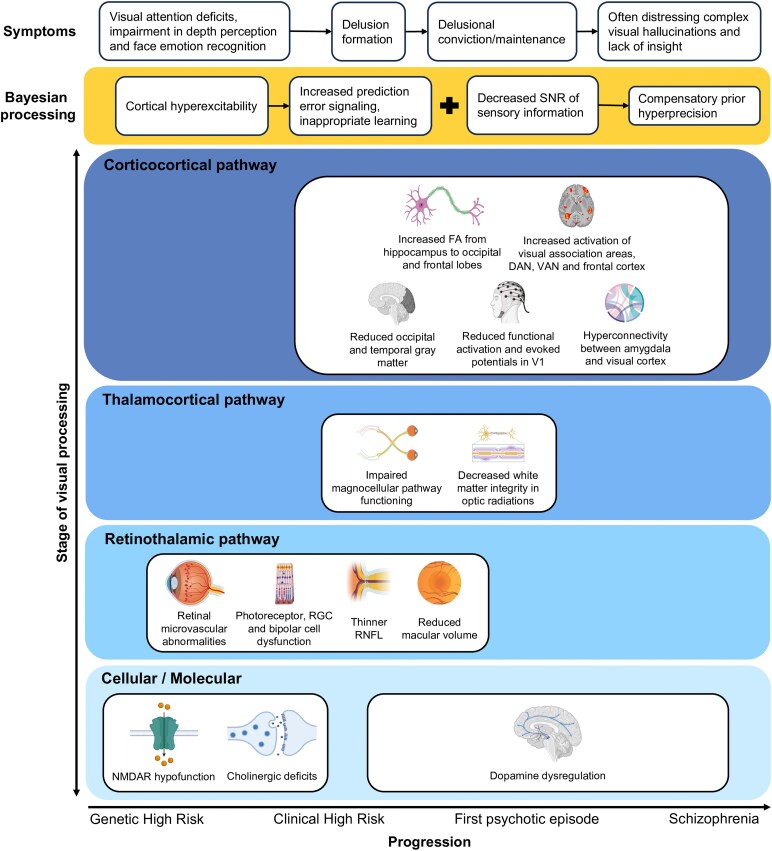 Figure 5
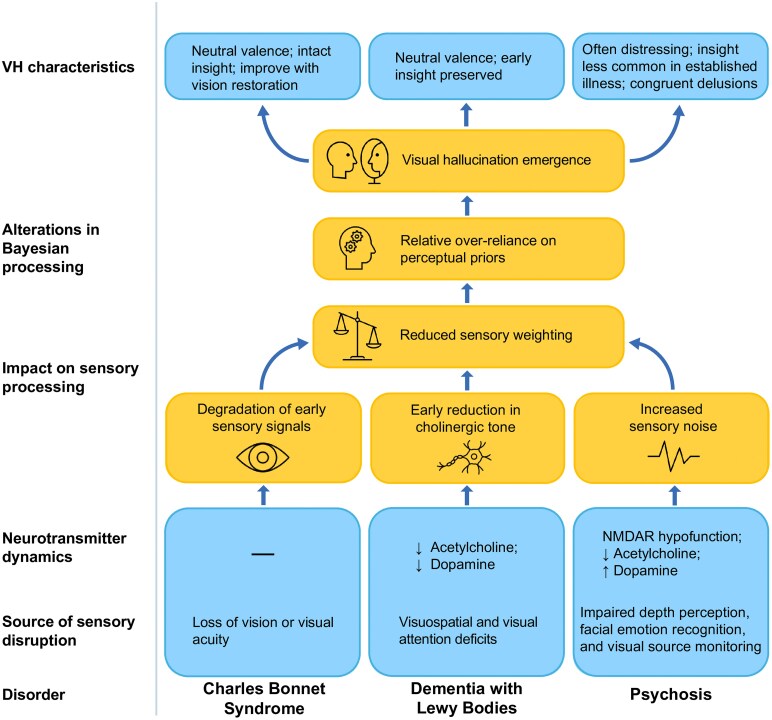 Figure 6
Peer Reviews
No public reviews on file for this paper yet. If you reviewed it on a platform where reviews are public (OpenReview, ICLR, NeurIPS, ICML), you can paste yours below so the community can read it here.
Videos
No videos yet. Explain this paper in a talk, walkthrough, or lecture? Add one.
Taxonomy
TopicsHallucinations in medical conditions · Spatial Neglect and Hemispheric Dysfunction · Psychedelics and Drug Studies