Mechanistic Insights Into the Retention and Separation Mechanism of Poly(Ethylene Glycol)‐Modified Short Oligonucleotides in Anion‐Exchange Chromatography
Noriko Yoshimoto, Tomoya Matsumoto, Yoshiatsu Ono, Yuma Kumagai

TL;DR
This study explores how adding PEG to short DNA molecules affects their purification through anion-exchange chromatography, revealing how PEG changes their behavior without altering their charge.
Contribution
The study provides mechanistic insights into how PEGylation affects the chromatographic behavior of oligonucleotides through steric and hydration effects.
Findings
PEGylation shifts elution to lower salt concentrations, especially for shorter oligomers and mid-position modifications.
PEGylation reduces the ion-exchange equilibrium constant, indicating altered local interaction environments.
PEGylation weakens the retention-dependent decrease in plate height, suggesting modified mass-transfer characteristics.
Abstract
Purification is a critical step in the development of synthetic short DNA for pharmaceutical applications. PEGylation enhances stability and pharmacokinetics but introduces steric and hydration effects that affect chromatographic behavior without altering the nominal DNA charge. This study investigated the retention and mass‐transfer behavior of thymine‐based poly(dT) oligomers (9–95 bases) modified with poly(ethylene glycol) (PEG) using anion‐exchange chromatography with a mechanistic ion‐exchange framework. By systematically varying PEG molecular weight and modification site, we examined how PEG‐induced changes in molecular size and local interaction environment are reflected in mechanistic retention parameters. PEGylation shifted elution to lower salt concentrations, with more pronounced effects observed for shorter oligomers and mid‐position modifications. Model‐based analysis…
Genes, proteins, chemicals, diseases, species, mutations and cell lines named across the full text — each resolved to its canonical identifier and authoritative record.
Click any figure to enlarge with its caption.
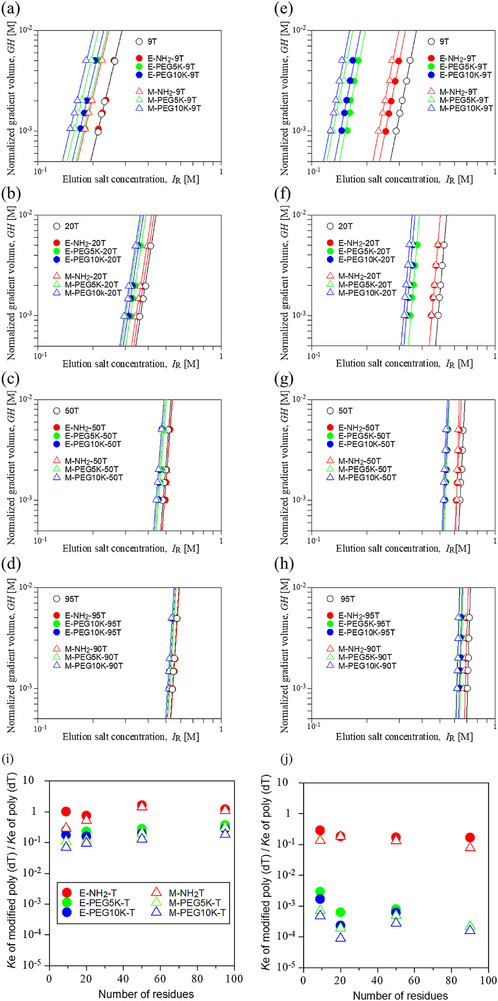 Figure 1
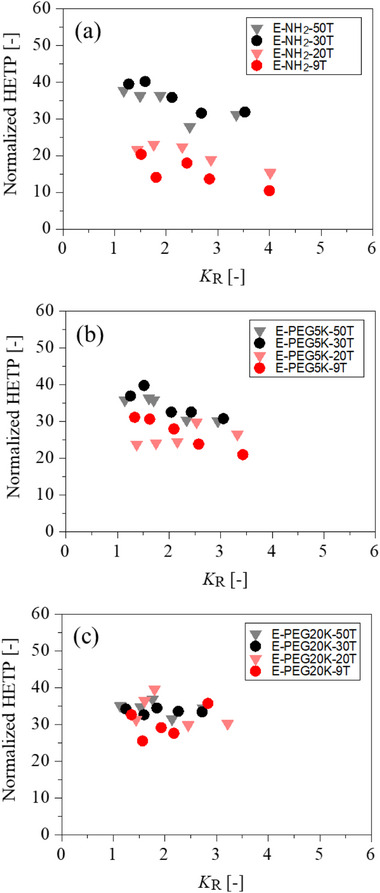 Figure 2
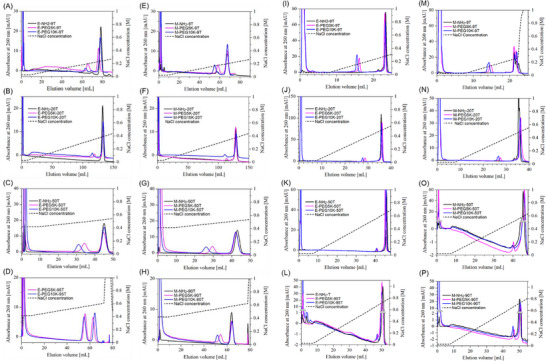 Figure 3
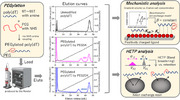 Figure 4
 Figure 5
 Figure 6
Peer Reviews
No public reviews on file for this paper yet. If you reviewed it on a platform where reviews are public (OpenReview, ICLR, NeurIPS, ICML), you can paste yours below so the community can read it here.
Videos
No videos yet. Explain this paper in a talk, walkthrough, or lecture? Add one.
Taxonomy
TopicsProtein purification and stability · Analytical Chemistry and Chromatography · RNA Interference and Gene Delivery