Excellent Intra- and Interobserver Reliability of the D.H. Dejour Version 2 Classification for Trochlear Dysplasia Using Radiographs Combined With MRI With Evaluation of Shortcomings
Michael J. Dan, Nicolas Cance, Edoardo Giovannetti de Sanctis, Tomas Pineda, David Henri Dejour

TL;DR
This study shows that using radiographs and MRI for the Dejour V2 classification of trochlear dysplasia has high reliability, especially when simplified to two grades.
Contribution
The study introduces a simplified two-grade classification for trochlear dysplasia that improves diagnostic reliability and sensitivity.
Findings
Intrarater and interrater reliability improved to 0.95 and 0.93, respectively, with the simplified two-grade classification.
High-grade trochlear dysplasia had 97.8% sensitivity and 96.4% specificity when using the simplified classification.
The original four-type classification had moderate sensitivity for low-grade trochlear dysplasia.
Abstract
The D.H. Dejour classification (Version 2 [V2]) expanded upon the H. Dejour radiographic classification of trochlear dysplasia by adding computed tomography (CT) scans to the evaluation. Magnetic resonance imaging (MRI) then became the main investigation of choice. To report the reliability of the Dejour V2 using a combination of radiographs and MRI instead of CT scan as per the original classification and to explore differences in the assessment of trochlear dysplasia between assessors to better understand limitations to the classification. Cohort study; Level of evidence, 3. This is a retrospective comparative study, conducted by reviewing a prospectively maintained institutional database, between 2 groups of patients: those with recurrent patellar dislocation, termed objective patellar instability (OPI), and control patients with no patellofemoral symptoms. Inclusion criteria were…
Genes, proteins, chemicals, diseases, species, mutations and cell lines named across the full text — each resolved to its canonical identifier and authoritative record.
Click any figure to enlarge with its caption.
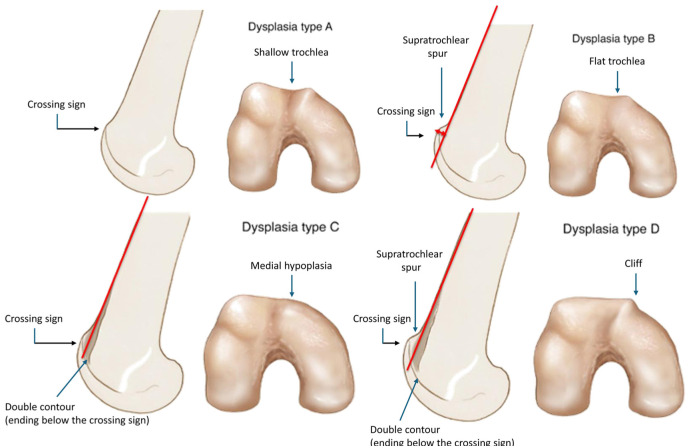 Figure 1
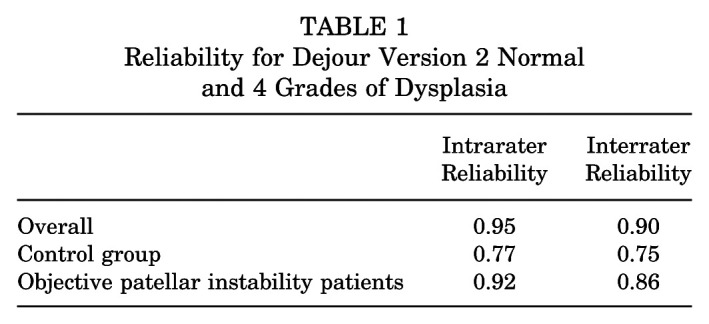 Figure 2
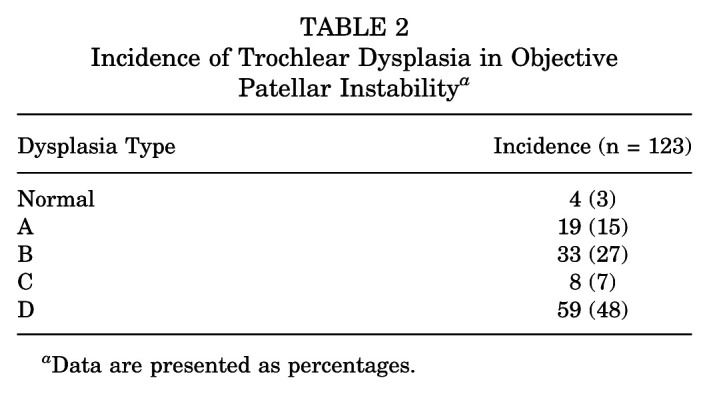 Figure 3
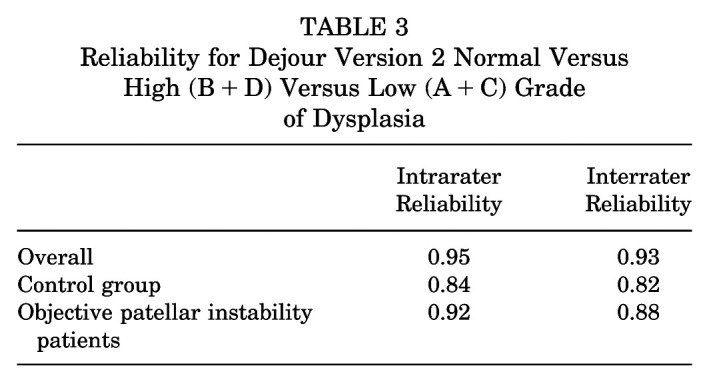 Figure 4
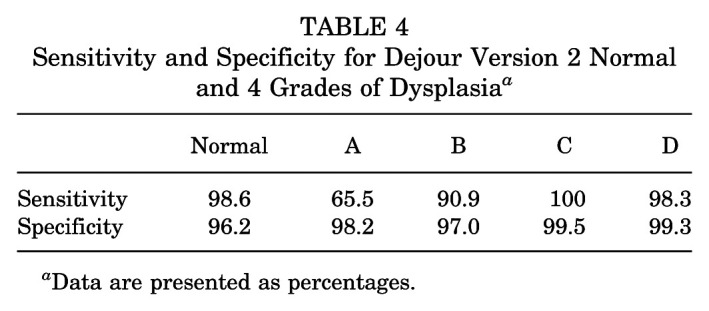 Figure 5
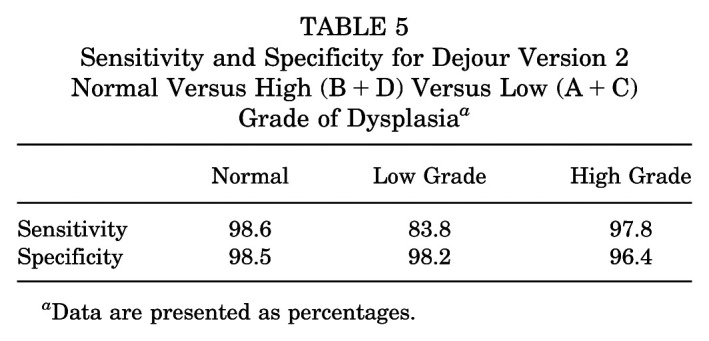 Figure 6
Peer Reviews
No public reviews on file for this paper yet. If you reviewed it on a platform where reviews are public (OpenReview, ICLR, NeurIPS, ICML), you can paste yours below so the community can read it here.
Videos
No videos yet. Explain this paper in a talk, walkthrough, or lecture? Add one.
Taxonomy
TopicsLower Extremity Biomechanics and Pathologies · Shoulder Injury and Treatment · Total Knee Arthroplasty Outcomes