Development of a new biological dressing: the modified cross-linking of Chitosan derived from cuttlefish (Sepia pharaonis) by-products as an effective agent for promoting cell migration
Ping-Hsiu Huang, Yu-Wei Chen, Jing-Huei Zeng, Bo-Heng Li, Ya-Ting Chen, Shu-Ling Hsieh, Ming-Kuei Shih, Chih-Yao Hou

TL;DR
Researchers developed a new wound healing dressing using modified chitosan from cuttlefish by-products, which promotes cell migration and could be a cost-effective treatment.
Contribution
A novel CMC-MCP complex was developed from cuttlefish by-products and shown to enhance cell migration and wound healing.
Findings
The CMC-MCP complex significantly promoted cell migration at low concentrations.
CMC-MCP increased the expression of MMP-2, MMP-9, TIMP-1, and TIMP-2, which are important for wound healing.
The complex showed potential as a safe and effective biological dressing for wound healing.
Abstract
This study aimed to extract chitosan (CS) from cuttlefish (Sepia pharaonis) bones (CB) and then chemically modify it to produce carboxymethyl chitosan (CMC). Marine cuttlefish skin collagen peptide (MCP) was then cross-linked with CMC to form a novel CMC-MCP complex. The physicochemical properties and biological effects of CS, CMC, MCP, and CMC-MCP were evaluated using human keratinocyte (HaCaT) cell lines. All materials showed cytotoxicity at high concentrations (100–1600 µg/mL), negatively affecting cell viability. At a lower concentration of 50 µg/mL, the materials were used to assess cell migration. Among them, the CMC-MCP complex significantly promoted cell migration. Additionally, CMC-MCP treatment led to increased expression levels of matrix metalloproteinases (MMP-2 and 9) and tissue inhibitors of metalloproteinases (TIMP-1 and 2), which are key regulators in the wound healing…
Genes, proteins, chemicals, diseases, species, mutations and cell lines named across the full text — each resolved to its canonical identifier and authoritative record.
Click any figure to enlarge with its caption.
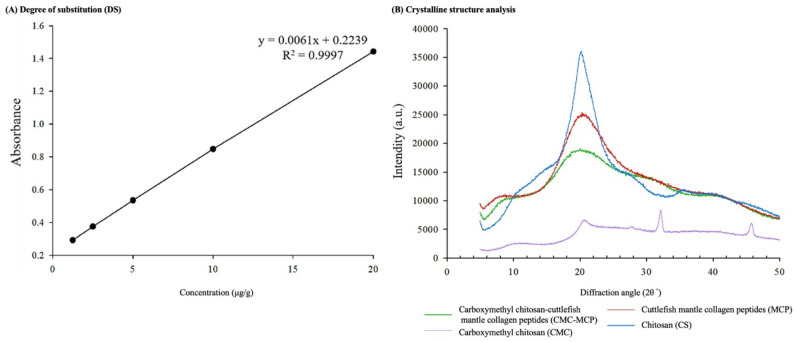 Figure 1
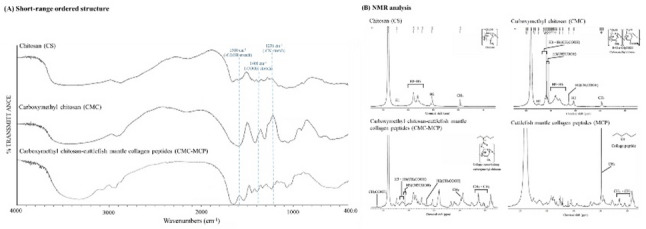 Figure 2
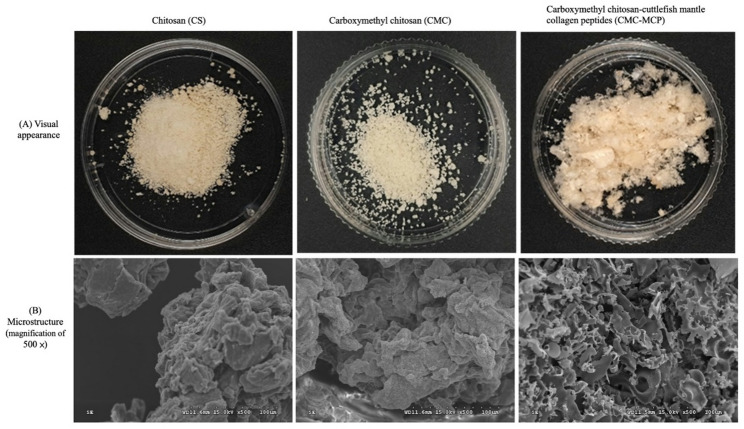 Figure 3
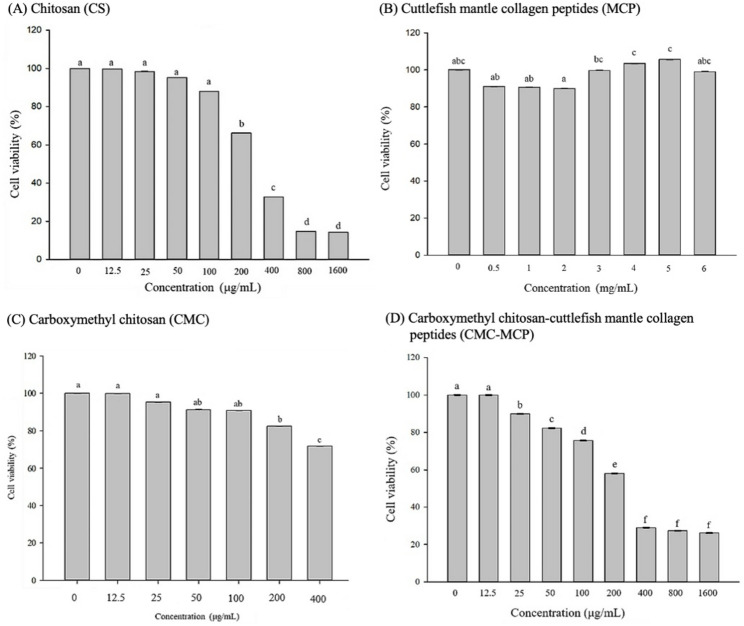 Figure 4
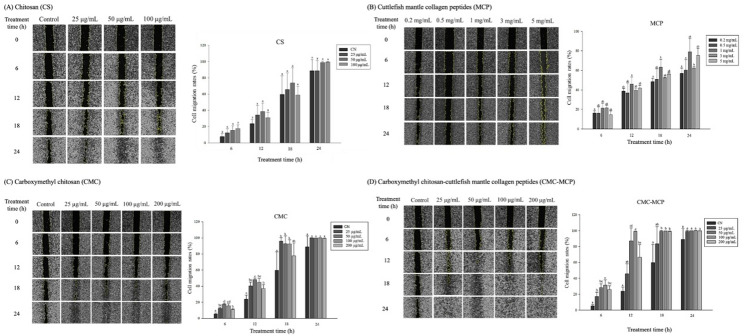 Figure 5
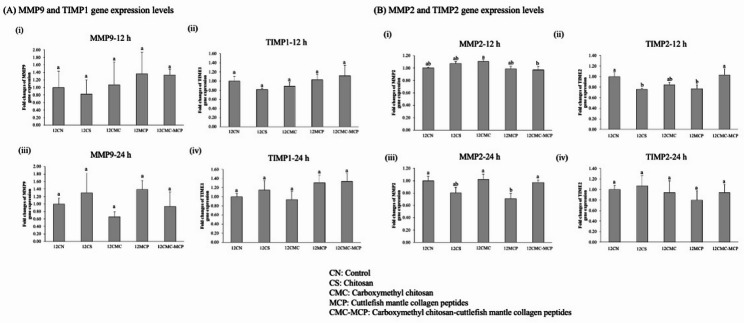 Figure 6
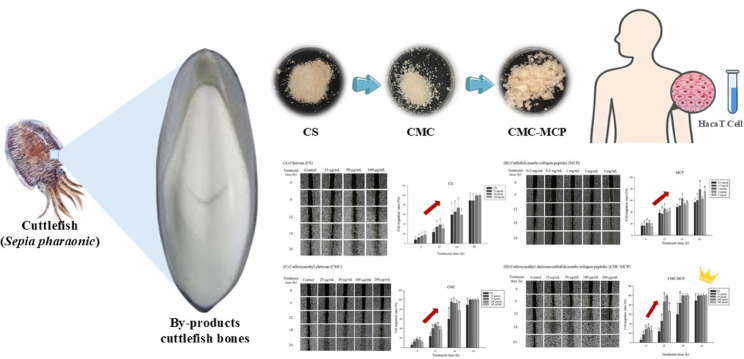 Figure 7
Peer Reviews
No public reviews on file for this paper yet. If you reviewed it on a platform where reviews are public (OpenReview, ICLR, NeurIPS, ICML), you can paste yours below so the community can read it here.
Videos
No videos yet. Explain this paper in a talk, walkthrough, or lecture? Add one.
Taxonomy
TopicsWound Healing and Treatments · Cephalopods and Marine Biology · Seaweed-derived Bioactive Compounds