The return of a forgotten ally: tabletop scanning electron microscopy in the realm of bacteriology
Omar Zmerli, Meriem Boukili, Sara Bellali, Jacques Bou Khalil

TL;DR
Tabletop scanning electron microscopy is becoming a valuable tool in bacteriology for fast and accurate bacterial analysis.
Contribution
The paper highlights the renewed role of tabletop SEM in transforming bacteriology research and clinical practices.
Findings
Tabletop SEM enables rapid and high-resolution bacterial visualization.
It aids in understanding bacteria-antibiotic interactions and morphological changes.
Combined with EDX, it provides insights into bacterial metabolism and chemical composition.
Abstract
Scanning electron microscopy (SEM) is re-emerging as an accessible method in bacteriology, driven by technological advances that produced the powerful and compact tabletop SEM. This review highlights recent advances (2015–2025) demonstrating how novel tabletop SEM delivers rapid, high-resolution, and accurate results that can transform both fundamental and clinical bacteriology. Several studies consistently demonstrate the utility of tabletop SEM in basic research, such as studying biofilms, building antibacterial coated material, and describing bacteria-environment interactions. In clinical bacteriology, diverse applications have emerged over the past few years placing the tabletop SEM at the forefront of bacterial visualization from clinical samples, reaching accurate descriptions of bacteria-antibiotic interactions and the accurate detection of bacterial morphologic changes following…
Click any figure to enlarge with its caption.
 Figure 1
 Figure 2
 Figure 3
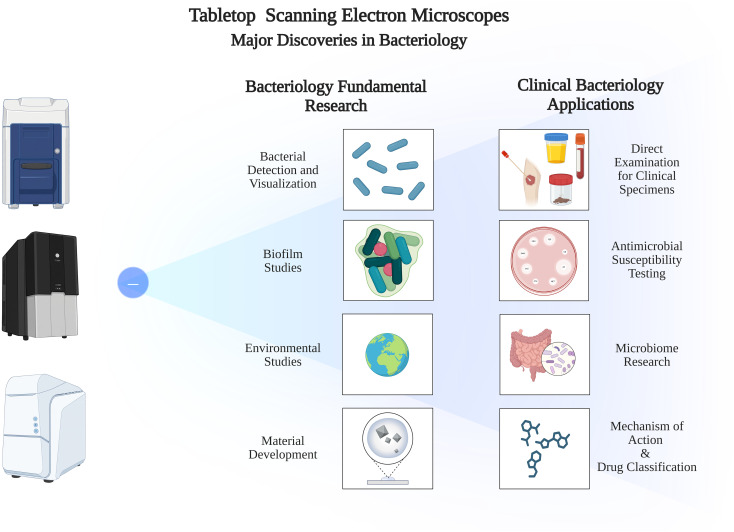 Figure 4
Peer Reviews
No public reviews on file for this paper yet. If you reviewed it on a platform where reviews are public (OpenReview, ICLR, NeurIPS, ICML), you can paste yours below so the community can read it here.
Videos
No videos yet. Explain this paper in a talk, walkthrough, or lecture? Add one.
Taxonomy
TopicsAdvanced Electron Microscopy Techniques and Applications · Electron and X-Ray Spectroscopy Techniques · Bacterial Identification and Susceptibility Testing