Sex differences in APOE- and PICALM-related cognitive profiles in healthy middle-aged adults
Adam Bednorz, Paulina Trybek, Minh Tuan Hoang, Dorota Religa

TL;DR
This study found that genetic risk factors for Alzheimer's disease affect cognitive performance differently in men and women, suggesting early signs of risk.
Contribution
The study reveals sex-specific gene-cognition interactions in healthy middle-aged adults, highlighting early risk indicators.
Findings
APOE ε3ε4 in women with lower cognitive performance is linked to worse recognition accuracy and more perseverations.
PICALM GG interacts with education to influence fluid intelligence in women.
In men, APOE ε3ε4 and APOE×PICALM interactions are associated with reduced fluid intelligence and episodic memory.
Abstract
The APOE ε4 and PICALM GG genotypes are strong genetic risk factors for Alzheimer’s disease. This study aimed to identify cognitive subgroups using unsupervised machine learning and to investigate the influence of APOE and PICALM genotypes on cognitive performance. Cognitive, genetic and demographic data from 192 healthy middle-aged adults (50–63 years) from the PEARL-Neuro Database were analyzed using agglomerative hierarchical clustering. Neuropsychological tests included the California Verbal Learning Test, Raven’s Progressive Matrices, and the Edinburgh Handedness Inventory. Subsequent analyses used linear regression models to assess the effects of APOE, PICALM, and their interaction on cognitive outcomes. Two cognitive subgroups (better vs. worse performance) were identified for both females (n = 60/43) and males (n = 38/51). In women with lower cognitive performance, the…
Genes, proteins, chemicals, diseases, species, mutations and cell lines named across the full text — each resolved to its canonical identifier and authoritative record.
Click any figure to enlarge with its caption.
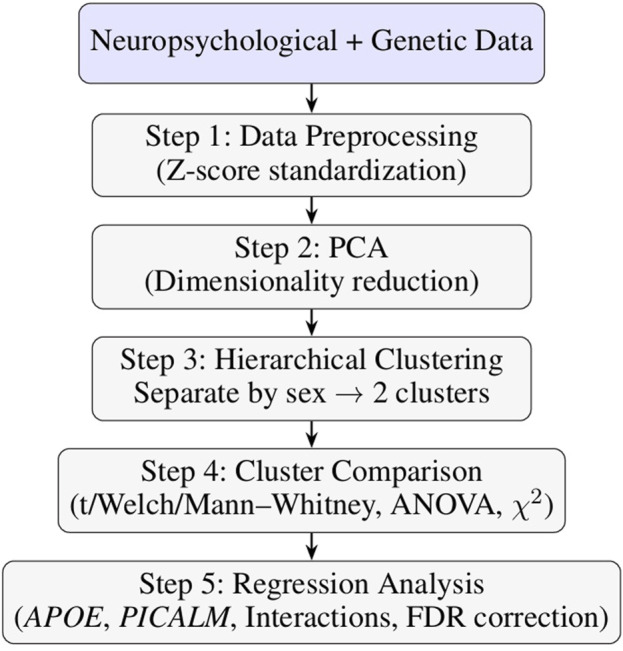 Figure 1
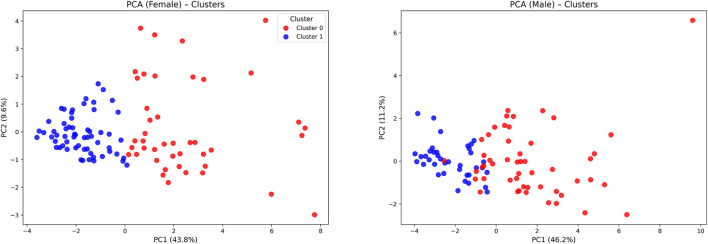 Figure 2
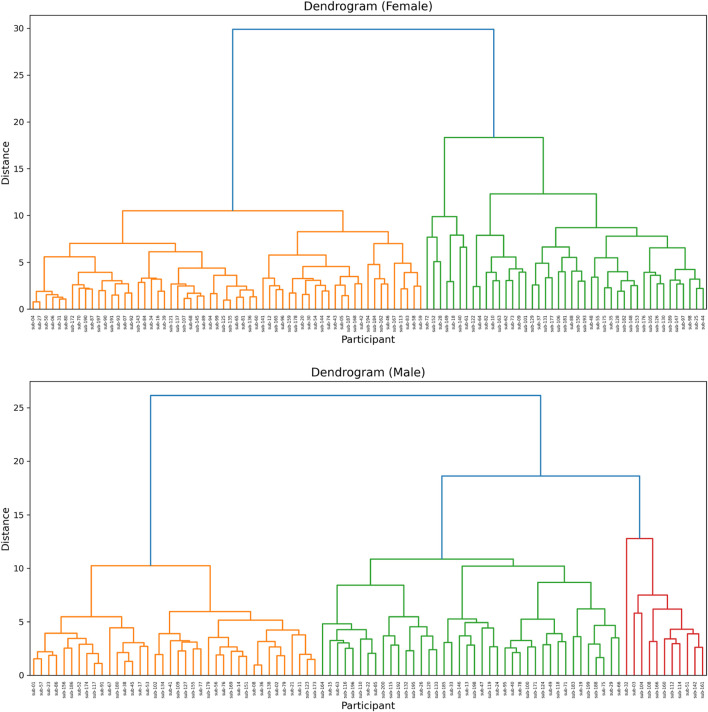 Figure 3
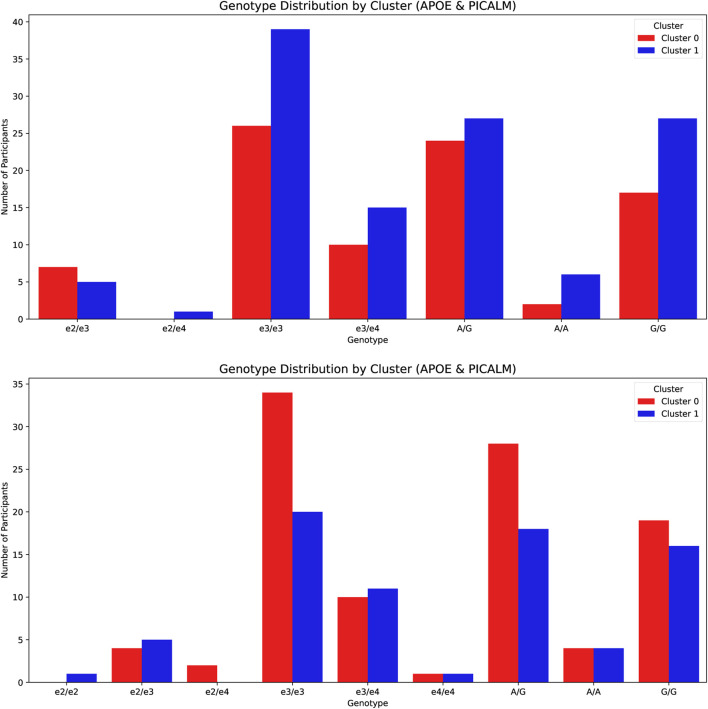 Figure 4
Peer Reviews
No public reviews on file for this paper yet. If you reviewed it on a platform where reviews are public (OpenReview, ICLR, NeurIPS, ICML), you can paste yours below so the community can read it here.
Videos
No videos yet. Explain this paper in a talk, walkthrough, or lecture? Add one.
Taxonomy
TopicsDementia and Cognitive Impairment Research · Hemispheric Asymmetry in Neuroscience · Alzheimer's disease research and treatments