Influence of anesthetic agent and burst suppression on postoperative delirium in elderly patients: a prospective cohort study with automated EEG analysis
Maximilian Markus, Marc Dorenbeck, Vera Röhr, Sophie Leroy, Benjamin Blankertz, Emery N. Brown, Claudia Spies, Susanne Koch

TL;DR
This study found that sevoflurane increases postoperative delirium risk in elderly patients more than propofol, even with less burst suppression, and introduces a new tool to detect burst suppression.
Contribution
A new automated algorithm for burst suppression detection and evidence that sevoflurane increases delirium risk more than propofol.
Findings
Sevoflurane was associated with higher postoperative delirium rates than propofol.
Burst suppression under sevoflurane increased delirium risk 3.8-fold compared to propofol.
The new automated burst suppression detection algorithm showed high precision.
Abstract
Guidelines currently suggest considering EEG guidance during general anesthesia in elderly patients to avoid prolonged burst suppression (BS), with the aim of mitigating postoperative delirium (POD). Our study aimed to investigate the association between POD and intraoperative BS duration dependent on the general anesthetic agent used (propofol vs. sevoflurane). In this prospective study (2019–2022), EEGs from 265 patients over 70 years undergoing general anesthesia were analyzed for intraoperative BS duration both visually and using one new automated algorithm to evaluate its accuracy. Associations between BS duration, anesthetic agent, and postoperative delirium (POD) were evaluated using multivariable logistic regression, adjusting for confounders. BS duration was markedly shorter than in prior cohorts but did not reduce overall postoperative delirium (POD) incidence. POD occurred…
Genes, proteins, chemicals, diseases, species, mutations and cell lines named across the full text — each resolved to its canonical identifier and authoritative record.
Click any figure to enlarge with its caption.
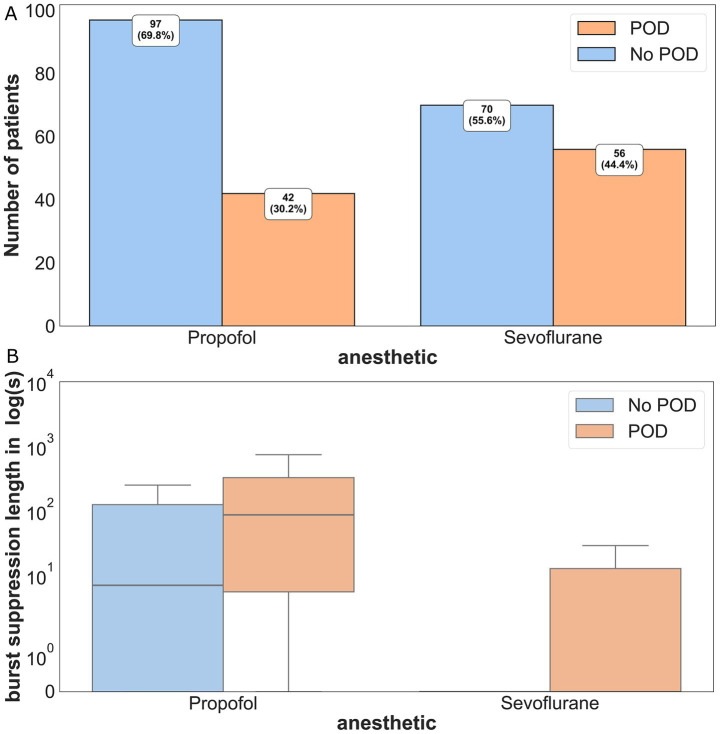 Figure 1
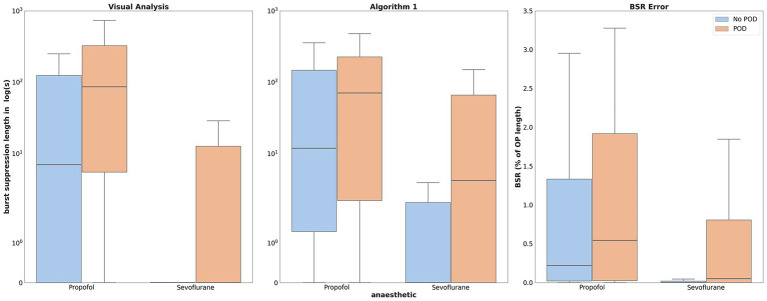 Figure 2
Peer Reviews
No public reviews on file for this paper yet. If you reviewed it on a platform where reviews are public (OpenReview, ICLR, NeurIPS, ICML), you can paste yours below so the community can read it here.
Videos
No videos yet. Explain this paper in a talk, walkthrough, or lecture? Add one.
Taxonomy
TopicsIntensive Care Unit Cognitive Disorders · Anesthesia and Sedative Agents · Anesthesia and Neurotoxicity Research