Parametric analysis of electromagnetic wave interactions with layered biological tissues for varying frequency, polarization, and fat thickness
Akram Gasmelseed

TL;DR
This paper studies how electromagnetic waves interact with layered biological tissues at different frequencies and angles, revealing how fat thickness and polarization affect heating and reflection.
Contribution
A novel MATLAB framework integrating transmission line theory, dielectric modeling, and bioheat simulations to analyze EM wave interactions with layered tissues across ISM bands.
Findings
Significant superficial heating (up to 3.5°C) occurs at 5.8 GHz due to reduced penetration depth.
Subcutaneous fat modulates the balance between reflection and absorption depending on its thickness.
Polarization and angle influence the shape of reflection curves, including TM Brewster-like minima.
Abstract
Electromagnetic wave interaction with biological tissue is frequency-, angle-, and polarization-dependent, influencing both dosimetric parameters and resultant thermal effects. This work presents a comprehensive analysis across the major ISM bands (433, 915, 2450, and 5800 MHz) for transverse electric (TE) and transverse magnetic (TM) polarizations incident on a three-layer tissue model (skin–fat–muscle). A custom MATLAB code was developed to integrate the multilayer transmission line formalism, polarization-specific wave impedance modeling, Cole–Cole dielectric parameterization, and a finite difference method (FDM) solution of the Pennes bioheat equation. Simulations were performed for incident power density 50 W/\documentclass[12pt]{minimal} \usepackage{amsmath} \usepackage{wasysym} \usepackage{amsfonts} \usepackage{amssymb} \usepackage{amsbsy}…
Genes, proteins, chemicals, diseases, species, mutations and cell lines named across the full text — each resolved to its canonical identifier and authoritative record.
Click any figure to enlarge with its caption.
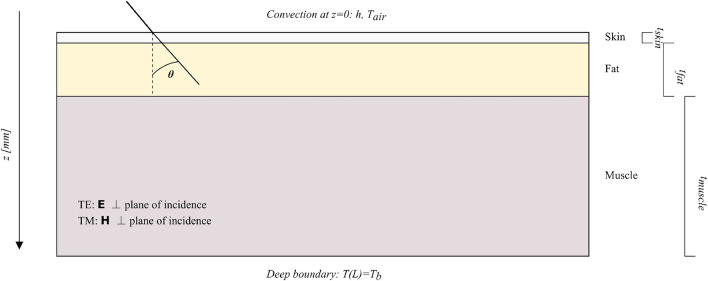 Figure 1
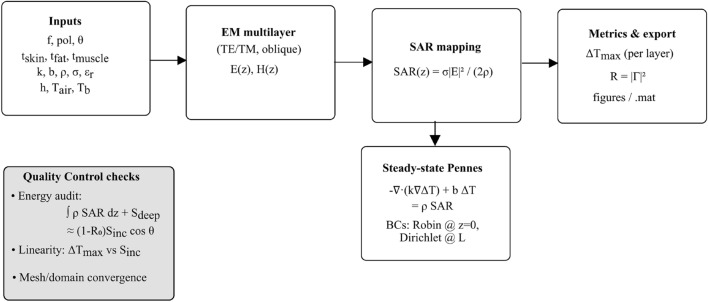 Figure 2
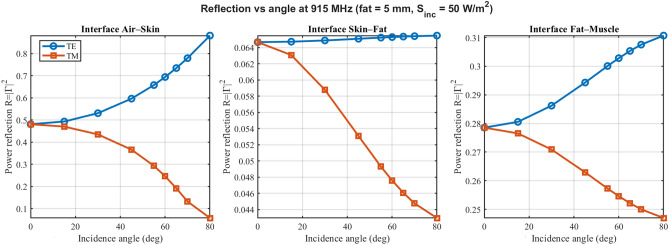 Figure 3
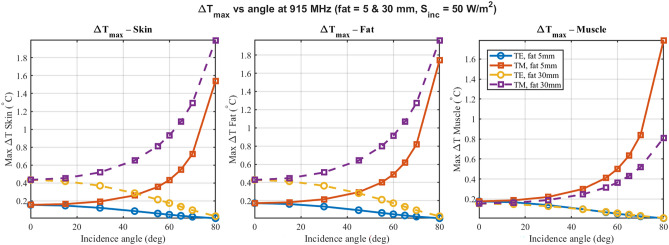 Figure 4
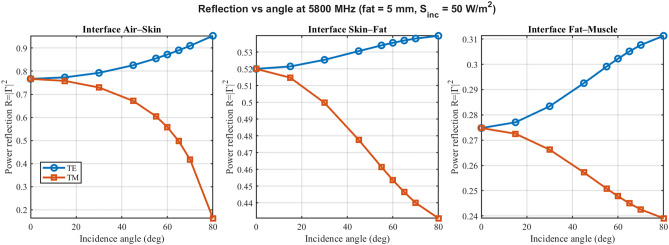 Figure 5
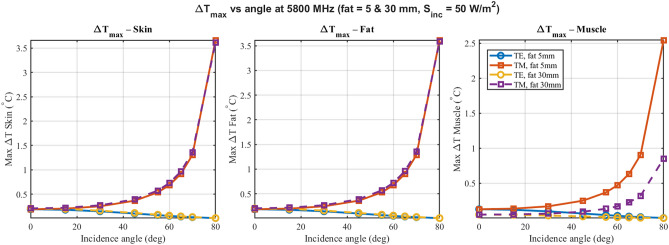 Figure 6
Peer Reviews
No public reviews on file for this paper yet. If you reviewed it on a platform where reviews are public (OpenReview, ICLR, NeurIPS, ICML), you can paste yours below so the community can read it here.
Videos
No videos yet. Explain this paper in a talk, walkthrough, or lecture? Add one.
Taxonomy
TopicsElectromagnetic Fields and Biological Effects · Ultrasound and Hyperthermia Applications · Body Composition Measurement Techniques