Antibody levels to variant and conserved Plasmodium falciparum antigens predict reduction in parasite burden in Malian children
Delesa Damena, Lauren Dang, Amadou Barry, Jonathan P. Renn, Santara Gaoussou, Almahamoudou Mahamar, Oumar Attaher, Djibrilla Issiaka, Robert D. Morrison, Santosh A. Misal, Alassane Dicko, Patrick E. Duffy, Michal Fried

TL;DR
The study found that high antibody levels to specific Plasmodium falciparum proteins reduce parasite burden in children, suggesting a protective immune response.
Contribution
Identified specific Plasmodium proteins whose antibodies predict reduced malaria severity and demonstrated their role in opsonic phagocytosis.
Findings
High antibody levels to DBLγ11 and DBLζ5 reduced odds of high parasite density infection.
Antibodies to PF3D7_0201600 and PF3D7_0532300 also predicted lower parasite burden.
Top tertile antibody levels significantly enhanced opsonic phagocytosis of DBLγ11 and DBLζ5.
Abstract
Proteins expressed on the surface of Plasmodium falciparum-infected erythrocytes (IEs) are targets of immunity. Previous studies described that IEs from young children are more readily recognized than IEs from older children. Here, we aimed to identify targets of naturally acquired antibodies that may play a role in protection from malaria. We applied immunoprecipitation followed by mass spectrometry (IP-MS) using plasma samples from susceptible and semi-immune children. We then investigated whether 1) antibody levels to membrane-associated proteins identified by IP-MS, or 2) PfEMP1s expressed in IEs of young children predict reduction in malaria disease. Significant reduction in risk of high parasite density infection was predicted by high antibody levels to DBLγ11 [OR (95%CI): 0.74 (0.63-0.86)] and DBLζ5 [0.80 (0.69-0.93)], as well as two Plasmodium helical interspersed subtelomeric…
Genes, proteins, chemicals, diseases, species, mutations and cell lines named across the full text — each resolved to its canonical identifier and authoritative record.
Click any figure to enlarge with its caption.
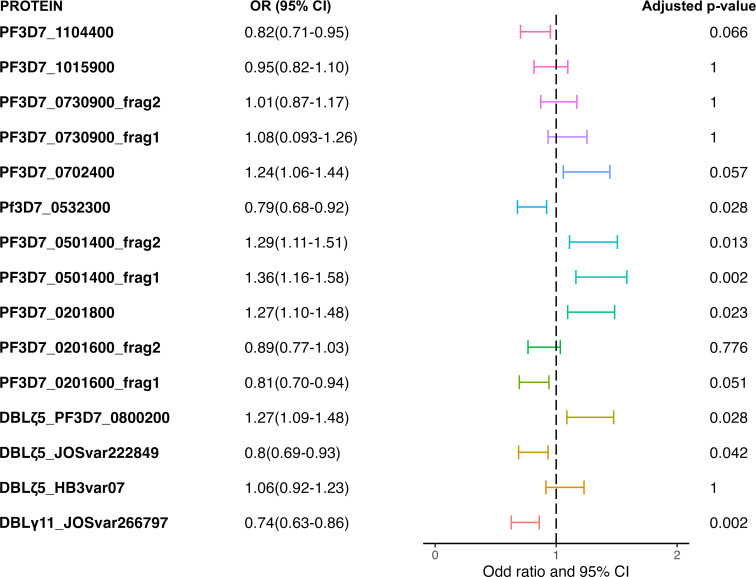 Figure 1
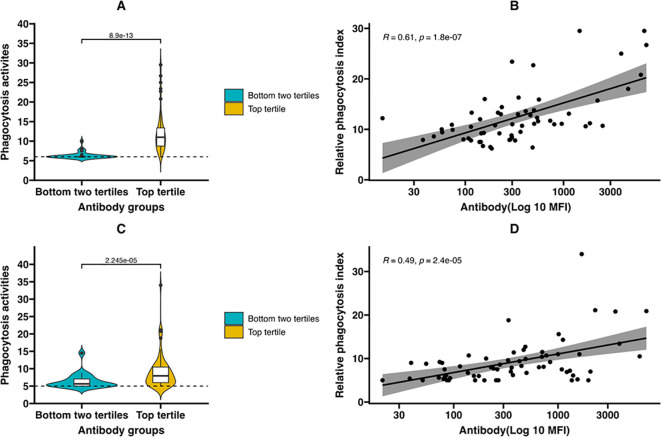 Figure 2
Peer Reviews
No public reviews on file for this paper yet. If you reviewed it on a platform where reviews are public (OpenReview, ICLR, NeurIPS, ICML), you can paste yours below so the community can read it here.
Videos
No videos yet. Explain this paper in a talk, walkthrough, or lecture? Add one.
Taxonomy
TopicsMalaria Research and Control · Parasites and Host Interactions · Parasitic Diseases Research and Treatment