Emotional intelligence and language learning performance of EFL learners in China: chain mediating effects of willingness to communicate and foreign language learning boredom
Ruoting Wang, Qingshu Xu

TL;DR
This study shows how emotional intelligence helps Chinese EFL learners by boosting their willingness to communicate and reducing boredom, which in turn improves language performance.
Contribution
The study introduces a chain mediation model linking emotional intelligence to language performance through willingness to communicate and boredom.
Findings
Emotional intelligence directly predicts better language performance in EFL learners.
Emotional intelligence indirectly improves performance by increasing willingness to communicate and reducing foreign language learning boredom.
The chain mediation model aligns with Control–Value Theory, showing how affective factors influence learning outcomes.
Abstract
Emotional intelligence (EI) has been widely recognized as a key affective factor in second language (L2) learning, yet its underlying mechanisms remain insufficiently explained. Drawing on Control–Value Theory (CVT), this study conceptualizes EI as a distal resource that enhances control–value appraisals, thereby fostering communicative engagement and mitigating negative achievement emotions, which jointly influence performance. A total of 1,158 Chinese undergraduates from seven universities completed validated measures of EI, willingness to communicate (WTC), foreign language learning boredom (FLLB), and submitted EFL test results. Structural equation modeling (SEM) was conducted using parcel-level indicators, and indirect effects were examined via bootstrap estimation (B = 5,000, BCa). The hypothesized model demonstrated excellent fit and revealed that EI directly predicted language…
Click any figure to enlarge with its caption.
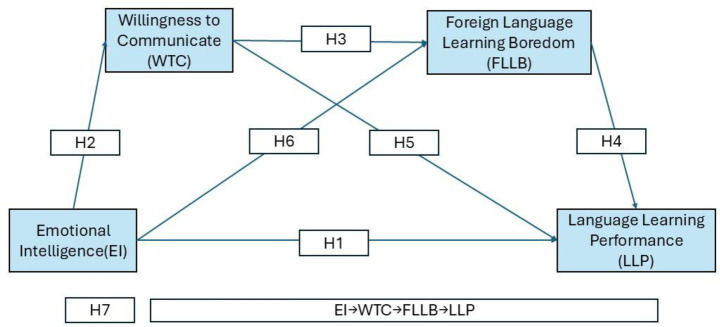 Figure 1
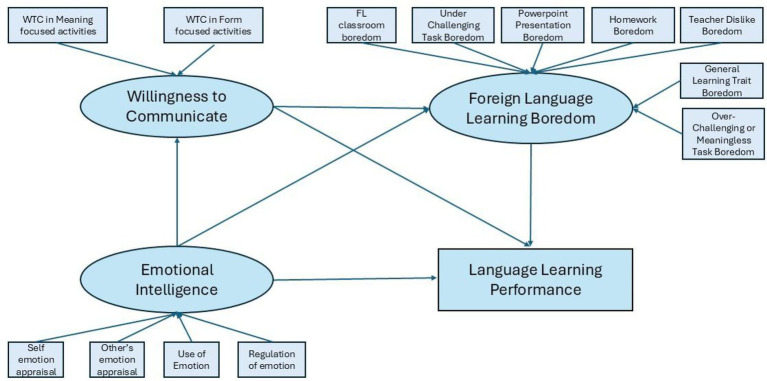 Figure 2
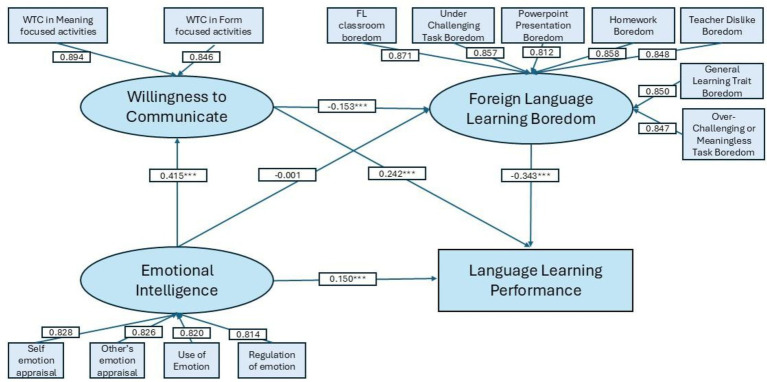 Figure 3
Peer Reviews
No public reviews on file for this paper yet. If you reviewed it on a platform where reviews are public (OpenReview, ICLR, NeurIPS, ICML), you can paste yours below so the community can read it here.
Videos
No videos yet. Explain this paper in a talk, walkthrough, or lecture? Add one.
Taxonomy
TopicsMind wandering and attention · Flow Experience in Various Fields · Humor Studies and Applications