Management and outcomes of craniectomy and cranioplasty in pediatric intracranial infections: a multicenter cohort study
Artem Rafaelian, Sae-Yeon Won, Ulrich Sure, Phillipp Dammann, Laurèl Rauschenbach, Christian Senft, Nazife Dinc, Nazeer Aboud, Florian Ringel, Malte Ottenhausen, Daniel Scurtu, Wolfgang Deinsberger, Stefanie Kästner, Joe Jun Qiao Chen, Hartmut Vatter, Sevgi Sarikaya-Seiwert

TL;DR
This study examines the use of craniectomy and delayed cranioplasty in children with severe brain infections, finding low complication rates and improved outcomes.
Contribution
The study provides insights into the management and outcomes of craniectomy and cranioplasty in pediatric intracranial infections.
Findings
Craniectomy was significantly associated with sinusitis and paresis in pediatric patients.
Streptococcus intermedius was the most common pathogen in the craniectomy group.
Cranioplasty improved functional outcomes with low complication rates in children.
Abstract
In recent years, there has been a noticeable increase in severe intracranial infections among pediatric patients, often requiring craniotomy or decompressive craniectomy. However, determining the optimal timing and material for cranioplasty in pediatric patients presents an ongoing challenge. We conducted a multicenter retrospective cohort study of pediatric patients treated between 2013 and 2024. A total of 76 children with intracranial infections were included; 37% of those underwent decompressive craniectomy. Of these, 21% subsequently received cranioplasty using various graft materials. Clinical, microbiological, radiological, and neurosurgical data were analyzed to assess risk factors, outcomes, and complications. Craniectomy was significantly associated with the presence of sinusitis (p = 0.025) and paresis (p = 0.006). Streptococcus intermedius was the predominant pathogen…
Genes, proteins, chemicals, diseases, species, mutations and cell lines named across the full text — each resolved to its canonical identifier and authoritative record.
Click any figure to enlarge with its caption.
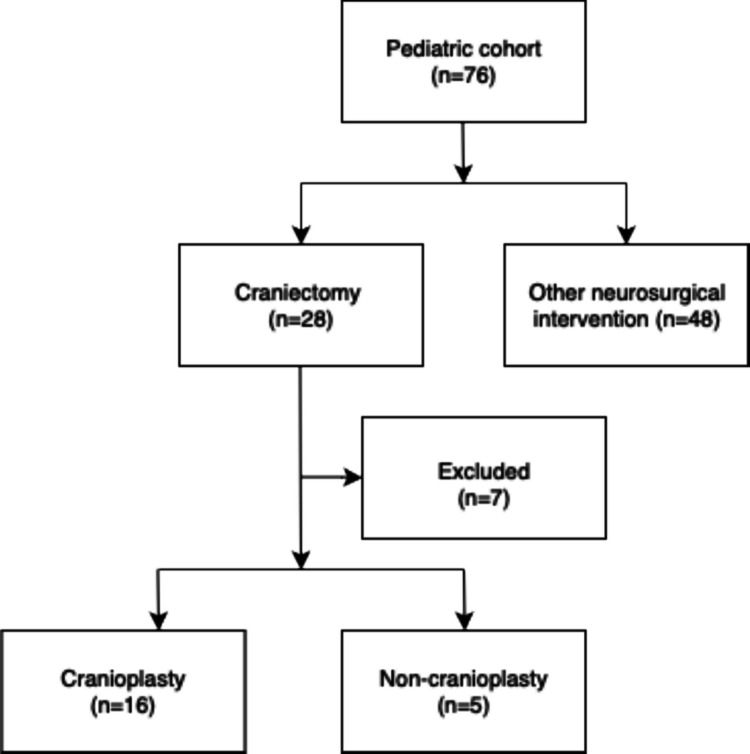 Figure 1
Peer Reviews
No public reviews on file for this paper yet. If you reviewed it on a platform where reviews are public (OpenReview, ICLR, NeurIPS, ICML), you can paste yours below so the community can read it here.
Videos
No videos yet. Explain this paper in a talk, walkthrough, or lecture? Add one.
Taxonomy
TopicsTraumatic Brain Injury and Neurovascular Disturbances · Cerebrospinal fluid and hydrocephalus · Craniofacial Disorders and Treatments