Machine learning-based models for preoperative prediction of pituitary adenoma consistency: a systematic review and meta-analysis
Bardia Hajikarimloo, Ibrahim Mohammadzadeh, Salem M. Tos, Ali Mortezaei, Mohammad Amin Habibi

TL;DR
This paper reviews machine learning models for predicting pituitary adenoma consistency before surgery, showing high accuracy and potential for improving surgical planning.
Contribution
A meta-analysis of ML models for predicting pituitary adenoma consistency, providing pooled diagnostic performance metrics.
Findings
Pooled AUC of 0.92 indicates excellent predictive accuracy of ML models for PA consistency.
Algorithms like Random Forest and SVM showed strong performance with high sensitivity and specificity.
Leave-one-out analyses confirmed model robustness and low publication bias.
Abstract
The consistency of pituitary adenoma (PA) significantly impacts surgical difficulty and the extent of resection. Machine learning (ML) and radiomics have emerged as quantitative tools to predict tumor firmness from MRI-derived features. This systematic review and meta-analysis aimed to synthesize the diagnostic performance of ML-based models for preoperative prediction of PA consistency. PubMed, Embase, Scopus, and Web of Science were searched through September 2025. Studies developing or validating ML or deep learning (DL) models for predicting PA consistency were included. Pooled estimates of area under the curve (AUC), accuracy (ACC), sensitivity (SEN), specificity (SPE), and diagnostic odds ratio (DOR) were calculated with 95% confidence intervals (CIs). Nine studies with 1,621 patients were analyzed. Algorithms included Extra Trees (ET), Random Forest (RF), Support Vector Machine…
Genes, proteins, chemicals, diseases, species, mutations and cell lines named across the full text — each resolved to its canonical identifier and authoritative record.
Click any figure to enlarge with its caption.
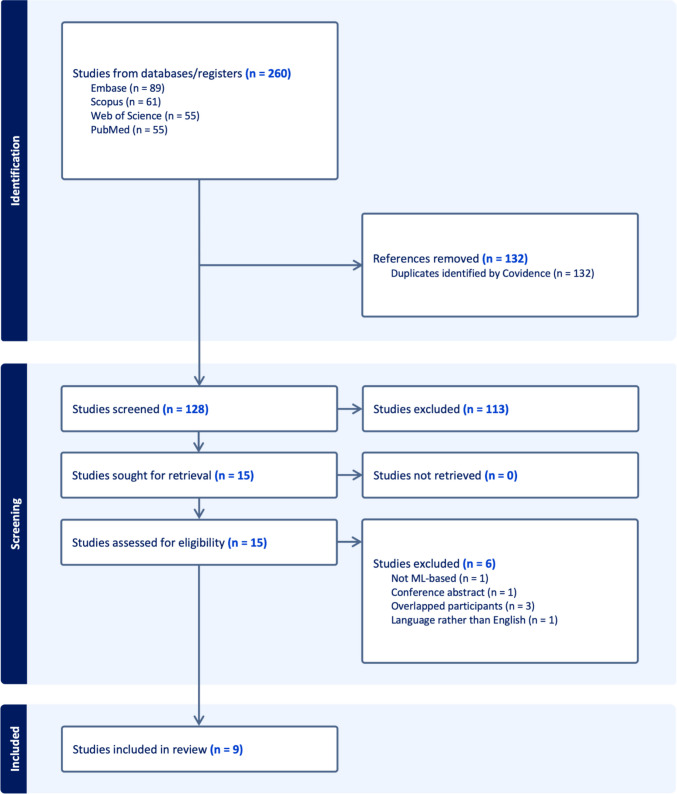 Figure 1
 Figure 2
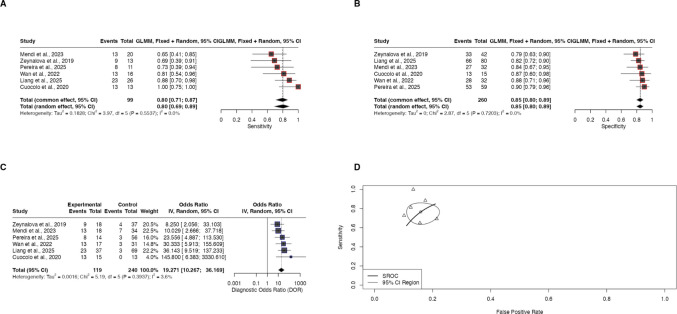 Figure 3
Peer Reviews
No public reviews on file for this paper yet. If you reviewed it on a platform where reviews are public (OpenReview, ICLR, NeurIPS, ICML), you can paste yours below so the community can read it here.
Videos
No videos yet. Explain this paper in a talk, walkthrough, or lecture? Add one.
Taxonomy
TopicsPituitary Gland Disorders and Treatments · Radiomics and Machine Learning in Medical Imaging · Meningioma and schwannoma management