Ser500 phosphorylation acts as a conformational switch to prime eEF-2K for activation
Amanda L. Bohanon, Luke S. Browning, Andrea Piserchio, Kimberly J. Long, Sharon Jacob, Rae M. Sammons, Clint D.J. Tavares, Eun Jeong Cho, Ranajeet Ghose, Kevin N. Dalby

TL;DR
Phosphorylation at Ser500 in eEF-2K lowers the calcium requirement for activation and helps integrate multiple cellular signals.
Contribution
The study reveals that Ser500 phosphorylation acts as a conformational switch to prime eEF-2K for activation.
Findings
Phosphomimetic S500D enhances CaM binding and intrinsic activity of eEF-2K.
Deletion near S500 increases eEF-2 phosphorylation in cells, supporting an inhibitory role for this segment.
Phosphorylation at T348 and S500 synergize to stabilize an active conformation and increase CaM responsiveness.
Abstract
Eukaryotic elongation factor-2 kinase (eEF-2K), a member of the α-kinase family of atypical serine/threonine kinases, phosphorylates eEF-2 to slow ribosomal translocation and modulate translational elongation. eEF-2K activation requires Ca2+/calmodulin (CaM) and integrates upstream signals through specific sites within an intrinsically disordered regulatory loop (R-loop; ∼321–520) that links the α-kinase core to a C-terminal domain. Unlike canonical CaM-dependent kinases that are activated by displacement of an autoinhibitory segment that occludes the active site, eEF-2K is activated by CaM-driven stabilization of an active state; Ca2+/CaM engagement triggers rapid autophosphorylation at T348, which is essential for full activity. Phosphorylation on S500, by eEF-2K or PKA, lowers the CaM requirement (∼20-fold) without increasing maximal catalytic turnover. Here we show that the…
Genes, proteins, chemicals, diseases, species, mutations and cell lines named across the full text — each resolved to its canonical identifier and authoritative record.
Click any figure to enlarge with its caption.
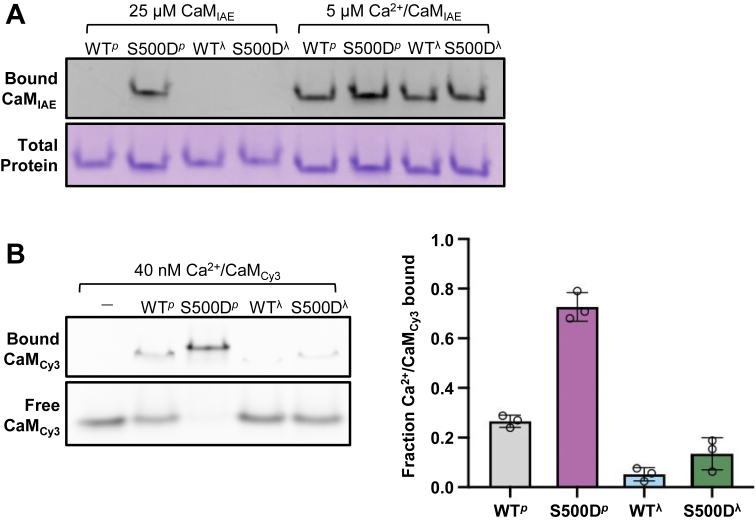 Figure 1
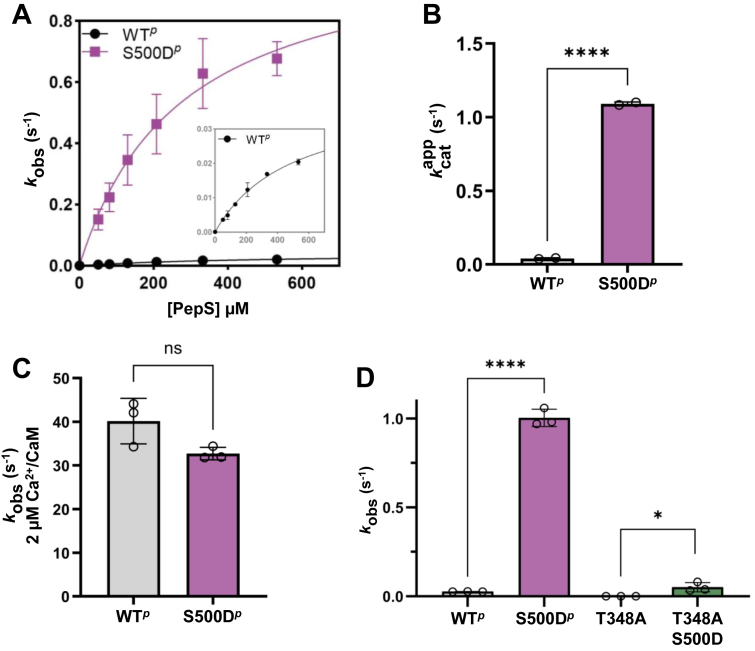 Figure 2
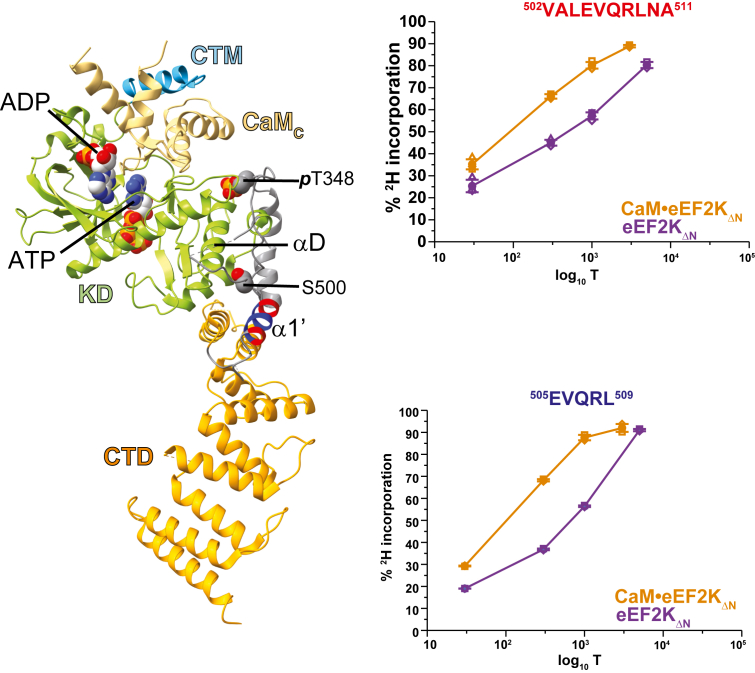 Figure 3
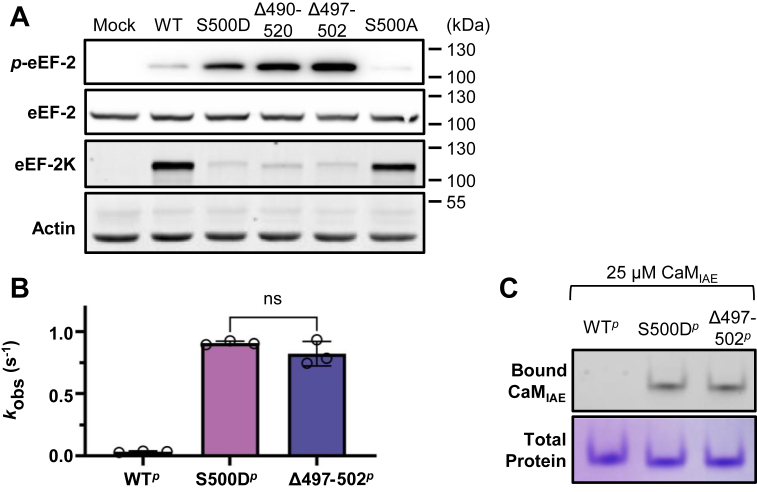 Figure 4
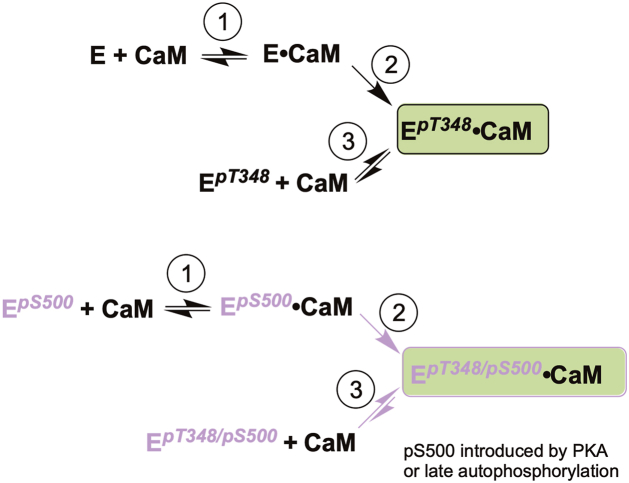 Figure 5
Peer Reviews
No public reviews on file for this paper yet. If you reviewed it on a platform where reviews are public (OpenReview, ICLR, NeurIPS, ICML), you can paste yours below so the community can read it here.
Videos
No videos yet. Explain this paper in a talk, walkthrough, or lecture? Add one.
Taxonomy
TopicsRNA and protein synthesis mechanisms · RNA modifications and cancer · PI3K/AKT/mTOR signaling in cancer