Multisite, External Validation of an AI-Enabled ECG Algorithm for Detection of Low Ejection Fraction
Rickey E. Carter, Patrick W. Johnson, Jordan B. Strom, Jonathan W. Waks, Andrew Krumerman, Kevin J. Ferrick, Roger DeRaad, Benjamin A. Steinberg, Mikolaj A. Wieczorek, Jessica Cruz, Zachi I. Attia, Francisco Lopez-Jimenez, Paul A. Friedman, Samir Awasthi

TL;DR
This study validates an AI-based ECG algorithm for detecting low ejection fraction across multiple U.S. sites, showing strong accuracy and potential for clinical use.
Contribution
The study provides a large-scale, multisite external validation of an AI-enabled ECG algorithm for low ejection fraction detection.
Findings
The AI algorithm demonstrated an AUROC of 0.92 for detecting low ejection fraction.
The algorithm had 84.5% sensitivity and 83.6% specificity for LEF detection.
The algorithm produced a negative result in 78% of cases, suggesting potential as a rule-out strategy.
Abstract
Low left ventricular ejection fraction (LEF) can progress undiagnosed. Artificial intelligence–based electrocardiogram (ECG-AI) screening may provide a scalable means to detect LEF. The purpose of this study was to validate a complete ECG-AI software as a medical device for LEF detection. Four geographically diverse sites in the United States identified patients with both ECGs and transthoracic echocardiograms performed within 30 days of each other in clinical practice. Data were electronically extracted to specific guidelines and transmitted to the coordinating center for analysis. Records of 16,000 subjects were extracted, resulting in an evaluable set of 13,960 subjects (mean age 66 years; 52% male). The device demonstrated excellent discrimination (AUROC: 0.92 [95% CI: 0.91-0.93]) and was 84.5% (95% CI: 82.2%-86.6%) sensitive and 83.6% (95% CI: 82.9%-84.2%) specific for LEF. The…
Genes, proteins, chemicals, diseases, species, mutations and cell lines named across the full text — each resolved to its canonical identifier and authoritative record.
Click any figure to enlarge with its caption.
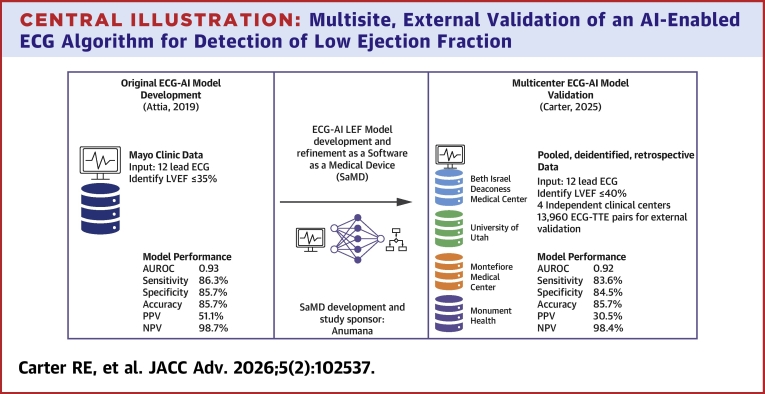 Figure 1
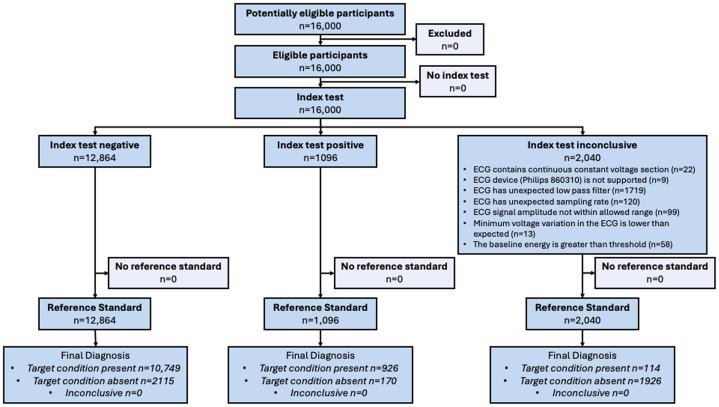 Figure 2
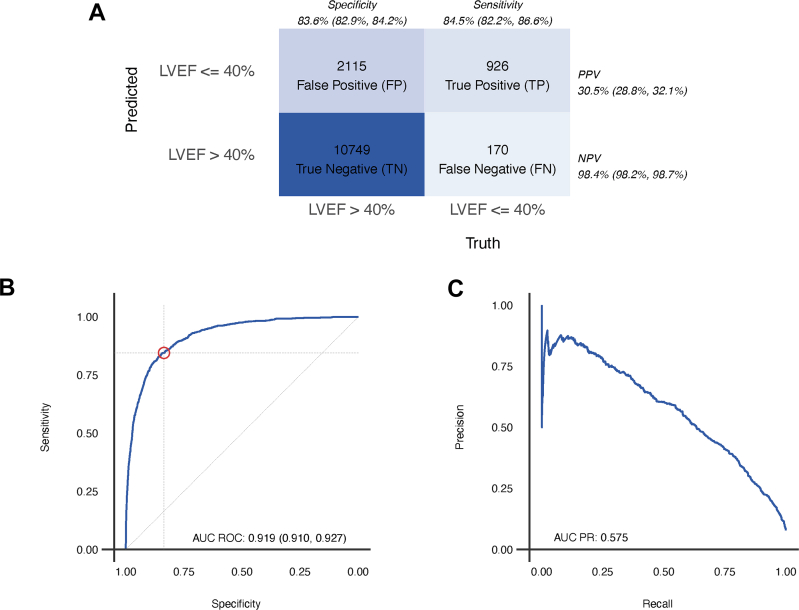 Figure 3
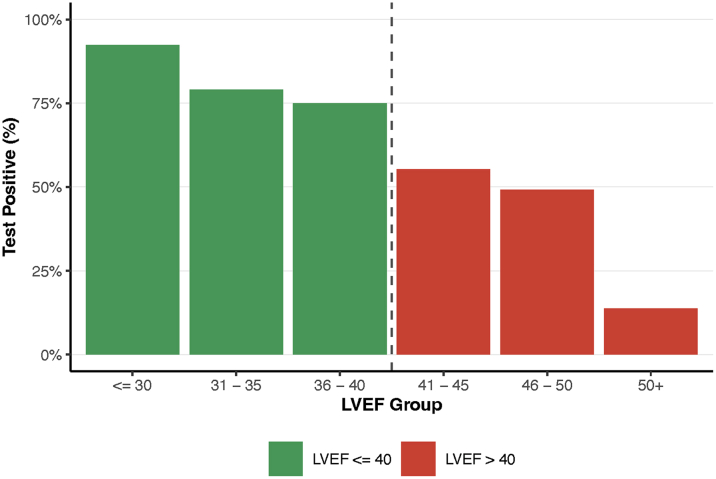 Figure 4
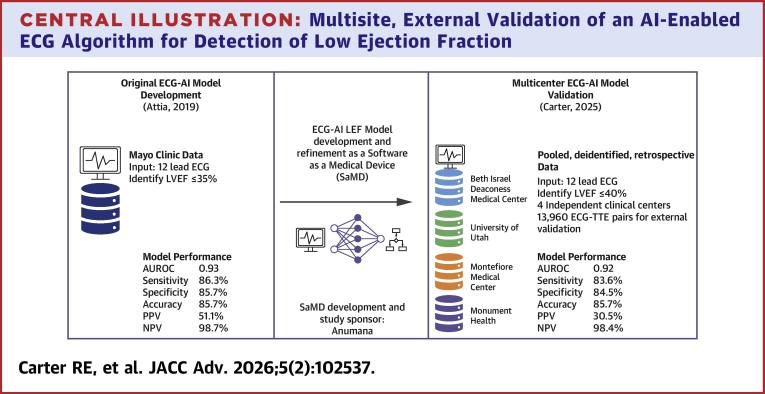 Figure 5
Peer Reviews
No public reviews on file for this paper yet. If you reviewed it on a platform where reviews are public (OpenReview, ICLR, NeurIPS, ICML), you can paste yours below so the community can read it here.
Videos
No videos yet. Explain this paper in a talk, walkthrough, or lecture? Add one.
Taxonomy
TopicsECG Monitoring and Analysis · Atrial Fibrillation Management and Outcomes · Cardiovascular Function and Risk Factors