Phantom-based performance comparison of two commercial deep learning CT reconstruction algorithms with super- and normal-resolution settings
Joël Greffier, Catherine Roy, Djamel Dabli, Jean-Paul Beregi, Maxime Pastor

TL;DR
This study compares two deep learning CT reconstruction methods, showing that the super-resolution version improves image quality and lesion detection in abdominal scans.
Contribution
The study introduces a novel comparison of super-resolution and normal-resolution deep learning CT reconstruction algorithms using a phantom-based approach.
Findings
SR-DLR improved spatial resolution and detectability of simulated abdominal lesions compared to NR-DLR.
Image noise was reduced with SR-DLR for level-2 and level-3, but image texture was better for level-1 and level-2.
SR-DLR shows potential for reducing radiation doses in abdominal CT imaging.
Abstract
We compared a super-resolution deep learning image reconstruction (SR-DLR) algorithm with a normal-resolution (NR)-DLR algorithm according to radiation dose for abdominal computed tomography (CT). An image-quality phantom was scanned with an energy-integrating detectors CT unit at three volume CT dose index radiation dose levels (12.7, 5.9, and 3 mGy). Images were reconstructed using a 1,0242 matrix for SR-DLR and a 5122 matrix for NR-DLR, for three DLR levels (level-1, level-2, and level-3). Noise power spectrum (NPS) and task-based transfer function (TTF) for iodine and Solid Water® inserts were computed; TTF values at 50% (f50, mm-1) were used to quantify spatial resolution. The detectability index (d’) was computed for two simulated lesions. Noise magnitude values were lower with SR-DLR than with NR-DLR for level-2 (-27.6 ± 3.8%) and level-3 (-43.5 ± 1.4%), the opposite for…
Genes, proteins, chemicals, diseases, species, mutations and cell lines named across the full text — each resolved to its canonical identifier and authoritative record.
Click any figure to enlarge with its caption.
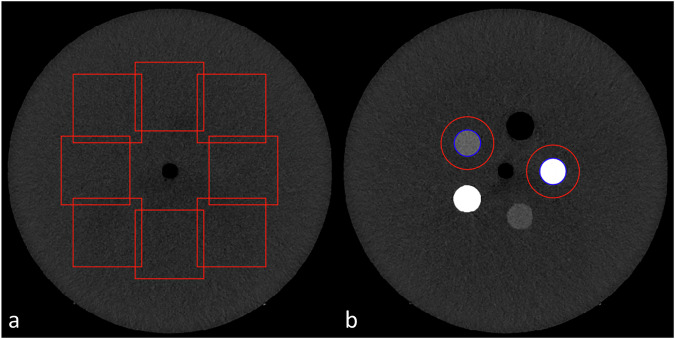 Figure 1
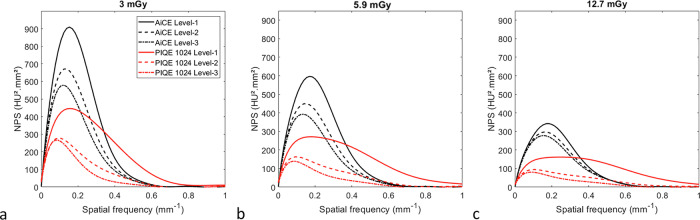 Figure 2
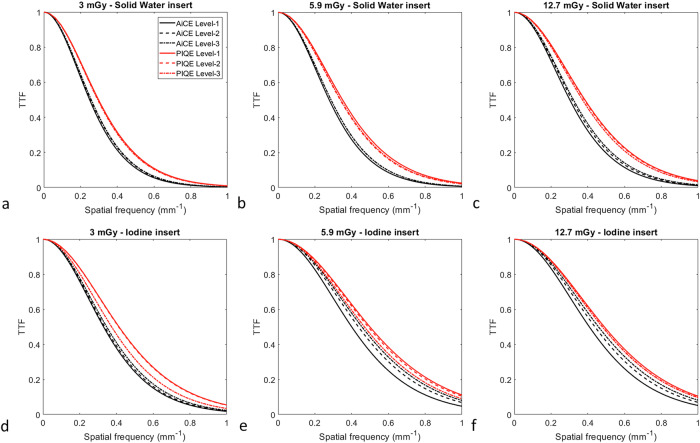 Figure 3
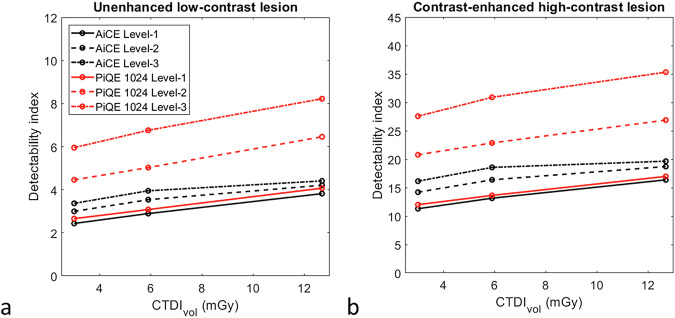 Figure 4
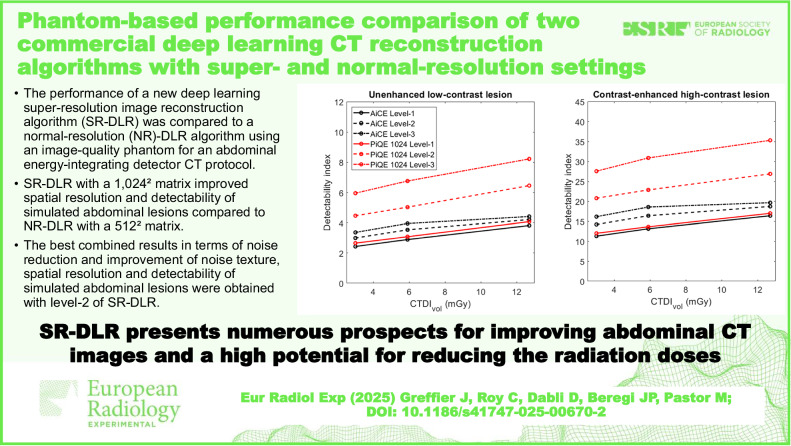 Figure 5
Peer Reviews
No public reviews on file for this paper yet. If you reviewed it on a platform where reviews are public (OpenReview, ICLR, NeurIPS, ICML), you can paste yours below so the community can read it here.
Videos
No videos yet. Explain this paper in a talk, walkthrough, or lecture? Add one.
Taxonomy
TopicsRadiation Dose and Imaging · Advanced X-ray and CT Imaging · Medical Imaging Techniques and Applications