Prospective validation of an AI software for detecting clinically significant prostate cancer on biparametric MRI
Mohammed R. S. Sunoqrot, Rebecca Segre, Gabriel A. Nketiah, Petter Davik, Torill A. E. Sjøbakk, Sverre Langørgen, Mattijs Elschot, Tone F. Bathen

TL;DR
A new AI software was tested for detecting significant prostate cancer on MRI scans and showed potential to reduce unnecessary biopsies.
Contribution
A fully automated radiomics software was prospectively validated for detecting clinically significant prostate cancer on biparametric MRI.
Findings
The AI software demonstrated feasibility with a 7% failure rate and no serious adverse effects.
The software achieved high diagnostic performance, with potential to reduce unnecessary biopsies.
At an optimized threshold, the software showed higher average precision and fewer false positives per patient compared to the radiologist.
Abstract
To evaluate the feasibility and safety (primary endpoints), and performance (secondary endpoint) of a new artificial intelligence (AI) software for detecting clinically significant prostate cancer (csPCa) on biparametric MRI (bpMRI) compared to an expert radiologist. In this prospective study at St. Olavs Hospital, Norway (December 2023–October 2024), 89 consecutive biopsy-naïve men underwent bpMRI for suspected PCa. Scans were interpreted by a radiologist using PI-RADS v2.1 and a radiomics-based AI software. Biopsies were obtained from all radiologist- and/or AI-identified lesions. csPCa was defined as ISUP ≥ 2. Feasibility was defined by a < 10% software-failure rate, and safety by the absence of serious adverse device effects (SADEs). Performance was evaluated with ROC, free-response ROC, and precision-recall curves. Among 89 patients eligible for primary endpoints evaluation, the…
Genes, proteins, chemicals, diseases, species, mutations and cell lines named across the full text — each resolved to its canonical identifier and authoritative record.
Click any figure to enlarge with its caption.
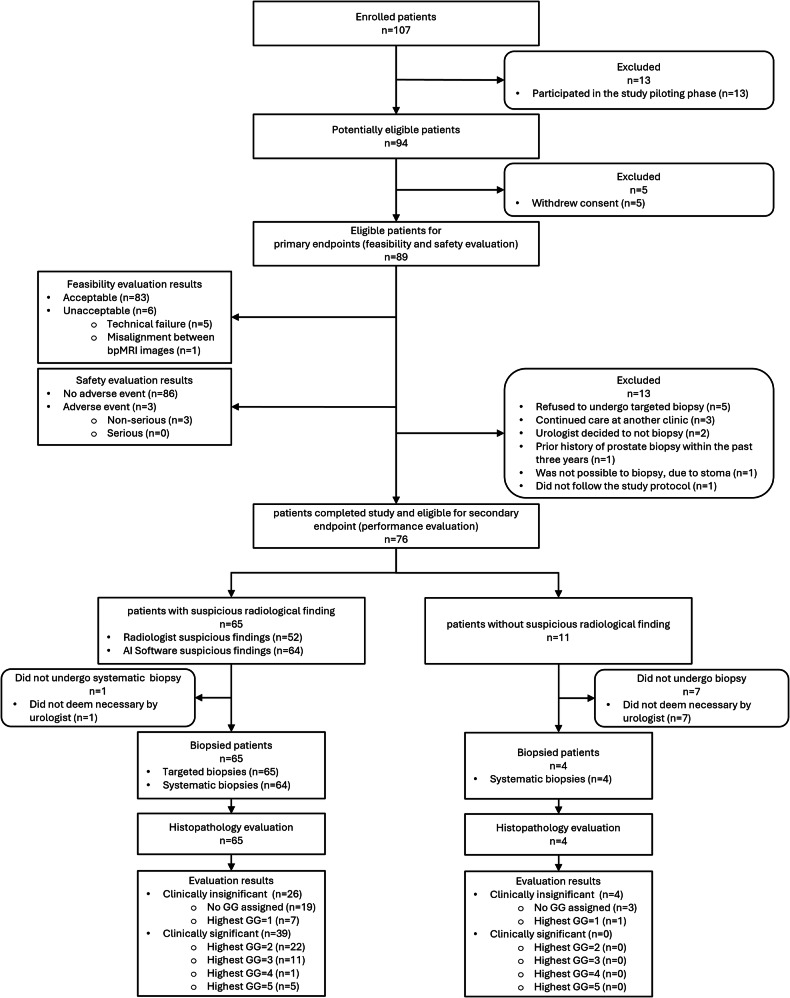 Figure 1
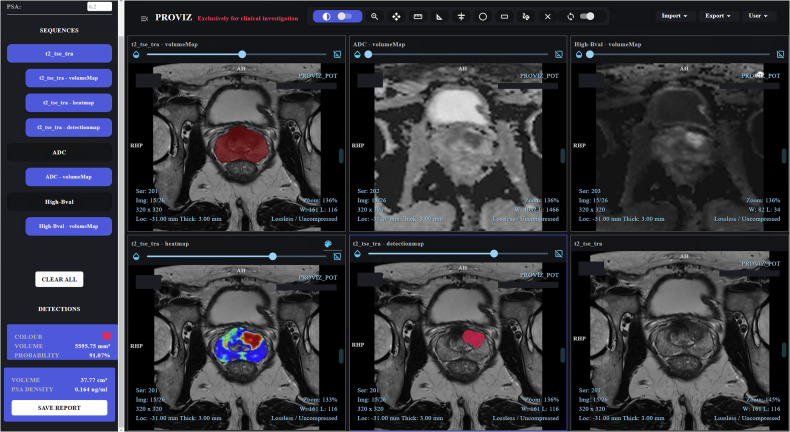 Figure 2
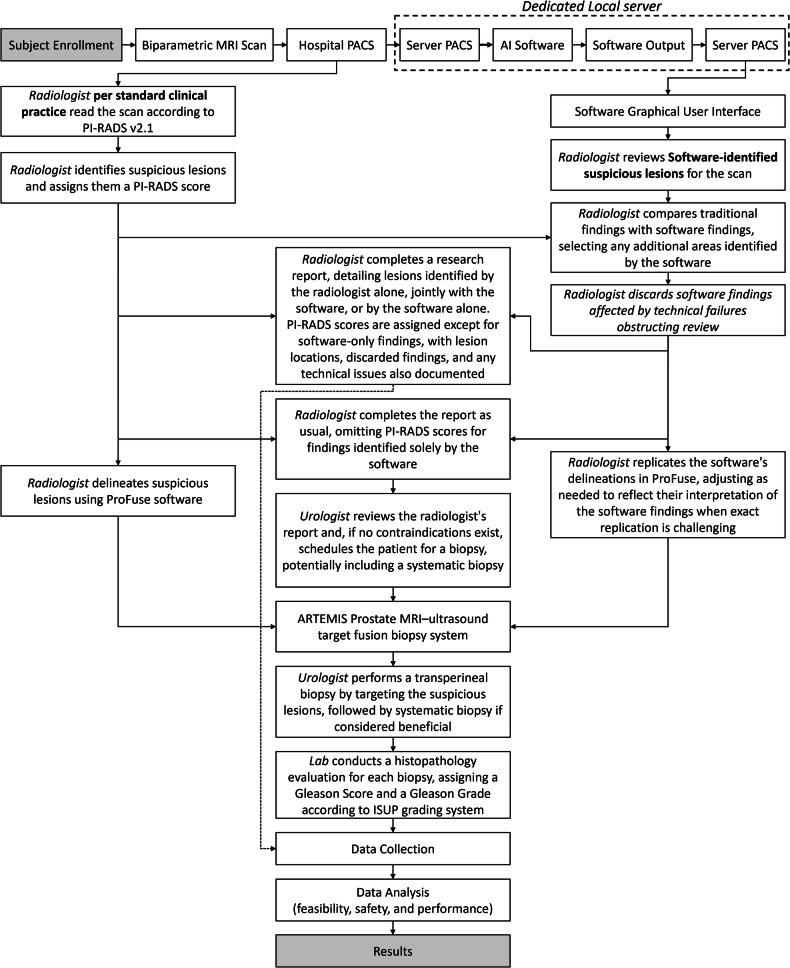 Figure 3
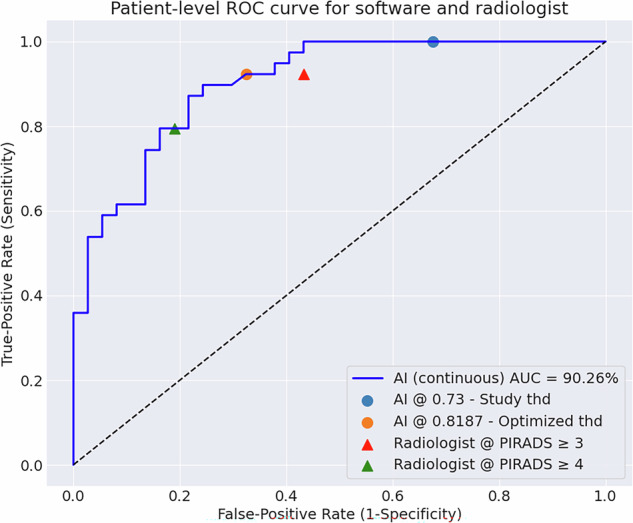 Figure 4
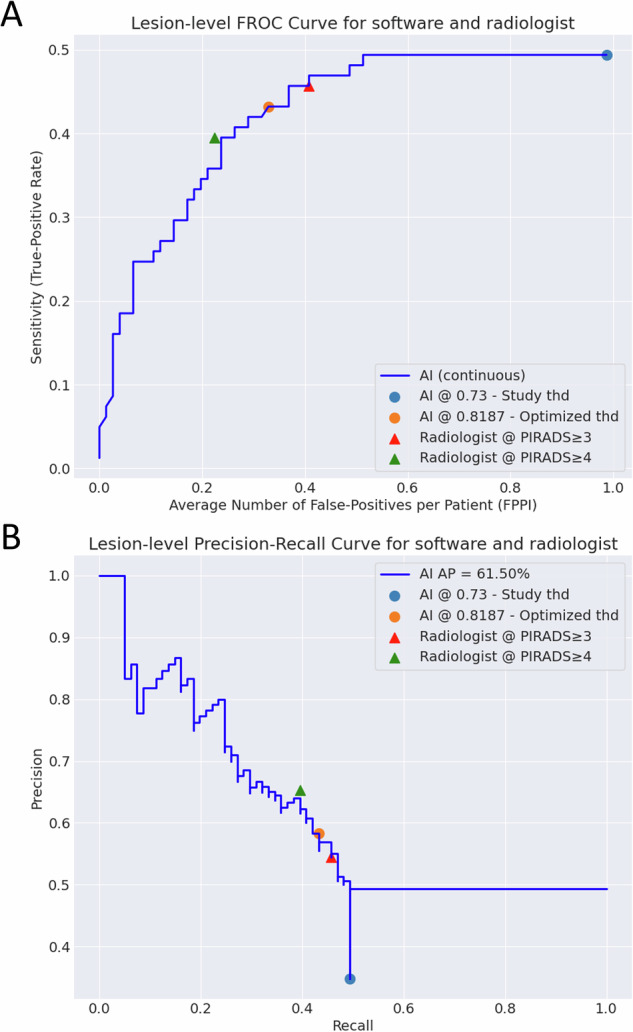 Figure 5
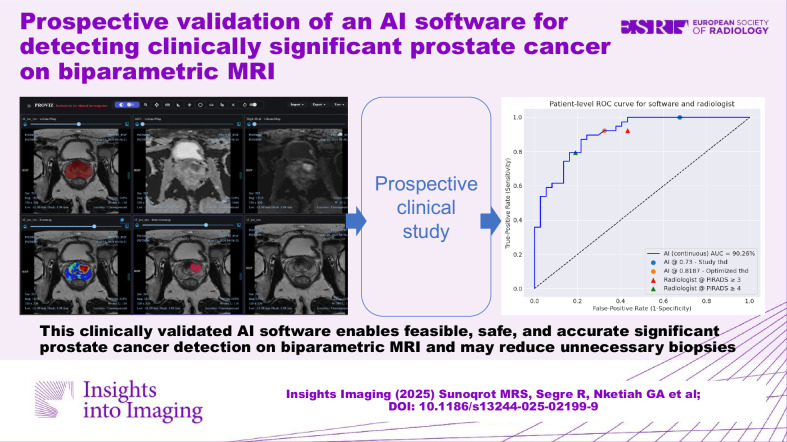 Figure 6
Peer Reviews
No public reviews on file for this paper yet. If you reviewed it on a platform where reviews are public (OpenReview, ICLR, NeurIPS, ICML), you can paste yours below so the community can read it here.
Videos
No videos yet. Explain this paper in a talk, walkthrough, or lecture? Add one.
Taxonomy
TopicsProstate Cancer Diagnosis and Treatment · Radiomics and Machine Learning in Medical Imaging · Prostate Cancer Treatment and Research