From resources to efficacy over time: a longitudinal study of psychological capital, emotion regulation, and teacher self-efficacy
Pu Zhang, Hong Zhang

TL;DR
This study finds that teachers' psychological resources improve their self-efficacy by helping them regulate emotions over time.
Contribution
The study provides longitudinal evidence of how psychological capital enhances teacher self-efficacy through emotion regulation.
Findings
Psychological capital positively predicts emotion regulation and teacher self-efficacy.
Emotion regulation partially mediates the relationship between psychological capital and teacher self-efficacy.
Longitudinal data confirm that psychological capital at one time point predicts later emotion regulation and self-efficacy.
Abstract
The underlying mechanism through which teachers’ psychological capital (PsyCap) influences teacher self-efficacy (TSE) remains insufficiently understood. This study aims to examine the mediating role of emotion regulation (ER) in the association between PsyCap and TSE among Chinese primary school teachers using both cross-sectional and longitudinal data. A total of 606 Chinese primary school teachers were included at baseline. Data on PsyCap, ER, and TSE were collected. Structural equation modeling (SEM) was used to examine the cross-sectional mediation effect. In addition, a three-wave longitudinal subsample (N = 412) was analyzed using a time-lagged mediation model to test whether psychological capital predicts subsequent emotion regulation and, in turn, later teacher self-efficacy. PsyCap, ER, and TSE were significantly correlated (p < 0.01). Cross-sectional SEM showed that PsyCap…
Click any figure to enlarge with its caption.
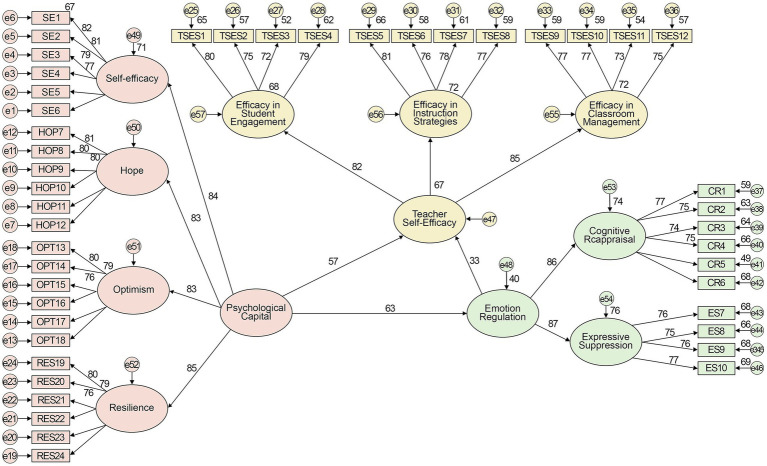 Figure 1
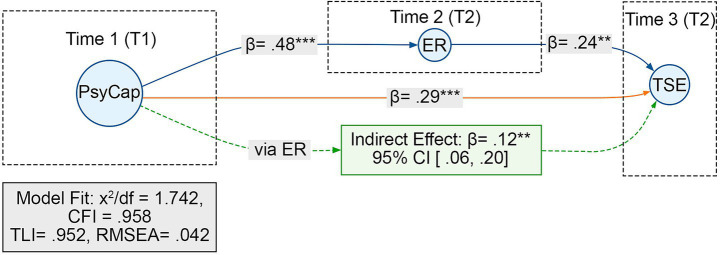 Figure 2
Peer Reviews
No public reviews on file for this paper yet. If you reviewed it on a platform where reviews are public (OpenReview, ICLR, NeurIPS, ICML), you can paste yours below so the community can read it here.
Videos
No videos yet. Explain this paper in a talk, walkthrough, or lecture? Add one.
Taxonomy
TopicsEmotional Intelligence and Performance · Emotional Labor in Professions · Early Childhood Education and Development