Immune checkpoint inhibitor-associated diabetes mellitus: mechanisms, clinical manifestations, and management strategies
Yu Chen, Xiaolu Wang, Shuyun Duan

TL;DR
Immune checkpoint inhibitors can cause a rare but severe form of diabetes that requires lifelong insulin therapy and has unique features compared to type 1 diabetes.
Contribution
This review provides insights into the mechanisms, clinical features, and emerging treatment strategies for ICI-DM.
Findings
ICI-DM often presents with rapid-onset diabetes and diabetic ketoacidosis, differing from classical type 1 diabetes.
PD-1/PD-L1 blockade contributes to β-cell destruction through immune activation and genetic susceptibility.
Early detection and monitoring are critical for managing ICI-DM due to its rapid progression and treatment resistance.
Abstract
Immune checkpoint inhibitor–associated diabetes mellitus (ICI-DM) is a rare but life-threatening endocrine immune-related adverse event characterized by abrupt insulin deficiency and a high incidence of diabetic ketoacidosis (DKA). Unlike classical type 1 diabetes, ICI-DM often develops after only a few treatment cycles, shows a fulminant phenotype with disproportionally modest HbA1c elevation, and is typically irreversible and glucocorticoid-refractory, necessitating permanent insulin therapy. Mechanistically, PD-1/PD-L1 blockade disrupts pancreatic immune tolerance and permits autoreactive CD8+ T-cell–mediated β-cell destruction, with risk amplified by susceptible HLA haplotypes and pre-existing islet autoantibodies (most commonly GAD antibodies). Additional contributors include pancreatic inflammation, cytokine-driven immune activation, incretin axis perturbations (GLP-1/GIP), and…
Genes, proteins, chemicals, diseases, species, mutations and cell lines named across the full text — each resolved to its canonical identifier and authoritative record.
Click any figure to enlarge with its caption.
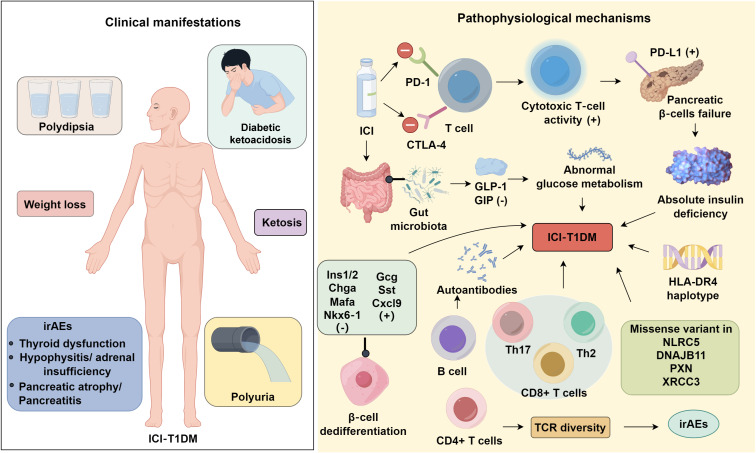 Figure 1
Peer Reviews
No public reviews on file for this paper yet. If you reviewed it on a platform where reviews are public (OpenReview, ICLR, NeurIPS, ICML), you can paste yours below so the community can read it here.
Videos
No videos yet. Explain this paper in a talk, walkthrough, or lecture? Add one.
Taxonomy
TopicsDiabetes and associated disorders · Cancer Immunotherapy and Biomarkers · Diabetes Management and Research