Selective impairment and a positive recognition bias of the facial emotion recognition after propofol anesthesia during gastrointestinal endoscopy
Zhuonan Sun, Qiong Lan, Hua Zhang, Lijing Zheng, Qingao Liu, Haoyu Zuo, Yu Feng, Yusen Xiao, Ning Yang, Xixi Jia, Yanan Song, Yajie Liu, Dengyang Han, Yinyin Qu, Jing Zhang, Ye Wang, Zhengqian Li, Xiangyang Guo, Taotao Liu

TL;DR
This study finds that propofol anesthesia during endoscopy impairs the ability to recognize anger in facial expressions, while leaving other emotions and decision-making abilities largely unaffected.
Contribution
The study reveals a selective impairment in anger facial emotion recognition after propofol anesthesia, along with a positive recognition bias for anger and neutral expressions.
Findings
Propofol anesthesia selectively impairs anger facial emotion recognition post-procedure.
Patients showed a positive bias, mistaking anger and neutral expressions for happiness.
Morning procedures and absence of insomnia were linked to decreased anger recognition scores.
Abstract
Propofol may induce emotional impairment like euphoria and elation. Previous studies have demonstrated that emotional impairment can injure social cognition like emotion recognition and decision-making abilities. Therefore, this study is designed to investigate the effects of propofol anesthesia on facial emotion recognition (FER) and delay discounting behavior. Patients underwent diagnostic gastrointestinal endoscopy (GI) with propofol anesthesia in this prospective cohort observational study. Prior to and following the procedure (approximately 30 min afterwards), patients were asked to select the word that best describes the presented facial photographs displaying happiness, anger, and neutral expressions. Additionally, Monetary Choice Questionnaire-9 was used to assess delay discounting. Within a cohort of 87 patients, 11 patients (12.6%) met the criterion of FER deficit post-GI.…
Genes, proteins, chemicals, diseases, species, mutations and cell lines named across the full text — each resolved to its canonical identifier and authoritative record.
Click any figure to enlarge with its caption.
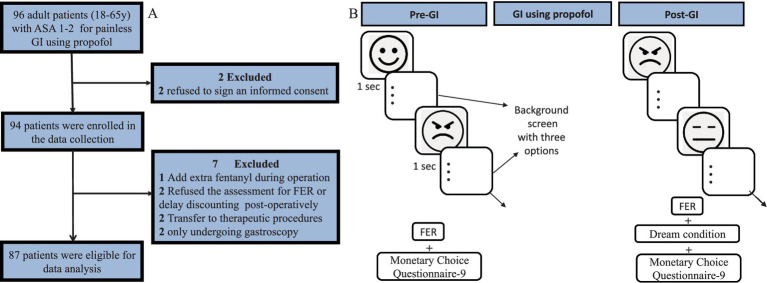 Figure 1
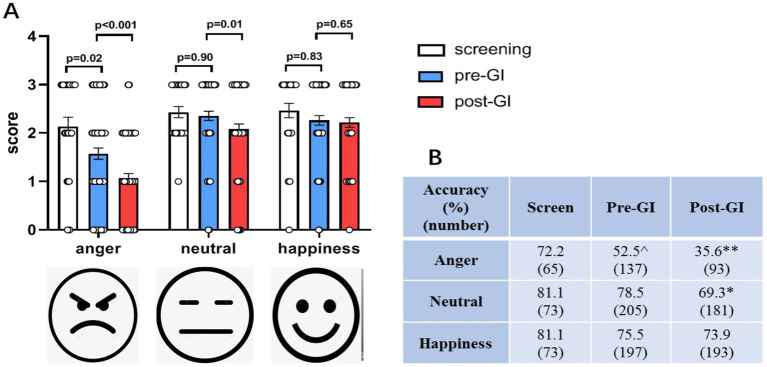 Figure 2
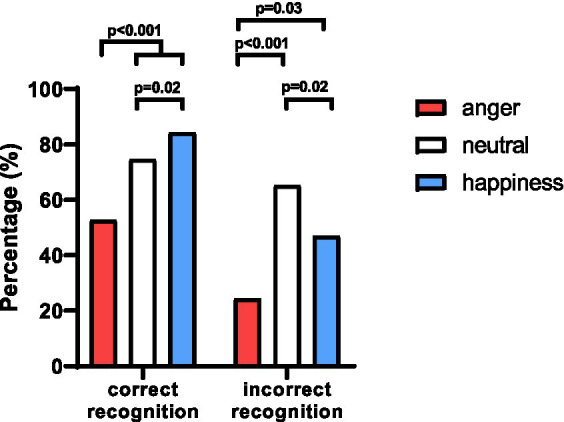 Figure 3
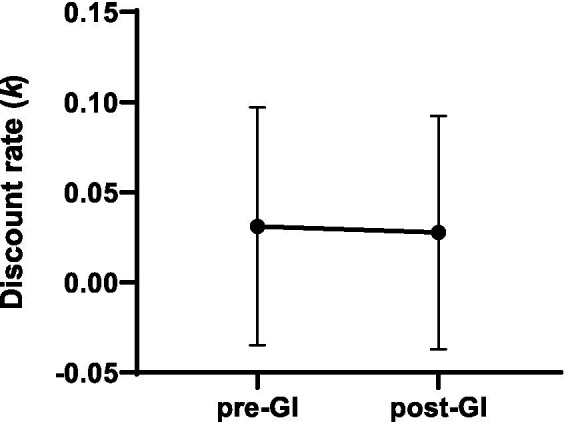 Figure 4
Peer Reviews
No public reviews on file for this paper yet. If you reviewed it on a platform where reviews are public (OpenReview, ICLR, NeurIPS, ICML), you can paste yours below so the community can read it here.
Videos
No videos yet. Explain this paper in a talk, walkthrough, or lecture? Add one.
Taxonomy
TopicsAnesthesia and Sedative Agents · Music Therapy and Health · Nausea and vomiting management