Larger-volume capillary blood sampling is a valid alternative to assess progesterone and 17ß-estradiol for cycle phase identification in tactical female athletes
Jennifer Schlie, Eva Fellinger, Sina Albrecht, Jessica Güldenstern, Annette Schmidt

TL;DR
This study shows that capillary blood from the earlobe can accurately measure hormones to track menstrual cycle phases in female athletes, offering a practical alternative to venous blood sampling.
Contribution
The study demonstrates that larger-volume capillary sampling is a valid alternative to venous sampling for hormone assessment in tactical female athletes.
Findings
Capillary sampling showed good to very good agreement with venous sampling for progesterone and 17ß-estradiol.
The method is practical and minimally invasive, suitable for field-based use with athletes.
It allows accurate cycle phase classification and detection of hormonal deficiencies.
Abstract
Serum-based hormone analysis is considered essential for determining menstrual cycle phases in sport and exercise science. However, its reliance on venous blood sampling limits applicability in field-based or operational contexts. This study evaluated the validity of larger-volume capillary samples obtained from the earlobe for the quantification of progesterone (P4) and 17ß-estradiol (E2) in comparison to venous blood sampling. Twelve eumenorrheic female soldiers (mean age: 24.4 ± 2.9 years; BMI: 24.4 ± 2.2 kg/m2) participated in a longitudinal protocol involving paired capillary and venous blood sampling twice weekly across one complete individual menstrual cycle. Blood was drawn from the earlobe (capillary, 100–250 µL) and antecubital vein (venous, 4 mL) and analyzed via ELISA for P4 and E2 concentrations. All participants completed six or more sampling timepoints and had ovulatory…
Genes, proteins, chemicals, diseases, species, mutations and cell lines named across the full text — each resolved to its canonical identifier and authoritative record.
Click any figure to enlarge with its caption.
 Figure 1
 Figure 2
 Figure 3
 Figure 4
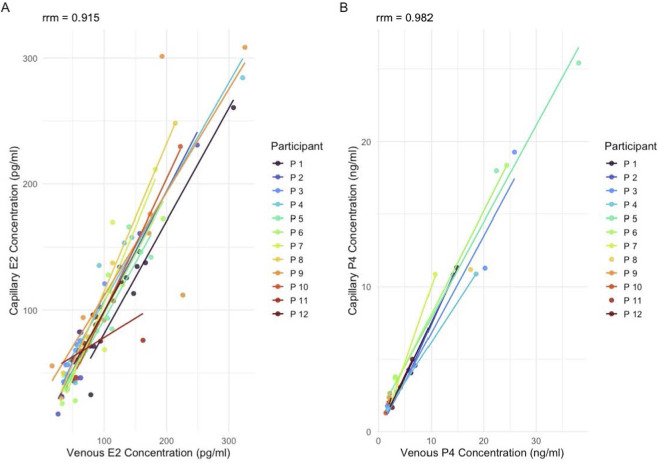 Figure 5
Peer Reviews
No public reviews on file for this paper yet. If you reviewed it on a platform where reviews are public (OpenReview, ICLR, NeurIPS, ICML), you can paste yours below so the community can read it here.
Videos
No videos yet. Explain this paper in a talk, walkthrough, or lecture? Add one.
Taxonomy
TopicsMuscle metabolism and nutrition · Exercise and Physiological Responses · Thermoregulation and physiological responses