Geographic information systems for occupational cancer surveillance: a scoping review
Diana Carolina Sanchez, Lorena Lisbeth Talero, Jose Ferney Mejia-Duarte, Alejandra Mendoza-Monsalve, Maricel Licht-Ardila, Alexandra Hurtado-Ortiz

TL;DR
This paper reviews how geographic information systems help track occupational cancer by analyzing spatial data and identifying risk factors.
Contribution
A systematic scoping review of GIS applications in occupational cancer surveillance, highlighting their benefits and limitations.
Findings
GIS are used to monitor cancer morbidity, mortality, and environmental risk factors.
Challenges include data accuracy and omission of socioeconomic variables.
GIS support public health planning and cancer prevention strategies.
Abstract
Geographic Information Systems (GIS) are key tools for managing spatial data and understanding the determinants of occupational cancer. To evaluate the applications, advantages, and limitations of GIS in the surveillance of occupational cancer. : A systematic scoping review was conducted using PubMed, Embase, Scopus, and Bireme databases, following the Population, Context, and Concept (PCC) framework outlined in the Joanna Briggs Institute (JBI) methodological guidelines and the PRISMA ScR. A semi-automated process supported by Rayyan® software was employed for study selection. The variables identified were transferred to a spreadsheet for qualitative analysis and synthesis. A total of 55 articles were included, addressing various cancer types and exposure to industrial emissions and potentially carcinogenic pollutants. The most commonly used GIS, spatial analysis methodologies, and…
Genes, proteins, chemicals, diseases, species, mutations and cell lines named across the full text — each resolved to its canonical identifier and authoritative record.
Click any figure to enlarge with its caption.
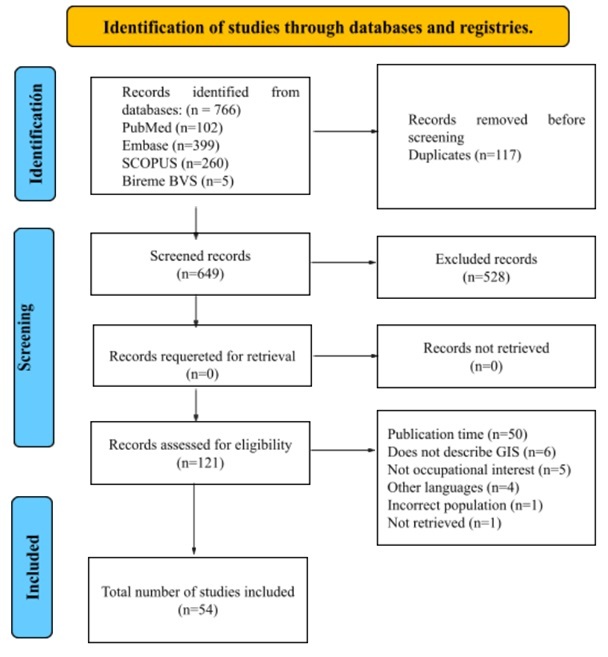 Figure 1
Peer Reviews
No public reviews on file for this paper yet. If you reviewed it on a platform where reviews are public (OpenReview, ICLR, NeurIPS, ICML), you can paste yours below so the community can read it here.
Videos
No videos yet. Explain this paper in a talk, walkthrough, or lecture? Add one.
Taxonomy
TopicsAir Quality Monitoring and Forecasting · Data-Driven Disease Surveillance