Silent victims: risk factors associated with school violence in Peruvian adolescents
Jhan Carlos Manuel Fernández-Delgado, Francisca Edita Diaz-Villanueva, Carlos Jesus Canova-Barrios, Felipe Machuca-Contreras, Maria Kappes, Eman Sameh AbdElhay

TL;DR
This study examines the types and risk factors of school violence among Peruvian adolescents, finding that verbal and psychological violence are most common and influenced by individual, family, and social factors.
Contribution
The study identifies specific risk factors and prevalence rates of school violence in Peruvian adolescents using a cross-sectional design.
Findings
Verbal and psychological violence were the most prevalent types among Peruvian adolescents.
Individual, family, and social factors were most strongly associated with school violence.
Community, cultural, and school factors had less influence on school violence.
Abstract
School violence is a global and complex problem. Identify the types of school violence and their associated factors in Peruvian adolescents. An analytical cross-sectional study was conducted. Two self-administered instruments were administered to 253 adolescents selected through stratified random sampling from the first to fifth grade of secondary school at a Peruvian public institution in 2024. Bivariate and multivariate regression analyses were used to identify factors associated with school violence. Verbal violence (63.24%) and psychological violence (54.94%) were the most prevalent, while physical violence (37.55%) and sexual violence (3.95%) were less frequent. The most influential factors were individual (75.49%), social (62.87%), and family (56.13%) factors, whereas community (35.56%), cultural (35.97%), and school (43.10%) factors had less influence. Bivariate analysis…
Genes, proteins, chemicals, diseases, species, mutations and cell lines named across the full text — each resolved to its canonical identifier and authoritative record.
Click any figure to enlarge with its caption.
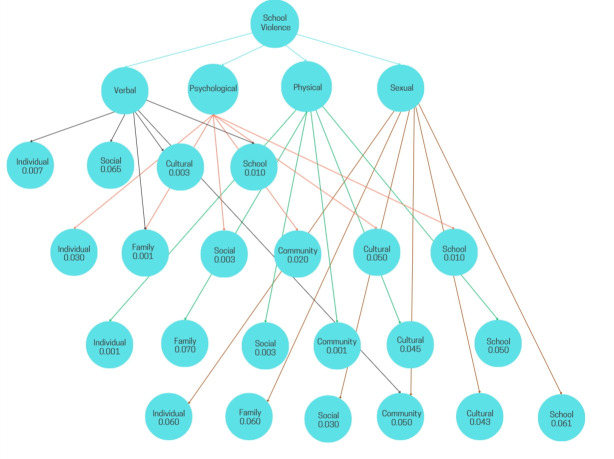 Figure 1
Peer Reviews
No public reviews on file for this paper yet. If you reviewed it on a platform where reviews are public (OpenReview, ICLR, NeurIPS, ICML), you can paste yours below so the community can read it here.
Videos
No videos yet. Explain this paper in a talk, walkthrough, or lecture? Add one.
Taxonomy
TopicsBullying, Victimization, and Aggression · Educational Innovations and Technology · Social Skills and Education
Introduction
School violence is a complex social and public health issue that encompasses various forms of repeated and intentional abuse—physical, verbal, psychological, and sexual1,2. Although it has long existed within academic settings, it has only recently received greater attention. Historically, the focus was placed almost exclusively on physical aggression, overlooking other harmful behaviors normalized in everyday interactions, such as jokes and insults3. These forms of violence have a profound impact on students’ emotional well-being, self-esteem, social development, and academic performance, with consequences that extend to family life, the school climate, and adolescent mental health—often triggering anxiety, depression, and risk behaviors4,5. Therefore, a comprehensive response is required from educational institutions, families, and society at large.
The high prevalence of school violence worldwide—affecting one in three students—highlights the importance of understanding its associated factors6. Identifying the types of violence and their determinants (individual, family, social, community, cultural, and school-related) is essential for designing effective prevention and intervention strategies. Each factor contributes differently to the type and frequency of violence experienced, underscoring the need for a holistic approach to foster safe, healthy educational environments7,8.
In response to this issue, the Peruvian Ministry of Education (MINEDU) launched the Specialized System for Reporting School Violence (SíseVe) in 2013. This platform allows confidential reporting of incidents through a website, email, phone, WhatsApp, or mobile application, and cases are followed up according to established protocols9. In 2024, SíseVe recorded more incidents in public schools (76%) than in private schools (24%), with girls (51%) more frequently affected than boys (49%). Adolescents were the most affected group (58%)10.
Despite policy advances—such as Law 31902 (2023), which requires the presence of at least one psychologist per school and the installation of video surveillance—implementation remains insufficient, with 98% of schools lacking these resources11. The persistence of school violence has led to the declaration of a national emergency regarding school coexistence, highlighting the urgent need for the effective enforcement of existing legal measures.
This study aimed to provide evidence on the magnitude and risk factors of school violence among Peruvian adolescents, thereby contributing to greater awareness and informed policy development. As the first study of its kind in Peru, it highlights the need for targeted prevention programs that may significantly reduce the long-term costs of unaddressed school violence. Its findings also offer insights to inform future research and interventions in educational and social policy. The aim of the study was to identify the types of school violence and their associated factors among Peruvian adolescents.
Materials and Methods
Study design and sample
A cross-sectional, analytical study was conducted with a population of 732 secondary school students from a public institution in Peru. The study subjects were Peruvian adolescents aged 12 to 17 years. The sample size was calculated using a statistical formula for finite populations12 with a 95% confidence level and a 5% margin of error. Based on these parameters, 253 were included. A proportional stratified sampling technique was applied to determine the number of students per grade, from the first to the fifth year of secondary school. Inclusion criteria considered both sexes, parental consent for participation of their minor child, and the adolescent’s voluntary assent. Those participants who did not demonstrate sufficient commitment to completing the study instruments were excluded.
Instruments
The sociodemographic questionnaire collected data on sex, age, grade level, school shift, family type, socioeconomic status, and area of residence. The study instruments were developed and validated by the researchers through expert judgment by ten evaluators (four psychologists, three nurses, and three schoolteachers), who assessed clarity, organization, and relevance. Content validity indices showed an Aiken’s V of 0.98 for the school violence instrument and 1.0 for the instrument assessing risk factors for school violence. Internal consistency was high, with Kuder-Richardson coefficients of 0.89 and 0.86, respectively. Both instruments were pilot-tested with 25 participants with characteristics similar to those of the study sample.
The school violence instrument included four dimensions: psychological violence (isolation, control, contempt, distrust, humiliation, intimidation, and threats) with seven items; physical violence (beating, pushing, use of objects, violence disguised as playing around, attempted murder) with five items; verbal violence (insults, shouting, slander) with three items, and sexual violence (non-consensual touching, sexual coercion, sexual harassment, exposure to sexual material) with four items. Responses were dichotomous (Yes = 1, No = 0), for a total possible score of 19 points.
The risk factors for school violence instrument assessed six dimensions: individual (impulsiveness, poor skills, exposure to violence, self-control difficulties, victimization, gang involvement, substance use) with seven items; family (domestic violence, poor parental supervision, low emotional support, verbal conflicts) with four items; social (peer pressure, participation in violence, misunderstandings) with three items; school-related (absence of rules, low emotional support, negative climate) with three items; cultural (discrimination, machismo, aggressive role models) with three items, and community (crime, lack of recreational resources, poor cohesion) with three items. All responses were dichotomous (Yes = 1, No = 0), for a total score of 22 points.
Data collection
Two nurses were trained to administer the instruments. Parents or legal guardians were informed about the study objective and ethical principles. The support of the school principal facilitated engagement. She first called meetings with the parents or guardians of the randomly selected students. The meetings were organized by academic year and held on different days in September 2024. Before data collection, information sessions were conducted with the students to explain the types of violence and risk factors included in the instruments, ensuring that the concepts were clearly understood by the participants. Recruitment and data collection took place between October and December 2024.
Data analysis
Data were processed using IBM SPSS Statistics, version 27. Frequencies and percentages were calculated for each indicator. The Chi-square test of Pearson was used to analyze the relationship between school violence and sociodemographic variables; when the assumptions of the Chi-square test were not met (expected cell counts <5), Fisher’s exact test was applied. A significance level of p <0.05 was considered. Bivariate logistic regression analysis was performed to estimate crude odds ratios (COR) with 95% confidence intervals (CI). Subsequently, a multivariate analysis was conducted using a binomial regression model to estimate adjusted odds ratios (AOR) with 95% CI. Model fit was assessed using the Hosmer–Lemeshow goodness-of-fit test to verify the agreement between observed data and model-predicted values. Figure 1was created using Moqups (Evercoder Software SRL).
Availability of data and materials
The dataset used in this research is available in a Mendeley repository13.
Ethical considerations
The research followed the international ethical principles outlined in the Declaration of Helsinki and complied with Supreme Decree No. 021-2017-SA of the Peruvian Ministry of Health, which establishes guidelines for health research involving minors. Informed consent was obtained from parents or legal guardians, and informed assent was obtained from all participants. The principles of autonomy, justice, and non-maleficence were upheld. The study was approved by resolution of the Nursing Faculty Council at Universidad Nacional de Cajamarca.
Results
Sociodemographic information
The students’ ages ranged from 12 to 17 years, with females representing 58.10% and males 41.90% of the sample. Educational levels in secondary school extended over five years: first year (20.17%), second year (20.17%), third year (19.32%), fourth year (20.17%), and fifth year (20.17%). The school shift was morning for 44.66% and afternoon for 55.34%. Regarding family type, 22.53% lived in nuclear families, 43.08% in single-parent families, and 34.39% in extended families. Socioeconomic status was characterized as poverty (43.87%), extreme poverty (15.42%), and non-poor (40.71%). The area of residence was urban in 53.36% and rural in 46.64% of the sample. Bivariate analysis identified significant associations between school violence and sex (p = 0.03), family type (p = 0.02), socioeconomic status (p = 0.01), and area of residence (p = 0.03). (See Table 1).
Table 1. Characteristics of participants involved in school violence (n=253)Sociodemographic variablesTotal % (n)School violence p-value Yes % (n)No % (n)Sex
0.030^a^ Male 41.90 (106)67.90 (72)32.10(34) Female 58.10 (147)34.7 (51)65.3 (96)Age (M: 14.07, SD: 1.44)0.120^b^ 12 years 18.18 (46)19.60 (9)80.40 (37) 13 years 20.94 (53) 22.60 (12)77.40 (41) 14 years 20.17 (51)35.30 (18)64.70 (33) 15 years 18.58 (47)36.20 (17)63.80 (30) 16 years 20.94 (53)26.40 (14)73.60 (39) 17 years 1,19 (3)33.30 (1)66.70 (2) Secondary school year 0.180^a^ First 20.17 (51)23.50 (12)76.50 (39) Second 20.17 (51)19.60 (10)80.40 (41) Third 19.32 (49)34.70 (17)65.30 (32) Fourth 20.17 (51)31.40 (16)68.60 (35) Fifth 20.17 (51)29.40 (15)70.60 (36)School shift 0.100^a^ Morning 44.66 (113)32.70 (37)67.30 (76) Afternoon 55.34 (140)23.60 (33)76.40 (107) Family type 0.020^a^ Nuclear 22.53 (57)38.60 (22)61.40 (35) Single-parent 43.08 (109)33.03 (36)66.97 (73) Extended 34.39 (87)13.79 (12)86.21 (75) Socioeconomic status 0.010^a^ Non-poor40.71 (103)35.92 (37)64.08 (66) Poor43.87 (111)18.02 (20)91.98 (91) Extreme poverty 15.42 (39)33.33 (13)66.67 (26)Area of residence0.030^a^ Urban 53.36 (135)30.37 (41)69.63 (94) Rural 46.64 (118)24.58 (29)75.42 (89)95% CI: 95% Confidence Interval. p <0.05 indicates a statistically significant association with school violence. ^a^p calculated using Pearson’s Chi-square test. ^b^p calculated using Fisher’s exact test.
**Types of school violence in adolescents **
Four types of school violence were reported. In the psychological dimension, 54.94% of adolescents were affected, with a COR of 2.00 (95% CI: 1.52-2.35) and an AOR of 2.00 (95% CI: 1.52-2.12), confirming that adolescents experience this type of school violence. The most frequent subtypes were isolation and humiliation (67.19%). Logistic regression analysis showed a COR of 2.52 (95% CI: 2.24-2.90) and an AOR of 2.42 (95% CI: 2.00-2.82), confirming a high probability of exposure to these subtypes of violence in similar contexts.
In the physical dimension, 37.55% of adolescents were affected, with a COR of 1.52 (95% CI: 1.25- 1.82) and an AOR of 1.42 (95% CI: 1.14-1.72). Beating was reported by 30.83% (COR = 1.25 [95% CI: 1.05-1.52]; AOR = 1.12 [95% CI: 0.90-1.43]) and pushing by 28.85% (COR = 1.22 [95% CI: 1.00-1.50]; AOR = 1.10 [95% CI: 0.90-1.4]).
The verbal dimension presented the highest prevalence, affecting 63.24% of adolescents, with a COR of 2.62 (95% CI: 2.33-3.05) and an AOR of 2.32 (95% CI: 1.92-2.72). Insults were reported by 73.52% of participants, with a COR of 3.15 (95% CI: 2.75-3.68) and an AOR of 3.00 (95% CI: 2.61-3.25), highlighting this subtype as a key indicator of verbal violence.
In the sexual dimension, 3.95% of adolescents reported being affected, representing the lowest prevalence. Logistic regression showed a COR of 0.20 (95% CI: 0.12-0.35) and an AOR of 2.32 (95% CI: 1.92-2.72). Exposure to sexual material was the most frequent subtype (4.74%), with a COR of 0.27 (95% CI: 0.16-0.32) and an AOR of 0.25 (95% CI: 0.11-0.32). (See Table 2)
Table 2. Types of school violence experienced by Peruvian adolescents (n=253)Dimensions Yes % (n) No % (n) COR (95% CI)AOR (95% CI) p-value Psychological violence 54.94 (139) 45.06 (114) 2.00(1.52-2.35) 2.00(1.52-2.12) 0.003 Isolation 67.19 (170) 32.81 (83) 2.52(2.24-2.90) 2.42(2.00-2.82) <0.001 Control 47.04 (119) 52.96 (134) 1.81(1.52-2.22) 1.67(1.32-2.00) 0.010 Contempt 42.29 (107) 57.71 (146) 1.65(1.35-2.00) 1.51(1.25-1.81) 0.005 Distrust 52.17 (132) 47.83 (121) 2.00(1.70-2.42) 1.80(1.56-2.12) 0.002 Humiliation 67.19 (170) 32.81 (83) 2.52(2.24-2.90) 2.42(2.00-2.82) 0.001 Intimidation 35.97 (91) 64.03 (162) 1.32(1.00-1.75) 1.24(1.00-1.52) 0.050 Threats 48.22 (122) 51.78 (131) 2.00(1.72-2.34) 1.81(1.53-2.10) 0.010 Physical violence 37.55 (95)
62.45 (158) 1.52(1.25-1.82) 1.42(1.14-1.72) 0.016 Beating 30.83 (78) 69.17 (175) 1.25(1.05-1.52) 1.12(0.90-1.43) 0.060 Pushing28.85 (73) 71.15 (180) 1.22(1.00-1.50) 1.10(0.90-1.4) 0.055 Using objects 26.88 (68) 73.12 (185) 1.05(0.95-1.42) 1.05(0.8-1.3) 0.070 Violence disguised as playing around 16.60 (42) 83.40 (211) 0.82(0.67-1.05) 0.72(0.5-0.9) 0.020 Attempted murder 0.40 (1) 99.60 (252) 0.10(0.00-0.10) 0.13(0.0-0.1) 0.001Verbal violence 63.24 (160) ** 36.76 (93) 2.62(2.33-3.05) 2.32(1.92-2.72) 0.012 Insults 73.52 (186) 26.48 (67) 3.15(2.75-3.68) 3.00(2.61-3.25) 0.002 Shouting 48.22 (122) 51.78 (131) 2.00(1.72-2.32) 1.85(1.52-2.17) 0.026 Slander 35.97 (91) 64.03 (162) 1.37(1.00-1.75) 1.23(1.00-1.52) 0.050 Sexual violence ** 3.95 (10) 96.05 (243) 0.20(0.12-0.35) 0.20(0.10-0.35) 0.001 Non-consensual touching 0.40 (1) 99.60 (252) 0.12(0.05-0.13) 0.10(0.10-0.12) <0.001 Sexual coercion 1.19 (3) 98.81 (250) 0.15(0.00-0.20) 0.11(0.04-0.26) <0.001 Sexual harassment 1.19 (3) 98.81 (250) 0.12(0.00-0.25) 0.10(0.00-0.20) <0.001 Exposure to sexual material 4.74 (12) 95.26 (241) 0.27(0.16-0.32) 0.25(0.11-0.32) 0.001COR: Crude odds ratio; AOR: adjusted odds ratio; 95% CI: 95% Confidence interval. COR values > 1 indicate higher crude odds of experiencing the corresponding type or subtype of school violence. AOR values > 1 indicate higher adjusted odds. Model fit was verified using the Hosmer-Lemeshow test (p = 0.403), confirming adequate model fit.
**Risk factors for school violence **
Six categories of risk factors associated with school violence were identified. The individual factors were reported by 75.49% of participants, with a COR of 3.00 (95% CI: 2.62-4.02) and an AOR of 3.00 (95% CI: 2.61-3.75), indicating a greater probability of occurrence and bold associations (p = 0.001). The logistic regression analysis showed that impulsiveness (66.80%; COR = 2.41 [95% CI: 1.60-3.42]; AOR = 2.10 [95% CI: 1.42-3.21]; p = 0.003) and poor skills (64.03%; COR = 2.25 [95% CI: 1.51-3.32]; AOR = 2.00 [95% CI: 1.30-3.00]; p = 0.005) are the most reported subfactors in this dimension with significant associations with school violence.
The family factors were reported by 56.13% of participants, with a COR of 2.62 (95% CI: 1.42-3.10), an AOR of 2.50 (95% CI: 1.30-2.81), and p-value of 0.007. Low emotional support was reported by 67.55%, with a COR of 2.61 (95% CI: 1.81-3.83), an AOR of 2.35 (95% CI: 1.66-3.51), and p-value of 0.001, indicating a bold association with school violence.
The social factors were reported by 62.87% of the students, with a COR of 2.30 (95% CI: 1.63-3.35), an AOR of 2.00 (95% CI: 1.42-3.15), and p-value of 0.001. Participation in violence (59.29%; COR = 2.21 [95% CI: 1.50-3.20]; AOR = 2.00 [95% CI: 1.30-3.00]; p = 0.014) and misunderstandings (57.71%; COR = 2.00 [95% CI: 1.41-2.92]; AOR = 1.72 [95% CI: 1.27-2.62]; p = 0.001) were the most influential subfactors.
The school-related factors were reported by 43.10% of participants, with a COR of 1.75 (95% CI: 1.25- 2.63), an AOR of 1.52 (95% CI: 1.11-2.34), and p-value of 0.060. Low emotional support was the main subfactor (43.87%) with a COR of 1.95 (95% CI: 1.31-2.82), an AOR of 1.62 (95% CI: 1.11-2.41), and p-value of 0.050.
The cultural factors were reported by 35.97% of the participants, with a COR of 1.62 (95% CI: 1.10-2.52), an AOR of 1.40 (95% CI: 0.95-2.12), and p-value of 0.050. Machismo was the predominant subfactor (50.59%) with a COR of 2.00 (95% CI: 1.45-3.00), an AOR of 1.85 (95% CI: 1.33-2.77), and p-value of 0.003.
The community factors were reported by 35.56% of the students, with a COR of 2.00 (95% CI: 1.41-3.10), an AOR of 1.82 (95% CI: 1.32-2.85), and p-value 0.050. Lack of recreational resources (37.13%) was the most frequently reported subfactor, with a COR of 1.51 (95% CI: 1.00-2.36), an AOR of 1.50 (95% CI: 1.00-2.31), and p-value 0.150. (See Table 3)
Table 3. Risk factors associated with school violence in Peruvian adolescents (n=253)Dimensions Yes % (n) No % (n)COR(95% CI) AOR(95% CI) p-valueIndividual factors75.49 (191) 24.51 (62) 3.00(2.62-4.02) 3 .00(2.61-3.75) 0.001 Impulsiveness66.80 (169) 33.20 (84) 2.41(1.60-3.42) 2.10(1.42-3.21) 0.003 Poor skills64.03 (162) 35.97 (91) 2.25(1.51-3.32) 2.00(1.30-3.00) 0.005 Exposure to violence54.94 (139) 45.06 (114) 1.82(1.25-2.60) 1.65(1.11-2.42) 0.015 Self-control difficulties 57.71 (146) 42.29 (107) 2.00(1.43-2.90) 1.71(1.24-2.66) 0.010 Victimization 35.16 (89) 64.84 (164) 1.37(0.90-1.82) 1.20(0.80-1.75) 0.020 Gang involvement3.16 (8) 96.84 (245) 1.10(0.45-3.23) 0.9(0.31-2.73) 0.150 Substance use 4.74 (12) 95.26 (241) 1.12(0.44-3.20) 1.0(0.36-3.01) 0.650 Family factors56.13 (142)
43.87 (111) 2.62(1.42-3.10) 2.50(1.30-2.81) 0.007 Domestic violence 20.17 (51) 79.83 (202) 1.51(0.94-2.61) 1.43(0.83-2.42) 0.110 Poor parental supervision 45.87 (116) 54.13 (137) 1.70(1.25-2.50) 1.52(1.00-2.33) 0.020 Low emotional support 67.55 (171) 32.45 (82) 2.61(1.81-3.83) 2.35(1.66-3.51) 0.001 Verbal conflicts43.87 (111) 56.13 (142) 1.90(1.30-2.81) 1.67(1.15-2.48) 0.002 Social factors 62.87 (159)
37.13 (94) 2.30(1.63-3.35) 2.00(1.42-3.15) 0.001 Peer pressure 42.68 (108) 57.32 (145) 1.81(1.24-2.75) 1.65(1.16-2.45) 0.016 Participation in violence 59.29 (150) 40.71 (103) 2.21(1.50-3.20) 2.00(1.30-3.00) 0.014 Misunderstandings 57.71 (146) 42.29 (107) 2.00(1.41-2.92) 1.72(1.27-2.62) 0.001 School-related factors 43.10 (109) 56.90 (144) 1.75(1.25-2.63) 1.52(1.11-2.34) 0.060 Absence of rules 32.45 (82) 67.55 (171) 1.51(1.00-2.37) 1.30(0.95-2.00) 0.040 Low emotional support 43.87 (111) 56.13 (142) 1.95(1.31-2.82) 1.62(1.11-2.41) 0.050 Negative climate 26.88 (68) 73.12 (185) 1.46(0.90-2.22) 1.27(0.82-1.90) 0.040 Cultural factors 35.97 (91)
64.03 (162) 1.62(1.10-2.52) 1.40(0.95-2.12) 0.050 Discrimination26.88 (68) 73.12 (185) 1.47(0.93-2.00) 1.21(0.80-1.84) 0.062 Machismo 50.59 (128) 49.41 (125) 2.00(1.45-3.00) 1.85(1.33-2.77) 0.003 Aggressive role models 28.85 (73) 71.15 (180) 1.56(1.00-2.36) 1.30(0.98-2.03) 0.015 Community factors 35.56 (90) 64.44 (163) 2.00(1.41-3.10) 1.82(1.32-2.85) 0.050 Crime 34.84 (88) 65.16 (165) 2.33(1.62-3.54) 2.30(1.60-3.50) 0.020 Lack of recreational resources 37.13 (94) 62.87 (159) 1.51(1.00-2.36) 1.50(1.00-2.31) 0.150 Poor cohesion 28.47 (72) 71.53 (181) 1.45(0.92-2.10) 1.39(0.96-2.00) 0.650 COR = Crude odds ratio; AOR = Adjusted odds ratio; 95% CI = 95 % Confidence interval. COR values > 1 indicate higher crude odds of experiencing the corresponding risk factor; AOR values > 1 indicate higher adjusted odds. p <0.05 indicates a statistically significant association with school violence. Model fit was confirmed using the Hosmer–Lemeshow test (p = 0.463).
School violence and associated risk factors in adolescents
Building on the previous findings, various types of school violence were significantly associated with different contextual factors. Verbal violence was associated with individual (p = 0.007), family (p = 0.001), cultural (p = 0.003), and school-related (p = 0.010) factors. Psychological violence was linked to individual (p = 0.030), family (p = 0.001), social (p = 0.003), community (p = 0.020), and school- related (p = 0.020) factors. Physical violence showed associations with individual (p = 0.001), social (p = 0.002), and community (p = 0.045) factors. Lastly, sexual violence was associated with social (p = 0.030) and cultural (p = 0.043) factors. (See Figure 1).
Figure 1. Relationship between types of school violence and risk factors in Peruvian adolescents Note: p <0.05 indicates a significant relationship.
Discussion
This study found a notable prevalence of verbal and psychological violence, affecting more than half of the participants, consistent with previous research14. Gutiérrez15 identified verbal violence as the most frequent type of violence (M=14.56, SD:2.46) in school contexts, especially in secondary school, attributing its persistence to social normalization and the difficulty of early detection. By contrast, López-Arancibia16 reported verbal violence in only 12% of the students, classifying it at a high level.
Guevara-Vidalón et al.17 identified psychological violence in 59.8% of the students and emphasized its lasting emotional impact, which affects academic performance and adolescent mental health. Although it showed a lower prevalence in this study, prior research by Cid et al.18 and Cedeño-Sandoya19 showed the relevance of physical and sexual violence and highlighted their critical impact, especially on the psychosocial well-being of victims, emphasizing the importance of prevention strategies.
The analysis of factors associated with school violence revealed that individual, family, and social dimensions play a key role. However, this study did not explore the interaction between these variables or whether specific combinations might amplify or buffer the risk of school violence. Future research should examine these interaction effects to gain a deeper understanding of the complex mechanisms underlying school violence. This finding is consistent with that of Cid et al.18, who noted that impulsiveness, poor parental supervision, and lack of social skills increase vulnerability to school violence. Similarly, Faria and Martins20 emphasized the role of family and social environments— particularly authoritarian or neglectful parenting styles and disorganized settings—as contributors to school violence. The results also align with Caracas-Moreira et al.21, who found that peer networks and social exclusion are critical factors in sustaining violent behaviors in schools.
Regarding the role of community, cultural, and school-related factors, their more limited influence alignswith García-Montañezand Ascensio-Martínez22, whoarguethatthesefactorshavecomparatively less impact on adolescents' experiences of school violence. These findings suggest that individual, family, and social factors play a more significant role in both perpetration and victimization, and that violence in schools should not be viewed as generated exclusively within the school environment. In this research, although the adjusted analysis showed an increased probability of school violence when considering these factors (AOR > 1), the lack of statistical significance suggests insufficient evidence to support a direct association in the bivariate analysis. This finding implies that other factors may be influencing the relationship observed in the adjusted model. Hamodi-Galán and Jiménez-Robles23 argue that school and community culture play a relevant role in preventing bullying, which could be an area for improvement in the Peruvian context.
Implementing school policies that reinforce peaceful coexistence and tolerance can help mitigate these problems, as highlighted by the United Nations Educational, Scientific and Cultural Organization (UNESCO)24 as a key component of effective prevention programs. The Kiva program in Finland is a successful example of how school culture can influence bullying prevention, recognizing it as a social problem that requires a response at the community level25.
In Peru, however, geographical and cultural diversity pose challenges for implementing standardized school-level interventions. Various authors emphasize the need to implement comprehensive strategies to address scholar violence in the country. Castillo-Pulido26 argues that bullying is a changing and difficult-to-solve phenomenon that cannot be solved only within the school environment. An ecological approach encompassing personal, family, and community factors is therefore required. This research supports this perspective, considering other factors and emphasizing the need for comprehensive programs that not only reduce violence but also promote learning and emotional well-being.
From a methodological point of view, this study is among the first in Peru to combine complementary statistical approaches, thereby producing more robust results. In particular, factor scores were estimated for each dimension using confirmatory factor analysis.
Limitations
This research on school violence among Peruvian adolescents has several limitations that warrant consideration. First, the research relied on self-reported data, which may be subject to biases such as underreporting or overreporting due to fear of judgment or social stigma. Adolescents may also lack the ability to adequately comprehend or express the extent of their experiences with violence, leading to incomplete responses. These limitations may impact the accuracy of the findings and the generalizability of the results.
Another limitation is the research's cross-sectional design, which provides only a snapshot of school violence and its associated factors at a specific point in time. This design restricts the capacity to establish causal relationships between individual, social, and family-level influences and the incidence of violence. Longitudinal studies would be more effective in monitoring temporal changes and elucidating how these factors contribute to the development and escalation of violence among adolescents.
Finally, this research focused only on Peruvian adolescents, limiting the applicability of its results to other cultural and geographical settings. The findings may not comprehensively reflect the experiences of adolescents in other nations or regions with different sociocultural frameworks or resource availability. Consequently, further research in diverse contexts is essential to validate and expand on these results.
Implications
The study's results underscore the need for nurses to implement routine screening for violence among adolescents, especially within educational environments. Given the predominance of verbal and psychological violence, nurses may significantly contribute to identifying at-risk or affected students by including questions on mental health and safety in standard health assessments. Early identification enables timely interventions and opens opportunities for assistance, including counseling and the development of coping skills. Nurses must adopt a holistic approach, taking into account not just physical health but also the psychological and social well-being of adolescents.
Since family and social factors substantially influence adolescent experiences of violence, nurses should work closely with families and communities to help mitigate these risk factors. Family relationships, social contexts, and socioeconomic conditions all influence the incidence of violence. By collaborating with social workers and counselors, nurses can assist adolescents in addressing these difficulties. It is equally important for nurses to recognize the gender-specific characteristics that may influence violence and to tailor interventions that meet adolescents' needs, regardless of gender. This may include offering gender-sensitive counseling and promoting open dialogue around gender-based violence.
Collaboration with educational institutions and communities is another key consideration for nursing practice. Nurses should partner with schools to design and implement violence prevention programs, such as anti-bullying campaigns and mental health awareness projects. Nurses can contribute to reducing school violence by fostering safe school environments and providing support services to students and educators. Furthermore, nurses should advocate for policies that protect adolescents and guarantee that schools are equipped with the necessary resources, including counselors and safe spaces, to mitigate the effects of violence and foster a supportive educational setting for all students.
Conclusions
Verbal and psychological violence were the most common forms of school violence, whereas physical and sexual violence were less prevalent. This reflects a problem centered on less visible but equally harmful forms of aggression. Individual, social, and family factors were the most influential, showing that school violence cannot be attributed solely to school-related factors but rather results from a complex interaction of factors. In contrast, community, cultural, and school-related factors showed lower prevalence, suggesting the need for comprehensive strategies that address all levels of students' environment.
In this regard, future interventions should consider strengthening the socio-emotional approach within the school curriculum and fostering closer integration with community-based mental health services. Such measures could enhance early identification, prevention, and management of school violence in the Peruvian context.
Future research should explore longitudinal designs to examine how these factors evolve over time, or conduct regional comparative studies to identify local variations and inform the development of context-specific interventions.
The reference list from the paper itself. Each links out to its DOI / PubMed record.
- 1Páez Esteban AN Ramírez Cruz MA Campos de Aldana MS Duarte Bueno LM Urrea Vega EA Prevalence and factors associated with bullying in adolescents Rev Cuidarte 2020113 e 100010.15649/cuidarte.1000 · doi ↗
- 2Hammarén N Are bullying and reproduction of educational inequality the same thing? Towards a multifaceted understanding of school violence Poder Educ 2022141354910.1177/17577438211052650 · doi ↗
- 3Health Behavior i School-aged Children (HBSC) Peer Abuse. HBSC Spain[Internet]20212025 july 12https://www.hbsc.es/maltrato-entre-iguales
- 4Montero Medina DC Saltos Paredes DA School violence in adolescents: a systematic review Enlace Univ 2021202104 https://dialnet.unirioja.es/servlet/articulo?codigo=9232395
- 5Polanin JR Espelage DL Grotpeter JK Spinney E Ingram KM Valido A A meta-analysis of longitudinal partial correlations between school violence and mental health, school performance, and criminal or delinquent acts Psychol Bull 20211472115 https://psycnet.apa.org/buy/2020-91555-0013327102410.1037/bul 0000314 · doi ↗ · pubmed ↗
- 6United Nations Educational, Scientific and Cultural Organization (UNESCO) Safe learning environments: Preventing and addressing violence in and around schools [Internet]20242025 july 12https://www.unesco.org/en/health-education/safe-learning-environments
- 7Baldry AC Farrington DP Protective factors as moderators of risk factors in adolescence bullying Soc Psychol Educ 200582638410.1007/s 11218-005-5866-5 · doi ↗
- 8Ttofi MM Farrington DP School bullying: Risk factors, theories and interventions In: Handbook on crime Willan 2010427457