Altmetric attention and citation performance in sport science: a cross-sectional analysis of 30 top-ranked journals
Yanbing Zhou, Ziwei Luo

TL;DR
This study examines how public attention via social media relates to citation performance in top sport science journals.
Contribution
It reveals that social media attention is a stronger predictor of citations than journal prestige in sport science.
Findings
A significant correlation was found between citation and altmetric scores across 30 top-ranked sport science journals.
Review studies showed a stronger correlation between citations and social media attention than research articles.
Social media attention was a more powerful predictor of citations than journal impact factor.
Abstract
Disconnection between efficacy and implementation remained in sport and exercise science, making it vital to understand the relationship between research quality and public attention. Citation score (CS) and Journal impact factor (JIF) are the main metrics of research quality. Alternatively, Altmetric score (AS) tracks article dissemination on social media to reflect public attention. This study aimed to explore the CS-AS correlations on levels of article types and journals, and predictors of citation performance. Web of Science Core Collection was systematically searched for research and review studies published in 2022 in the top-ranked 30 journals under the sport science category of Journal Citation Reports™. Publications from 2022 were selected to accumulate citations while preserving contemporary representativeness. CS and AS scores were retrieved from the website Dimensions…
Click any figure to enlarge with its caption.
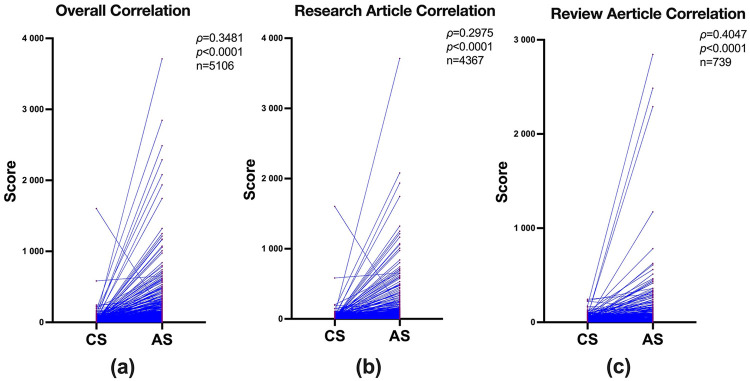 Figure 1
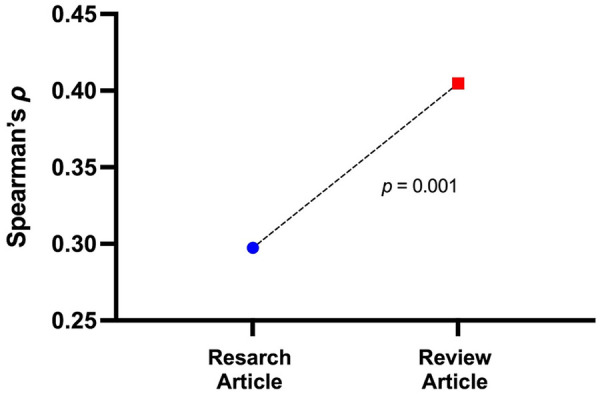 Figure 2
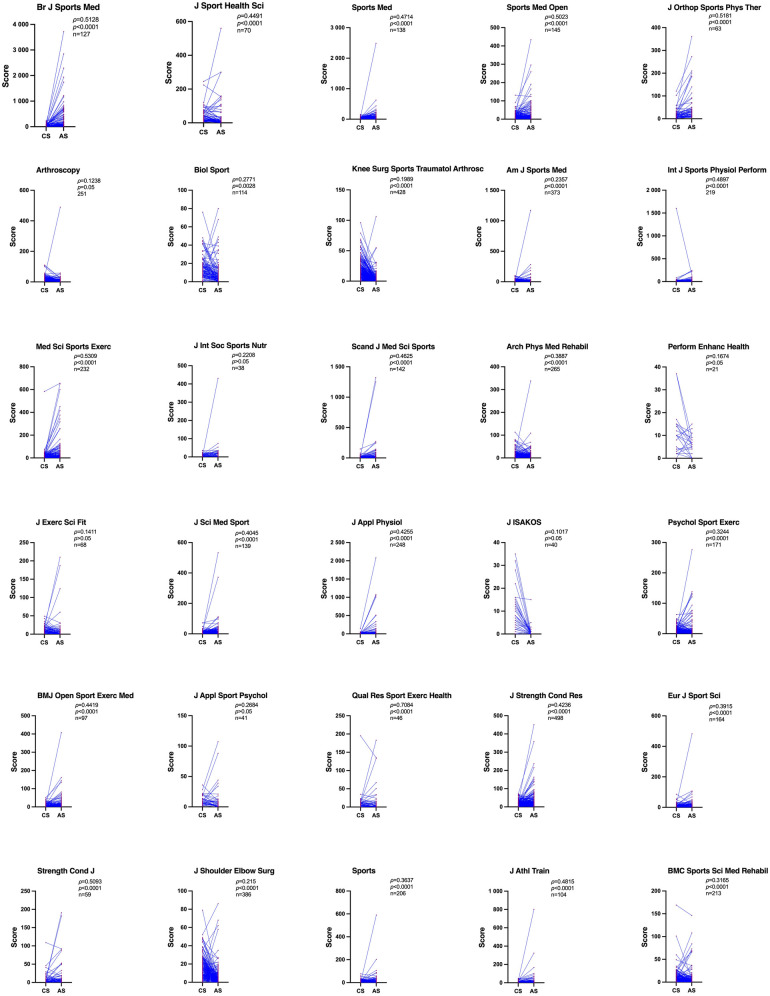 Figure 3
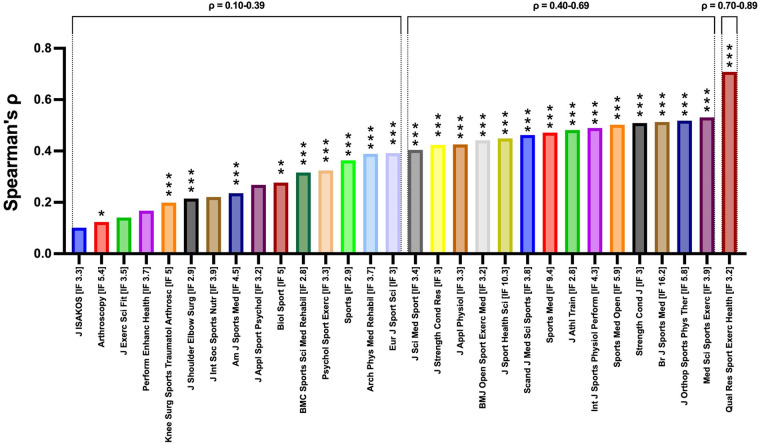 Figure 4
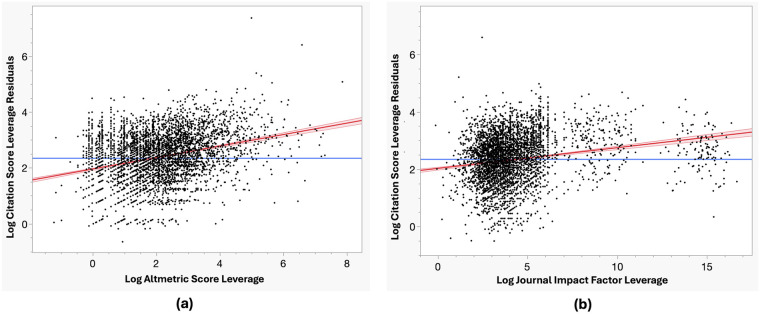 Figure 5
| Journals | Study outputs | Citation scores | Altmetric scores | JCR IF (2024) | JCR quartile | ||
|---|---|---|---|---|---|---|---|
| Median | IQR | Median | IQR | ||||
| British Journal of Sports Medicine | 127 | 25 | 27 | 74 | 238 | 16.2 | Q1 |
| Journal of Sport and Health Science | 70 | 28 | 42.75 | 9 | 27 | 10.3 | Q1 |
| Sports Medicine | 138 | 30 | 33.25 | 34.5 | 79 | 9.4 | Q1 |
| Sports Medicine-Open | 145 | 15 | 19 | 10 | 21 | 5.9 | Q1 |
| Journal of Orthopaedic & Sports Physical Therapy | 63 | 14 | 18 | 27 | 29 | 5.8 | Q1 |
| Arthroscopy-The Journal of Arthroscopic and Related Surgery | 251 | 12 | 13 | 5 | 6 | 5.4 | Q1 |
| Biology of Sport | 114 | 12 | 13 | 5 | 8 | 5 | Q1 |
| Knee Surgery Sports Traumatology Arthroscopy | 428 | 10.5 | 12 | 1 | 3 | 5 | Q1 |
| American Journal of Sports Medicine | 373 | 11 | 13.5 | 3 | 7 | 4.5 | Q1 |
| International Journal of Sports Physiology and Performance | 219 | 7 | 9 | 8 | 11 | 4.3 | Q1 |
| Medicine & Science in Sports & Exercise | 232 | 10 | 12 | 9 | 21 | 3.9 | Q1 |
| Journal of The International Society of Sports Nutrition | 38 | 8 | 9.5 | 12 | 22.5 | 3.9 | Q1 |
| Scandinavian Journal of Medicine & Science in Sports | 142 | 9.5 | 10 | 6 | 18.25 | 3.8 | Q1 |
| Archives of Physical Medicine and Rehabilitation | 265 | 8 | 11 | 4 | 6 | 3.7 | Q1 |
| Performance Enhancement & Health | 21 | 10 | 11.5 | 6 | 6 | 3.7 | Q1 |
| Journal of Exercise Science & Fitness | 68 | 9 | 12.75 | 3 | 7 | 3.5 | Q1 |
| Journal of Science and Medicine in Sport | 139 | 9 | 10 | 9 | 15 | 3.4 | Q1 |
| Journal of Applied Physiology | 248 | 8 | 10 | 6.5 | 12 | 3.3 | Q1 |
| Journal of Joint Disorders & Orthopaedic Sports Medicine | 40 | 6.5 | 10.75 | 0 | 1 | 3.3 | Q1 |
| Psychology of Sport and Exercise | 171 | 9 | 10 | 3 | 9 | 3.3 | Q1 |
| BMJ Open Sport & Exercise Medicine | 97 | 7 | 9 | 10 | 17 | 3.2 | Q1 |
| Journal of Applied Sport Psychology | 41 | 8 | 8.5 | 4 | 10 | 3.2 | Q1 |
| Qualitative Research in Sport Exercise and Health | 46 | 7.5 | 10 | 3.5 | 13 | 3.2 | Q1 |
| Journal of Strength and Conditioning Research | 498 | 9 | 12 | 8 | 12 | 3 | Q1 |
| European Journal of Sport Science | 164 | 7 | 6 | 5 | 9.75 | 3 | Q1 |
| Strength and Conditioning Journal | 59 | 5 | 7 | 5 | 15 | 3 | Q1 |
| Journal of Shoulder and Elbow Surgery | 386 | 9 | 11 | 1 | 3 | 2.9 | Q1 |
| Sports | 206 | 7 | 8 | 2 | 5.25 | 2.9 | Q1 |
| Journal of Athletic Training | 104 | 7 | 11 | 8.5 | 15.75 | 2.8 | Q1 |
| BMC Sports Science Medicine and Rehabilitation | 213 | 7 | 8 | 1 | 4 | 2.8 | Q1 |
Peer Reviews
No public reviews on file for this paper yet. If you reviewed it on a platform where reviews are public (OpenReview, ICLR, NeurIPS, ICML), you can paste yours below so the community can read it here.
Videos
No videos yet. Explain this paper in a talk, walkthrough, or lecture? Add one.
Taxonomy
TopicsMeta-analysis and systematic reviews · scientometrics and bibliometrics research · Academic Writing and Publishing
Introduction
1
The volume of research in sports and exercise science has grown exponentially over the past decades (1). However, there is still a distinct disconnect between efficacy and real-world implementation (2). Despite the longstanding establishment of the physical activity guideline (3), the global obesity rate continues to rise (4). Barely half of the adults in the U.S. could accumulate at least 150 min/week of moderate-to-vigorous physical activity (5). Only 4% can identify the recommendations in both aerobic and muscular exercises (6). Similarly, multiple guidelines of sport-related injuries have been published; however, sport teams, including team physicians, have yet to consistently implement this knowledge and the best practice (7, 8). These disconnects raise an important question about how sport and exercise science research is communicated, perceived, and utilized by the sports team and the general public.
To address this issue, it is crucial to understand the relationship between scientific research and public attention. Citation score (CS) and journal impact factor (JIF) are two critical metrics to measure the quality and value of a research article (9, 10). CS is determined by how often an article is cited by other articles. The JIF (Clarivate™, JISC Services Ltd., Bristol, UK) is defined as the average number of citations for an article in a particular journal within two years after publication. While CS and JIF take time to accumulate, alternatively, Altmetric Score (AS) serves as a real-time metric to track public attention of a particular article on social media. The AS is derived from an automated algorithm and weighted to reflect the reach and credibility of each platform, such as blogs, Wikipedia, and social media posts (e.g., X, Facebook, blogs, Mendeley, and news outlets). AS is computed in near-real time but may continue to evolve months after publication, depending on engagement trends.
Despite that, in the previous study (11), the relation between CS and AS was analyzed, showing high heterogeneity, reducing the confidence and credibility in the pooled estimate. Therefore, this cross-sectional study aimed to explore the relationship between CS and AS on different layers, including the factors that could predict future citation performance. To our knowledge, this is the first study to perform stratified analyses on main article types and individual journals in sport and exercise science.
Materials and methods
2
Searching strategy
2.1
The Clarivate™ Journal Citation Reports™ (JCR) was utilized to determine the top journals. The JIF values were retrieved, and the top 30 journals under the category of Sport Science with the highest JIF were selected for a systematic search.
The Web of Science (WOS) Core Collection was utilized to perform the systematic search using advanced search strings {[SO = (Journal names)] AND DOP = (2022-01-01/2022-12-31)}. The publication time was restricted to the year of 2022, to allow a 2.5-period for the CS to accumulate (12). The search was performed on July 26th, 2025. The searching process was performed by two independent researchers (Y., Z., and Z., L.). Each reviewer was blinded to the other's results until the final merging step. Disagreement was addressed through discussion if needed.
Inclusion/exclusion criteria
2.2
Journals that focused on sports, exercise, clinical health, health promotion, and education would fit the inclusion criteria. The research article and review articles were included for analysis. Journals that concentrated on management (e.g., Journal of Sport Management) were excluded. Since the stratified analysis of main article types was part of the purpose of this study, journals that only accepted and published review articles (e.g., Exercise and Sport Sciences Reviews, Exercise Immunology Review), and Journals that only focused on a specific subfield (e.g., Science and Medicine in Football) were excluded to generate extended results. Article types other than research articles and review articles, such as comments, editorials, letters, and corrections, were excluded. Articles that were published outside the time frame of 2022 were excluded.
Data extraction
2.3
The search results from WOS Core Collection were input into Microsoft Excel (Version 2306, Microsoft® Corporation, USA, 2024) and EndNote (EndNote 21, Clarivate, USA, 2024) for literature management.
The Dimensions website (https://app.dimensions.ai/discover/publication) was utilized to retrieve the up-to-date CS and AS values. The DOI numbers extracted from the WOS Core Collection were applied to the website for data retrieval. All independent variables, including AS and JIF, were defined a priori. The extracted data of CS and AS were collected by two independent researchers (Y., Z., and Z., L.). The extraction process was blinded from each other till they ended. Disagreement was addressed through discussion if needed.
Statistical analysis
2.4
The correlations between CS and AS were the primary outcome at the level of article type (research/review), individual journal information, and the Citation-Altmetric overall correlation. The regression analysis was the second outcome to determine if AS and JIF could predict citation performance.
Descriptive analysis was presented with median and interquartile range (IQR), due to the non-normal distribution of the datasets. Correlation was tested using Spearman's rank-order correlation analyses, presented in the form of Spearman's ρ, 95% confidence interval (CI), and included sample size (n). Multiple testing corrections (Bonferroni) were applied to control for the increased risk of Type I error. The Fisher's r-to-z transformation was performed to compare the correlations from two independent samples (CS and AS). The transformed z-scores were tested for detecting significant differences. Multiple Linear Regression was performed for factor prediction.
The CS and AS scores were log-transformed by equations to reduce the skew and transform them to a normal distribution. Model fit was evaluated by R^2^, adjusted R^2^, and the lack-of-fit test. Regression results were shown by β estimate, standard error (SE), and t ratio. Regression coefficients (β) represent the expected change in the log-transformed citation score for a one-unit increase in the log-transformed Altmetric Score or JIF. Thus, β values are interpreted on the transformed scale and reflect proportional rather than absolute changes. A significance level of α = 0.05 was used for all statistical tests. Data were shown as median and interquartile range. Correlation strength was interpreted by Spearman's ρ as negligible [0.00–0.09], small [0.10–0.39], moderate [0.40–0.69], strong [0.70–0.89], or very strong [0.90–1.00] (13). Analyses were performed using GraphPad Prism (version 10.0.3; GraphPad Software, San Diego, CA, USA, 2023), Psychometrica (14) (https://www.psychometrica.de; accessed July 27, 2025), and JMP Pro (version 18.0; SAS Institute Inc., Cary, NC, USA, 2025).
Results
3
Overall correlations
3.1
After the systematic search, a total of 5,106 studies from the top 30 journals with the highest IF were included and analyzed. The information on journals and studies output, CS, and AS was shown in Table 1.
Among them, 4,367 research articles (85.5%) and 739 review articles (14.5%) were included. Their study outputs ranged from 21 to 498, with a CS of 10 (6–18) and an AS of 6 (2–15). The highest CS and AS were observed from the British Journal of Sports Medicine, with a CS of 25 (27) and an AS of 74 (238). The IFs of the included journals were between 16.2 and 2.8. All the included journals were categorized in JCR Quartile 1. All reported correlations met the significance threshold of α = 0.00167 after Bonferroni correction.
Correlations between article type differences
3.2
As shown in Figure 1, a small but significant correlation (ρ = 0.3481, 95% CI 0.3230–0.3726, p < 0.0001, n = 5,106) between CS and AS was observed in all research and review articles combined (Figure 1a). After subgrouping the article type, a small and a moderate correlation was found in research articles (ρ = 0.2975, 95% CI 0.2694–0.3251, p < 0.0001, n = 4,367) (Figure 1b) and in review articles (ρ=0.4047, 95% CI 0.3407–0.4650, p < 0.0001, n = 739) (Figure 1c).
Overall and subgroup correlations between citation scores (CS) and altmetric scores (AS) of the 30 top-ranking journals in sport and exercise science. Paired comparisons of CS and AS across (a) research and review articles combined, (b) research articles only, and (c) review articles only. All correlations were statistically significant (p < 0.0001).
Despite the magnitude of the overall correlation in Figure 1a being small (ρ = 0.3481), this level of association indicates that articles receiving greater online attention tend to receive more citations. The moderate correlation observed for review articles (ρ = 0.40) in Figure 1c suggests that public/media attention aligns more strongly with later citation performance for this article type compared to research articles (Figure 1b), in which the association remained small but significant.
The correlation of CS and AS between research articles and review articles was demonstrated in Figure 2. The difference in correlation strength was significant (Z = −3.074, p = 0.001). The review articles tended to show a tighter alignment between citation impact and public/media attention. Both the research study and review study correlations exceeded the Bonferroni-corrected significance threshold (α = 0.00167).
Comparison of citation-altmetrics correlation strength (Spearman's ρ) between research and review articles in the 30 top-ranking journals in sport and exercise science.
Correlations between journal differences
3.3
The correlations between CS and AS of the 30 top-ranking journals are individually shown in Figure 3. The strongest correlations were observed in Qualitative Research in Sport Exercise and Health (ρ = 0.7084, 95% CI 0.5200–0.8311, p < 0.0001, n = 46), indicating a strong and consistent alignment between citation impact and public/media attention in these journals.
Journal-level correlations between citation scores (CS) and altmetric scores (AS) of the 30 top-ranking journals in sport and exercise science.
Moderate and significant correlations were shown in Journal of Science and Medicine in Sport (ρ = 0.4045, 95% CI 0.2506–0.5385, p < 0.0001, n = 139), International Journal of Sports Physiology and Performance (ρ = 0.4897, 95% CI 0.3786–0.5870, p < 0.0001, n = 219), Journal of Athletic Training (ρ = 0.4815, 95% CI 0.3132–0.6204, p < 0.0001, n = 104), Sports Medicine (ρ = 0.4714, 95% CI 0.3259–0.5951, p < 0.0001, n = 138), Scandinavian Journal of Medicine & Science in Sports (ρ = 0.4625, 95% CI 0.2327–0.6231, p < 0.0001, n = 70), Journal of Sport and Health Science (ρ = 0.4491, 95% CI 0.2327–0.6231, p < 0.0001, n = 70), BMJ Open Sport & Exercise Medicine (ρ = 0.4419, 95% CI 0.2603–0.5933, p < 0.0001, n = 97), Journal of Applied Physiology (ρ = 0.4255, 95% CI 0.3144–0.5251, p < 0.0001, n = 248), Journal of Strength and Conditioning Research (ρ = 0.4236, 95% CI 0.3464–0.4950, p < 0.0001, n = 498). Journals with moderate-to-strong correlations (ρ ≥ 0.40) demonstrated a clearer pattern in which higher AS were more reliably associated with higher citation performance, indicating more effective translation of online visibility into scholarly impact.
Small but significant correlations were shown in the following journals: European Journal of Sport Science (ρ = 0.3915, 95% CI 0.2492–0.5173, p < 0.0001, n = 164), Archives of Physical Medicine and Rehabilitation (ρ = 0.3887, 95% CI 0.2780–0.4891, p < 0.0001, n = 265), Sports (ρ = 0.3637, 95% CI 0.2350–0.4798, p < 0.0001, n = 206), Psychology of Sport and Exercise (ρ = 0.3244, 95% CI 0.1790–0.4560, p < 0.0001, n = 171), BMC Sports Science Medicine and Rehabilitation (ρ = 0.3165, 95% CI 0.1863–0.4358, p < 0.0001, n = 213), Biology of Sport (ρ = 0.2771, 95% CI 0.0927–0.4431, p < 0.0001, n = 114), American Journal of Sports Medicine (ρ = 0.2357, 95% CI 0.1345–0.3321, p < 0.0001, n = 373), Journal of The International Society of Sports Nutrition (ρ = 0.2208, 95% CI −0.1161–0.5121, p > 0.05, n = 38), Journal of Shoulder and Elbow Surgery (ρ = 0.215, 95% CI 0.1148–0.3109, p < 0.0001, n = 386), Knee Surgery Sports Traumatology Arthroscopy (ρ = 0.1989, 95% CI 0.1033–0.2908, p < 0.0001, n = 428), Arthroscopy-The Journal of Arthroscopic and Related Surgery (ρ = 0.1238, 95% CI −0.0034–0.2473, p = 0.05, n = 251).
In Journal of Joint Disorders & Orthopaedic Sports Medicine (Journal of ISAKOS) (ρ = 0.1017, 95% CI −0.2257–0.4085, p > 0.05, n = 40), Journal of Exercise Science & Fitness (ρ = 0.1411, 95% CI −0.1079–0.3733, p > 0.05, n = 68), Performance Enhancement & Health (ρ = 0.1674, 95% CI −0.2974–0.5680, p > 0.05, n = 21), Journal of Applied Sport Psychology (ρ = 0.2684, 95% CI −0.05221–0.5388, p = 0.09, n = 41), the non-significant correlations were observed.
Since most p-values in the correlation analyses were <0.0001, they fell below the Bonferroni-corrected significance threshold (α = 0.05/30 = 0.00167), indicating the results remained robust to multiple testing. The aforementioned Spearman's ρ values were ranked from the lowest to the highest, shown in Figure 4.
Ranked strengths of citation-altmetric correlations (Spearman's ρ) across 30 JCR Q1 sport and exercise science journals. *** p < 0.0001, ** p < 0.01, * p < 0.05. JCR Q1, Journal Citation Reports Quartile 1.
Predictors of citation score
3.4
The results of the leverage analysis were shown in Figure 5. This model was tested statistically significant: F(k, n - k - 1) = F(2, 5,103) = 577.73, p < 0.0001. It explained 18.5% of the variance in CS (R^2^ = 0.185, adjusted R^2^ = 0.184), reflecting an overall predictive power. The model was proven able to fit this data with the non-significant lack-of-fit test results (F = 1.427, p = 0.144).
Log-transformed multiple linear regression: predictive influence of altmetric score and journal impact factor on citation score of the 30 top-ranking journals in sport and exercise science. Scatterplots of log-transformed leverage residuals of citation scores as a function of (a) Altmetric Score leverage and (b) Journal Impact Factor leverage.
AS and JIF were applied as predictors and showed statistical significance: AS (β = 0.206, SE = 0.009, t = 23.85, p < 0.001), JIF (β = 0.072, SE = 0.005, t = 14.58, p < 0.001), indicating that both public/media focus and journal reputation can positively predict citation performance.
Discussion
4
This is the first study to compare the strength of correlations between CS and AS in research articles vs. review articles. While both article types demonstrated significant correlations between CS and AS, the correlation strength was significantly stronger in the review papers than in the research papers, likely due to their broader study involvement and more comprehensive discussion of existing literature. This illustrates that journals may benefit from incorporating active social media dissemination strategies, particularly for review articles that tend to generate higher public engagement and citation performance.
This is also the first study to individually analyze 30 top-ranked journals in sport and exercise science. We found extensive significant correlations in most of the included journals (25 out of 30 journals), suggesting a widespread association between social media attention and citation performance in sport and exercise science top-ranked journals. When the JIF is higher, the citation performance can be accordingly higher. Additionally, journals with higher JIF tended to exhibit stronger citation performance. Our results highlighted the importance and potential benefits of social media on scientific studies.
Notably, despite the fact that JIF is a well-known surrogate factor of research quality, updated evidence showed that the relationship between JIF and CS is decreasing, due to the development of the era of digitalization (15). Meanwhile, the increased number of open-access journals and online-only journals, and the easier access to pre-print publications have been changing the dissemination of research and citation performance (16–18). Our regression results supported this previously tested trend that the influence of JIF on citation performance is decreasing, while the impact of social media is increasing. In our model, AS demonstrated a stronger predictive value (β = 0.2060, p < 0.001) compared to JIF (β = 0.0720, p < 0.001), suggesting that in sport and exercise science, public/media engagement and attention may play a more substantial role in boosting citation performance than journal prestige. However, the overall explanatory power of the model was modest (R² = 0.185), indicating that the overall predictive power remains moderate.
As the regression model used log-transformed values, the β coefficients describe proportional changes rather than raw-unit increases in citation counts. A one-unit increase in log(AS + 1) corresponds to approximately a multiplicative increase in AS on the original scale. Back-transforming by exponentiation could convert this change into an approximate percent increase in expected CS. Therefore, the coefficients should be interpreted as reflecting the relative, rather than absolute, influence of AS and JIF on citation performance.
Despite that many CS-AS correlations were small in magnitude, such values are common in scientometric and behavioral research, where outcomes (e.g., citation counts) are influenced by contextual factors (19). A small correlation (ρ = 0.20–0.30) still reflects a consistent tendency for articles with higher Altmetric attention to receive more citations over time. Moderate correlations (ρ = 0.40–0.70), particularly those observed in several journals and in review articles, represent a more meaningful alignment between public/media engagement and scholarly impact. These effect sizes indicate that Altmetric attention captures meaningful variation in citation performance, supporting its utility as an early indicator of emerging article influence.
Scientists work diligently to achieve progress and publish their works in prestigious journals. However, these discoveries often only spread among scientific circles, remaining inaccessible to the general public. Currently, scientists in the sport and exercise science field lack experience in communicating in mainstream media. Many scientists tend to consider their contribution to mainstream media to be redundant, given that it is dominated by journalists, blog owners, fitness influencers, and podcasters (20). On the other hand, the time-consuming science work, including literature reading, experiments, and publishing, results in limited time and efforts for scientists to contribute to spreading knowledge to the general public (21).
When science outreach is led by individuals with less professional expertise, such as influencers, the accuracy and clarity of science can be compromised, leading to misinformation or confusion in the general public on social media (22), especially when people tend to rely more on social media, such as during and after the COVID-19 pandemic. The important influence of social media has been fully proven during this time. An increased number of people in the general population started to use social media to seek information in the health field. Meanwhile, numerous media with misinformation have entered the general view, causing misleading and negative medical consequences (23). While the science outreach by professionals can help addressing the pressing need of broadening health communication, our findings suggested that such efforts could associate with increased citation performance and therefore higher academic influence, which could, in turn, foster the growth of scientists and encourage more frequent sharing on social media, creating a positive and sustainable feedback loop (24).
Prestigious journals such as the British Journal of Sports Medicine (25) and the International Journal of Sports Physiology and Performance (26) have realized the importance of social media. The posts on social media can be viewed by the followers and can usually be forwarded by influencers with a larger number of followers. Therefore, social media can create a cascading information flow to sharply increase the views among the general public. By using Facebook and X, the consensus on sport-related concussion (27) has reached over 30,000 views, boosting the understanding and application for the general public and team professionals. On the other hand, as younger generations (28) who were born during and after the spread of digital technology will not distinguish between traditional media and social media, the impact of social media on research impact should not be neglected.
Several limitations must be noted in this study. Foremost, this study utilized a cross-sectional design. Because of the nature of a cross-sectional study, no causal relationship can be determined. As we included only studies published throughout the whole year of 2022, the article samples might be limited. One example is the sharp decline of articles in the Journal of the International Society of Sports Nutrition. The output number, including research and review articles throughout 2022, was 38, lower than the usual 50–60 volumes in other recent years. We assume the change in publisher (2021) (29) can be one of the main reasons. It could result in shifts in editorial policy with more selective acceptance criteria. Similar cases occur in Performance Enhancement & Health (21 articles in 2022), Journal of Exercise Science & Fitness (68 articles in 2022), and Journal of ISAKOS (40 articles in 2022). Journal of ISAKOS moved to a gold open-access model as of January 2022, which was considered one of the main reasons for the publication drop. While the volumes of Performance Enhancement & Health and Journal of Exercise Science & Fitness were considered normal and aligned with their deliberate editorial strategies.
Second, some omitted variables need to be noted. The research topic, study design, collaborative networks, author reputation, and funding status were not considered as predictors in the current study. Although they were all topics under sport and exercise science, the subfields can be diverse. Meanwhile, citation behavior can be shaped by collaboration networks, as multi-center or internationally coauthored papers tend to receive greater visibility and downstream citations. Topic popularity and research trends may also independently boost both AS and CS. Certain periods, such as the COVID-19 pandemic, have produced policy-driven or event-driven spikes in citations, which may not reflect typical dissemination patterns. Open-access status also affects visibility, as freely accessible articles generally accumulate more views, media attention, and citations. Some journal-led or institution-led media campaigns, or press releases, could amplify early Altmetric activity. The Altmetric platform algorithm depends on some dominant social media platforms, such as X and Facebook. In the meantime, some non-Western or non-English media platforms can be neglected. Lastly, while the R² value indicated a moderate effect size, we opted for a multiple linear regression model to prioritize interpretability. Future work may consider more complex machine learning models (e.g., random forests) to improve predictive accuracy.
Conclusions
5
In 30 top-ranked journals in sport and exercise science, AS was significantly correlated with CS, with higher strength in review articles than in research articles. Significant correlations persisted in most (25 out of 30) included journals. AS and JIF can both predict the citation performance, with AS showing higher predictive strength than JIF. These findings highlighted the importance of public/media attention in predicting academic impact. Altmetric outreach could serve as an early indicator of future success in citation performance, as a moderate and meaningful predictor.
The reference list from the paper itself. Each links out to its DOI / PubMed record.
- 1Bauman A Lee KC Pratt M. Understanding the increases in physical activity publications from 1985 to 2022: a global perspective. J Phys Act Health. (2025) 22:175–81. 10.1123/jpah.2024-005039442913 · doi ↗ · pubmed ↗
- 2Bacon CEW Lacy AMP Lam KC. Knowledge translation in athletic training: considerations for bridging the knowledge-to-practice gap. J Athl Train. (2021) 56:1165–72. 10.4085/0470-2033406243 PMC 8582627 · doi ↗ · pubmed ↗
- 3Piercy KL Troiano RP Ballard RM Carlson SA Fulton JE Galuska DA The physical activity guidelines for Americans. JAMA. (2018) 320:2020–8. 10.1001/jama.2018.1485430418471 PMC 9582631 · doi ↗ · pubmed ↗
- 4Lim HJ Xue H Wang Y. Global Trends in Obesity. Handbook of Eating and Drinking: Interdisciplinary Perspectives. Cham: Springer International Publishing (2020). Available online at: https://khu.elsevierpure.com/en/publications/global-trends-in-obesity/?utm_source=chatgpt.com
- 5Bull FC Al-Ansari SS Biddle S Borodulin K Buman MP Cardon G World health organization 2020 guidelines on physical activity and sedentary behaviour. Br J Sports Med. (2020) 54:1451–62. 10.1136/bjsports-2020-10295533239350 PMC 7719906 · doi ↗ · pubmed ↗
- 6Vaara JP Vasankari T Koski HJ Kyröläinen H. Awareness and knowledge of physical activity recommendations in young adult men. Front Public Health. (2019) 7:310. 10.3389/fpubh.2019.0031031737590 PMC 6831523 · doi ↗ · pubmed ↗
- 7Van Der Horst N Van De Hoef S Van Otterloo P Klein M Brink M Backx F. Effective but not adhered to: how can we improve adherence to evidence-based hamstring injury prevention in amateur football? Clin J Sport Med. (2021) 31:42–8. 10.1097/JSM.000000000000071030550415 · doi ↗ · pubmed ↗
- 8Goddard K Roberts C-M Byron-Daniel J Woodford L. Psychological factors involved in adherence to sport injury rehabilitation: a systematic review. Int Rev Sport Exerc Psychol. (2021) 14:51–73. 10.1080/1750984 X.2020.1744179 · doi ↗