HIV, syphilis, and gonorrhea co-infection and associated factors among adolescents and young adults aged 15–24 years in Ningbo, China, 2005–2024
Haibo Jiang, Xing Zhang, Lixia Ye, Shiwen Tan, Kun Chu, Zehao Ye, Zhixin Zhu, Chengliang Chai, Yi Chen

TL;DR
This study examines the rising rates of HIV, syphilis, and gonorrhea co-infections among young people in Ningbo, China, and identifies key risk factors to guide prevention efforts.
Contribution
The study provides new insights into the long-term trends and predictors of STI co-infections among adolescents and young adults in Ningbo.
Findings
HIV, syphilis, and gonorrhea cases among 15–24-year-olds in Ningbo increased significantly from 2005 to 2024.
STI co-infections affected 4.9% of the population, with key predictors including reporting year, sex, occupation, and household registration.
Targeted interventions are recommended for high-risk groups to curb the rising STI epidemic.
Abstract
Sexually transmitted infections (STIs), including HIV, syphilis, and gonorrhea, have exhibited a rising trend among adolescents and young adults aged 15–24 years in China, presenting a major public health concern. This age group faces heightened risks due to behaviors such as unprotected sex, having multiple partners, and engaging in online dating, as well as limited access to healthcare services. Monitoring long-term trends and factors associated with STI co-infections is essential for developing effective prevention and intervention strategies. Historical data on newly reported syphilis and gonorrhea cases in Ningbo from 1 January 2005 to 31 December 2024 were retrieved from the China Disease Prevention and Control Information System. Cases with final review dates between 2005 and 2024 that were reported in Ningbo were selected and matched with concurrent case data from the…
Genes, proteins, chemicals, diseases, species, mutations and cell lines named across the full text — each resolved to its canonical identifier and authoritative record.
Click any figure to enlarge with its caption.
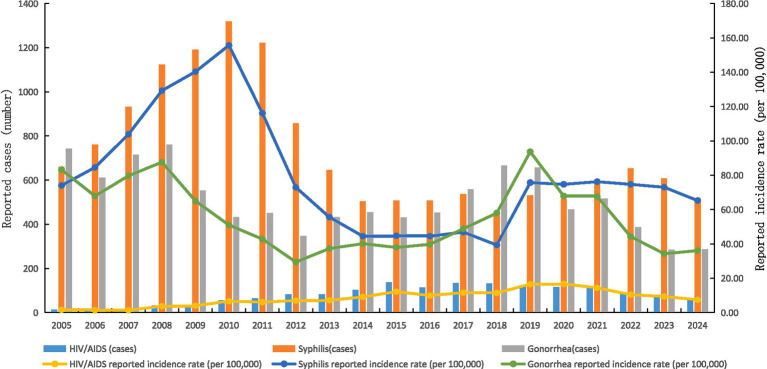 Figure 1
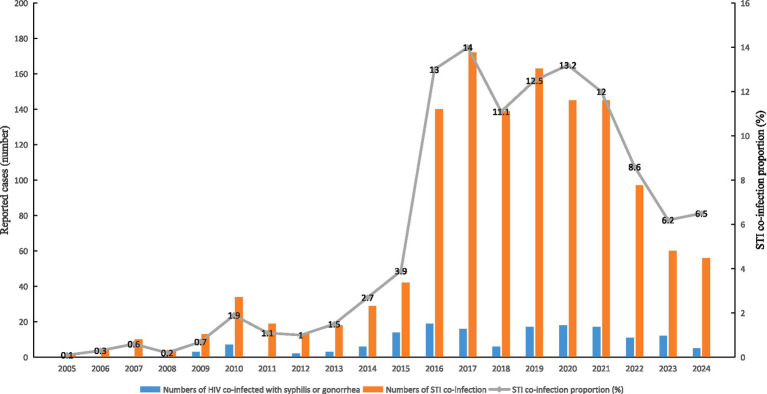 Figure 2
| Variables | Number of cases ( | STI co-infection | Univariate analysis | ||
|---|---|---|---|---|---|
| Number of cases | Proportion (%) | ||||
| Year | 1487.943 | <0.001 | |||
| 2005 | 1,416 | 1 | 0.1 | ||
| 2006 | 1,384 | 4 | 0.3 | ||
| 2007 | 1,659 | 10 | 0.6 | ||
| 2008 | 1,916 | 4 | 0.2 | ||
| 2009 | 1,777 | 13 | 0.7 | ||
| 2010 | 1,807 | 34 | 1.9 | ||
| 2011 | 1,735 | 19 | 1.1 | ||
| 2012 | 1,285 | 13 | 1.0 | ||
| 2013 | 1,162 | 18 | 1.5 | ||
| 2014 | 1,060 | 29 | 2.7 | ||
| 2015 | 1,075 | 42 | 3.9 | ||
| 2016 | 1,073 | 140 | 13.0 | ||
| 2017 | 1,229 | 172 | 14.0 | ||
| 2018 | 1,249 | 139 | 11.1 | ||
| 2019 | 1,304 | 163 | 12.5 | ||
| 2020 | 1,098 | 145 | 13.2 | ||
| 2021 | 1,208 | 145 | 12.0 | ||
| 2022 | 1,131 | 97 | 8.6 | ||
| 2023 | 970 | 60 | 6.2 | ||
| 2024 | 865 | 56 | 6.5 | ||
| Time period (year) | 1211.847 | <0.001 | |||
| 2005–2014 | 15,201 | 145 | 1.0 | ||
| 2015–2024 | 11,202 | 1,159 | 10.3 | ||
| Sex | 4.311 | 0.038 | |||
| Male individuals | 12,806 | 669 | 5.2 | ||
| Female individuals | 13,597 | 635 | 4.7 | ||
| Age | 33.102 | <0.001 | |||
| 15 ~ 19 | 6,291 | 397 | 6.3 | ||
| 20 ~ 24 | 20,112 | 907 | 4.5 | ||
| Current residence (in the past 6 months) | 48.167 | <0.001 | |||
| Ningbo | 24,987 | 1,183 | 4.7 | ||
| Other cities in Zhejiang province | 300 | 17 | 5.7 | ||
| Other provinces of China | 1,116 | 104 | 9.3 | ||
| Occupation | 132.615 | <0.001 | |||
| Catering and food industry/public venue attendants/workers/farmers/herdsmen/migrant workers/seafarers and long-distance drivers/fishermen (boatmen)/childcare workers and nannies/individual merchants/cadres and staff/teachers/retired personnel/scattered children | 15,039 | 542 | 3.6 | ||
| Housework and unemployed/detained personnel/commercial services/students/medical personnel | 11,364 | 762 | 6.7 | ||
| Marital status | 58.574 | <0.001 | |||
| Unmarried | 22,672 | 1,028 | 4.5 | ||
| Divorced or widowed | 65 | 2 | 3.1 | ||
| Married with spouse | 3,666 | 274 | 7.5 | ||
| Ethnicity | 0.828 | 0.406 | |||
| Han | 25,559 | 1,150 | 4.5 | ||
| Other ethnicities | 844 | 44 | 5.2 | ||
| Education level | 0.185 | 0.911 | |||
| Junior high school and below | 16,185 | 858 | 5.3 | ||
| High school or technical secondary school | 5,077 | 249 | 4.9 | ||
| Junior college and above | 5,141 | 226 | 4.4 | ||
| Household registration | 188.687 | <0.001 | |||
| Ningbo | 22,416 | 935 | 4.2 | ||
| Other cities in Zhejiang Province | 408 | 41 | 10.0 | ||
| Other provinces of China | 3,552 | 327 | 9.2 | ||
| Hong Kong/Macau/Taiwan/Foreign | 27 | 1 | 3.7 | ||
| Sexual contact history | 169.200 | <0.001 | |||
| Male–male sexual behavior history | 949 | 124 | 13.1 | ||
| Spouse/fixed partner positive | 195 | 21 | 10.8 | ||
| Heterosexual commercial behavior history | 2,024 | 118 | 5.8 | ||
| Heterosexual non-commercial behavior history | 271 | 22 | 8.1 | ||
| Other/unknown | 22,964 | 1,019 | 4.4 | ||
| Number of non-marital heterosexual partners | 30.221 | <0.001 | |||
| ≤1 | 25,670 | 1,236 | 4.8 | ||
| >1 | 733 | 68 | 9.3 | ||
| Number of male–male sexual partners | 152.705 | <0.001 | |||
| ≤1 | 25,625 | 1,192 | 4.7 | ||
| >1 | 778 | 112 | 14.4 | ||
| Number of injection drug use partners | - | 0.638 | |||
| ≤0 | 26,377 | 1,304 | 4.9 | ||
| >0 | 26 | 0 | 0 | ||
| Most likely transmission route | 147.714 | <0.001 | |||
| Male–male sexual transmission | 945 | 123 | 13.0 | ||
| Heterosexual transmission | 2,204 | 138 | 6.3 | ||
| Other/unknown | 23,254 | 1,043 | 4.5 | ||
| Blood sample source | 29.876 | <0.001 | |||
| PITC | 25,902 | 1,253 | 4.8 | ||
| VCT | 501 | 51 | 10.2 | ||
| Variables | ||
|---|---|---|
| Time period (year) | ||
| 2005–2014 | 1.000 | |
| 2015–2024 | 11.637 (9.740 ~ 13.905) | <0.001 |
| Sex | ||
| Male individuals | 1.000 | |
| Female individuals | 1.165 (1.037 ~ 2.310) | 0.010 |
| Occupation | ||
| Catering and food industry/public venue attendants/workers/farmers/herdsmen/migrant workers/seafarers and long-distance drivers/fishermen (boatmen)/childcare workers and nannies/individual merchants/cadres and staff/teachers/retired personnel/scattered children | 1.000 | |
| Housework and unemployed/detained personnel/commercial services/students/medical personnel | 1.310 (1.165 ~ 2.474) | <0.001 |
| Household registration | <0.001 | |
| Ningbo | 1.000 | |
| Other cities in Zhejiang province | 1.398(0.995 ~ 1.965) | 0.054 |
| Other provinces of China | 1.383(1.205 ~ 1.587) | <0.001 |
| Hong Kong/Macau/Taiwan/Foreign | 0.530(0.071 ~ 3.983) | 0.537 |
| Blood sample source | ||
| PITC | 1.000 | |
| VCT | 1.375 (1.015 ~ 3.863) | <0.001 |
Peer Reviews
No public reviews on file for this paper yet. If you reviewed it on a platform where reviews are public (OpenReview, ICLR, NeurIPS, ICML), you can paste yours below so the community can read it here.
Videos
No videos yet. Explain this paper in a talk, walkthrough, or lecture? Add one.
Taxonomy
TopicsSyphilis Diagnosis and Treatment · Adolescent Sexual and Reproductive Health · Reproductive tract infections research
Introduction
1
In recent years, the incidence of sexually transmitted infections (STIs), such as HIV/AIDS, syphilis, and gonorrhea, has exhibited a marked upward trend among adolescents and young adults aged 15–24 years. This trend is particularly evident in China and requires heightened attention from public health stakeholders (1). Data obtained from the National Notifiable Disease Reporting System indicate that newly diagnosed HIV cases in China rose from 9,373 in 2010 to 15,790 in 2019, reflecting an average annual growth rate of 6.0% (2). From 2010 to 2020, a total of 128,646 HIV/AIDS cases were reported nationwide among out-of-school youth aged 15–24 years, with the crude reporting rate increasing from 5.25 per 100,000 in 2010 to 13.75 per 100,000 in 2020 (3). This rise not only reflects improvements in testing coverage (4) but is also strongly linked to increased high-risk behaviors, including condomless sex and multiple sexual partners (5).
Moreover, the prevalence of STI co-infections in this demographic is on the rise, particularly the co-occurrence of HIV with syphilis or gonorrhea. This rise may intensify transmission dynamics and complicate treatment efforts (6). Evidence suggests that HIV/AIDS and syphilis co-infection rates among adolescents and young adults have surged over the past decade, especially in high-risk subgroups such as men who have sex with men (7). However, investigations into social networking patterns (e.g., online dating) (8) and infection risk factors among out-of-school youth remain limited (9), with current targeted interventions, testing, and educational initiatives providing insufficient coverage, thereby hindering the formulation of robust prevention strategies (10). For example, epidemiological surveys focused on out-of-school adolescents are scarce (11), and there is a dearth of targeted research on migrant populations and unemployed youth (12), highlighting the urgent need for studies on tailored prevention strategies to inform more effective intervention frameworks (13). This study used historical surveillance data from Ningbo to analyze the epidemiological profiles and risk factors for HIV, syphilis, and gonorrhea among adolescents and young adults aged 15–24 years, with the aim of providing scientific evidence for prevention and control measures (14).
Ningbo, as a representative coastal city in China, warrants focused scrutiny of STI infections in its adolescent and young adult population. The primary objective of this study was to delineate the epidemiological trends of HIV, syphilis, and gonorrhea among individuals aged 15–24 years in Ningbo from 2005 to 2024. In addition, the study aims to elucidate the associated factors contributing to co-infections. By conducting longitudinal tracking and analyzing infection data in this cohort, the study sought to offer foundational references for developing evidence-based intervention measures and prevention strategies.
Methods
2
Study participants
2.1
The inclusion criteria for this study are as follows: (1) newly diagnosed cases of HIV/AIDS, syphilis, or gonorrhea in Ningbo from 1 January 2005 to 31 December 2024. (2) In accordance with the requirements of the Law of the People’s Republic of China on the Prevention and Treatment of Infectious Diseases, informed consent was not required, and all confirmed STI cases were mandated to participate in the investigation.
Data source
2.2
A cross-sectional epidemiological survey was conducted. Trained personnel from the Center for Disease Control and Prevention carried out one-on-one, face-to-face interviews with participants after obtaining informed consent, utilizing the People’s Republic of China Notifiable Disease Reporting Card and a supplementary HIV/STI questionnaire. The questionnaire collected information on general demographics, high-risk behavior history, HIV testing history, local residency history, transmission routes, and receipt of relevant intervention services.
Relevant definitions
2.3
The yearly reported incidence rate of STIs was defined as the number of new HIV, syphilis, or gonorrhea cases reported in Ningbo (after excluding duplicates) divided by the annual resident population aged 15–24 years. The numerator was sourced from the China Information System for Disease Control and Prevention (CISDCP), based on reports from Ningbo. The denominator population data were obtained from the age statistics module of the Chinese infectious disease monitoring system.
STI co-infection was defined as the concurrent infection with two or more pathogens among newly reported STI cases, including HIV, syphilis, or gonorrhea, where the “confirmation detection positive date” variables for the respective pathogens (AIDS, syphilis, and gonorrhea) were the same, as confirmed by positive laboratory results (e.g., serological tests for syphilis/HIV and nucleic acid tests for gonorrhea) at diagnosis.
Sources of blood samples for newly diagnosed HIV/AIDS cases (hereafter “sample sources”) were classified as either provider-initiated HIV testing and counseling (PITC) or voluntary HIV counseling and testing (VCT).
Statistical analysis
2.4
Excel 2019 was utilized to stratify case data by diagnosis year, general demographic characteristics, sample sources, and transmission routes to evaluate STI co-infection trends. The data were then imported into the R 4.5.1 software. Temporal variations in the reported HIV, syphilis, and gonorrhea epidemics were assessed using linear regression models, while changes in STI co-infection prevalence and reported incidence rates were examined using chi-squared tests for trend. Univariate analyses and multivariate logistic regression were conducted to assess STI co-infection status, using grouping variables such as general demographic information, sexual contact history, transmission routes, and sample sources. Odds ratios (ORs) and 95% confidence intervals (CIs) were calculated to quantify the associations between independent variables and the outcome. All tests were two-tailed, with statistical significance set at a p-value of <0.05.
Data quality control and deduplication
2.5
To address potential reporting bias in long-term retrospective data, all cases were extracted from the China Information System for Disease Control and Prevention (CISDCP), which uses national ID-based automatic deduplication. Syphilis and gonorrhea cases were included only if the final review status was “confirmed” and the cases were reported in Ningbo. HIV cases from the Comprehensive HIV/AIDS Prevention and Control Information System (CRIMS) were merged using the same unique national ID and final review date. Data cleaning was performed independently by two senior epidemiologists (HJ and XZ) using R 4.5.1. Discrepancies were resolved by consensus with a third investigator (LY). Cases with missing national IDs or conflicting review dates were excluded (n = 41, 0.16%). Reporting completeness for syphilis/gonorrhea improved from ~70% in 2005–2010 to >95% after 2015, following national training programs (15, 16).
Results
3
Demographic and behavioral characteristics
3.1
From 2005 to 2024, the reported cases of HIV, syphilis, and gonorrhea among adolescents and young adults aged 15–24 years in Ningbo totaled 1,576 (6.0%), 14,623 (55.4%), and 10,204 (38.6%), respectively. The mean age of the reported cases was 21.2 ± 2.3 years, with 12,806 male individuals (48.5%), 25,559 of Han ethnicity (96.8%), 16,185 having a junior high school education or below (61.3%), 22,672 unmarried (85.9%), 24,987 currently residing in Ningbo (94.6%), 22,416 with household registration in Ningbo (84.9%), and occupations primarily consisting of housework and unemployment (7,951, 30.1%), farmers (5,055, 19.1%), and workers (2,694, 10.2%), including 885 students (3.4%).
The reported cases included 2,024 individuals with a history of heterosexual commercial sex (7.7%), 949 with a history of male–male sexual contact (3.6%), and 271 with a history of heterosexual non-commercial sex (1.0%). The number of non-marital heterosexual partners was ≥2 for 733 individuals (2.8%), the number of male–male sexual partners was ≥2 for 778 individuals (2.9%), and the number of shared injection drug use partners was ≥1 for 26 (0.1%). The most likely transmission route was heterosexual for 2,204 cases (8.3%), with the sample sources being provider-initiated testing and counseling (PITC) for 25,903 individuals (98.1%) (see Table 1).
Trends in the reported cases and incidence rates of HIV, syphilis, and gonorrhea
3.2
From 2005 to 2024, the co-infection rate of HIV, syphilis, and gonorrhea among adolescents and young adults aged 15–24 years in Ningbo was 4.9% (1,304/26,403). The number of reported HIV cases in this population increased from 14 in 2005 (reported incidence rate: 1.57 per 100,000) to 59 in 2024 (7.42 per 100,000), exhibiting a linear upward trend according to linear regression analysis (F = 16.071, p = 0.001). In addition, the reported HIV incidence rate showed an increasing trend (trend χ^2^ = 11.735, p = 0.001). The number of reported syphilis and gonorrhea cases decreased from 660 (74.00/100,000) and 742 (83.20/100,000) in 2005 to 519 (65.23/100,000) and 287 (36.07/100,000) in 2024, respectively. The reported syphilis incidence showed a downward trend (trend χ^2^ = 4.437, p = 0.035), while the gonorrhea trend was not significant (trend χ^2^ = 2.590, p = 0.108). This does not reflect a true decline in transmission but likely results from improved deduplication and reporting standardization after 2015 (see Discussion) (see Figure 1).
Trends in the reported cases and incidence rates of HIV, syphilis, and gonorrhea among adolescents aged 15–24 years in Ningbo, 2005–2024.
Co-infection status of HIV, syphilis, and gonorrhea
3.3
The number of reported HIV cases co-infected with other STIs (one or more) among adolescents and young adults aged 15–24 years increased from 0 in 2005 to 5 in 2024 (F = 17.688, p = 0.001). The number of co-infections (involving HIV, syphilis, and gonorrhea in two or more combinations) rose from 1 (0.1%) in 2005 to 56 (6.5%) in 2024 (F = 17.270, p = 0.001), with the co-infection proportion exhibiting an upward trend (trend χ^2^ = 10.854, p = 0.003) (see Figure 2).
Trends in the co-infection of HIV, syphilis, and gonorrhea among adolescents aged 15–24 years in Ningbo, 2005–2024.
Multivariate analysis of STI co-infection
3.4
Using STI co-infection as the dependent variable and demographic characteristics, reporting year, and sample source as independent variables, multivariate logistic regression analysis was performed. The results indicated that reporting year grouping, sex, occupation, household registration, and sample source were statistically significant predictors of STI co-infection (p < 0.05). The detailed results are presented in Table 2.
Discussion
4
Data from the Global Burden of Disease database indicate that the burden of STIs among adolescents and young adults in the Western Pacific region, including China, is increasing. Individuals aged 15–24 years represent a high-risk group for HIV, with syphilis and gonorrhea acting as risk factors for HIV acquisition (17). Based on data from the National Notifiable Disease Reporting System, our findings indicate an increasing incidence of reported HIV, syphilis, and gonorrhea cases among adolescents and young adults aged 15–24 years in Ningbo, consistent with trends observed in other municipalities (18). This escalation may primarily be attributed to a significant increase in HIV testing among this population, including higher testing among STI clinic attendees and expanded coverage across the general population (19). However, due to the lack of comprehensive multi-year data on HIV testing volumes in the 15–24 age group, further research is recommended to explore the associations between HIV testing strategies and epidemic growth in this demographic (20) to better elucidate the characteristics and underlying causes of epidemic changes.
This study found that the reported HIV incidence rate among adolescents and young adults aged 15–24 years in Ningbo increased from 1.57 per 100,000 in 2005 to 7.42 per 100,000 in 2024 (trend χ^2^ = 11.735, p = 0.001). This rise in HIV incidence may be linked to the growing prevalence of online dating (21), although this study did not specifically investigate dating patterns; future studies should incorporate such assessments to better understand transmission mechanisms. The reported incidence of syphilis showed a downward trend from 2005 to 2024, while gonorrhea followed a similar but non-significant pattern. This contrasts with national upward trends and does not indicate reduced transmission; rather, it likely reflects improved reporting quality. For example, duplicate reporting of syphilis decreased from ~25% in 2005–2010 to <5% after 2015 following national training programs and electronic card standardization (15, 16). In addition, a shift in testing venues, such as increasing gonorrhea diagnoses in private clinics (not fully reported to the CISDCP), may contribute to the apparent decline (22), alongside under-detection of asymptomatic gonorrhea, since routine dual testing is not universally implemented as it is for HIV. These artifacts are common in long-term surveillance and have been reported in Shenzhen and Hangzhou (18, 22), suggesting that the true incidence may be stable or rising. This underscores the need for sentinel surveillance with testing denominators.
The results of this study demonstrate that the co-infection proportion of STIs such as HIV, syphilis, and gonorrhea among adolescents and young adults aged 15–24 years in Ningbo from 2005 to 2024 was 4.9%, aligning with findings from related studies in cities such as Beijing (18, 22). This co-infection prevalence is consistent with levels reported in high-income countries (2–5%) and lower than that observed in low-income countries (5–15%) (17). Although the overall STI co-infection rate in Ningbo is relatively low, both HIV co-infection with other STIs and the multi-STI co-infection rate have shown upward trends, suggesting persistent STI transmission risks in this adolescent and young adult population, with the possibility of undetected latent infections (23). Targeted educational interventions should be implemented to enable the early identification of STI risks among adolescents and young adults.
Through the analysis of reported data, we identified multiple factors closely associated with STI co-infections in this adolescent and young adult population. Demographic characteristics such as reporting year, sex, occupation, and household registration exerted significant effects on STI co-infections. Notably, adolescents and young adults from other provinces, as well as those in high-risk occupations, such as housework and unemployment/detention/commercial services, exhibited higher co-infection proportions. This may be linked to elevated structural risks faced by these groups, including limited access to healthcare and lack of social support (24), consistent with literature on the impact of migration on epidemics (25). These findings imply that interventions should be multi-level, integrating local data to formulate precision-based strategies (26). In addition, this study highlights the importance of provider-initiated testing and counseling (PITC) by healthcare personnel for early STI detection. Promoting joint testing for HIV, syphilis, and gonorrhea in high-risk adolescents and young adults enables timely identification and intervention of infected individuals (4). Strengthening multi-pathogen co-testing and co-prevention strategies is recommended to effectively control STI transmission (17), thereby reducing transmission chains and improving prognosis (2). This evidence supports policy-level promotion, such as multi-disease screening programs at school and community levels (20).
This study has certain limitations, particularly the lack of in-depth epidemiological investigations into dating patterns for syphilis and gonorrhea, which may introduce bias in the assessment of risk factors. Downward trends in syphilis/gonorrhea likely reflect improved deduplication and under-reporting from private sectors rather than reduced incidence. Syphilis confirmation shifted from RPR-only (pre-2010) to TPPA/TPHA, potentially reducing false positives. The absence of testing volume data for syphilis/gonorrhea (unlike HIV) limits the interpretation of the reported incidence. It is recommended to conduct targeted epidemiological surveys among adolescents and young adults aged 15–24 years, including in-depth interviews, to better understand true transmission risk relationships (18). Future research could employ longitudinal cohort designs, incorporate big data analytics to track long-term trends, and expand variable scopes to include rural and remote areas (2). These approaches will provide a robust foundation for developing more effective intervention strategies (27).
Conclusion
5
This study examined the epidemiological trends and associated factors of HIV, syphilis, and gonorrhea co-infections among adolescents and young adults aged 15–24 years in Ningbo from 2005 to 2024. The reported HIV incidence showed an upward trend, while syphilis and gonorrhea incidences declined, with an overall co-infection prevalence of 4.9% and increasing multi-STI combinations. Key predictors included reporting year, sex, occupation, household registration, and sample source, highlighting vulnerabilities in high-risk subgroups such as male individuals, non-local residents, and individuals in occupations such as housework or unemployment. These findings underscore the need for targeted interventions, including enhanced STI education, behavioral strategies, and expanded provider-initiated testing and counseling, to mitigate the escalating STI burden in this population.
The reference list from the paper itself. Each links out to its DOI / PubMed record.
- 1Wang RZ Sun YN Wang H Yu XR Ma JY Liu Z . Progress on HIV and other sexually transmitted infections elimination among youth and adults across BRICS-plus countries: results from the global burden of disease study 2021. J Infect Public Health. (2025) 18:102625. doi: 10.1016/j.jiph.2024.102625, 39732057 · doi ↗ · pubmed ↗
- 2Zhao H Liu H Wang X Yang X Wang SR Han MJ . Epidemiological characteristics of newly-reported HIV cases among youth aged 15-24 years - China, 2010-2019. China CDC Wkly. (2020) 2:913–6. doi: 10.46234/ccdcw 2020.24934594799 PMC 8422364 · doi ↗ · pubmed ↗
- 3Wang SR Wang JJ Xu P Lyu WT Han MJ Wang S . Spatial analysis of HIV/AIDS cases among out-of-school youth aged 15–24 years – China, 2010–2020. China CDC Wkly. (2021) 3:1015–7. doi: 10.46234/ccdcw 2021.247, 34888117 PMC 8633549 · doi ↗ · pubmed ↗
- 4Wang SW Chen JL Li YS Zhang BB Li X Han Y . Trends in sexually transmitted and blood-borne infections in China from 2005 to 2021: a joinpoint regression model. BMC Infect Dis. (2023) 23:741. doi: 10.1186/s 12879-023-08733-8, 37904156 PMC 10614345 · doi ↗ · pubmed ↗
- 5Li YZ Xu JJ Reilly KH Zhang JM Wei HY Jiang YJ . Prevalence of HIV and syphilis infection among high school and college student MSM in China: a systematic review and meta-analysis. P Lo S One. (2013) 8:e 69137. doi: 10.1371/journal.pone.0069137, 23874891 PMC 3712943 · doi ↗ · pubmed ↗
- 6Xu JJ Han XX Reilly KH Shang H Xu J Han X. New features of the HIV epidemic among men who have sex with men in China. Emerg Microbes Infect. (2013) 2:e 45. doi: 10.1038/emi.2013.45, 26038478 PMC 3820985 · doi ↗ · pubmed ↗
- 7Chen XS Yin YP Liang GJ Gong XD Li HS Gills P . Sexually transmitted infections among female sex workers in Yunnan, China. AIDS Patient Care ST Ds. (2005) 19:853–60. doi: 10.1089/apc.2005.19.85316375618 · doi ↗ · pubmed ↗
- 8Balaji AB Bowles KE Le BC Paz-Bailey G Oster AMNHBS Study Group. High HIV incidence and prevalence and associated factors among young MSM, 2008. AIDS. (2013) 27:269–78. doi: 10.1097/QAD.0b 013e 32835 ad 489, 23079807 PMC 5098328 · doi ↗ · pubmed ↗