Shiitake mushroom-induced flagellate erythema
Dimitrios Karponis, Zoe C Venables

Abstract
Genes, proteins, chemicals, diseases, species, mutations and cell lines named across the full text — each resolved to its canonical identifier and authoritative record.
Click any figure to enlarge with its caption.
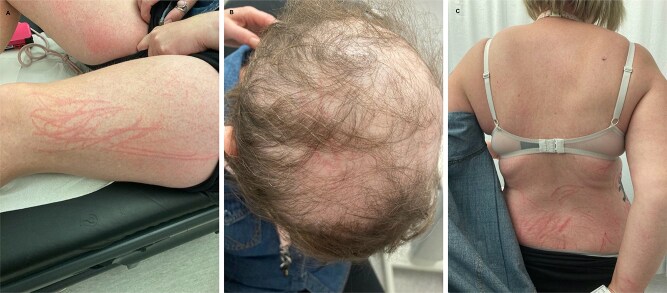 Figure 1
Peer Reviews
No public reviews on file for this paper yet. If you reviewed it on a platform where reviews are public (OpenReview, ICLR, NeurIPS, ICML), you can paste yours below so the community can read it here.
Videos
No videos yet. Explain this paper in a talk, walkthrough, or lecture? Add one.
Taxonomy
TopicsChemotherapy-related skin toxicity · Chemotherapy-induced cardiotoxicity and mitigation · Cancer Treatment and Pharmacology
A 38 year old female presented with generalised pruritus for 5 days followed by dermatographism and widespread, non-blanching, linear erythema for 2 days, starting on her thighs (Fig. 1A), involving the scalp (Fig. 1B) and sparing areas out of reach (Fig. 1C). Symptoms appeared 2 days after ingestion of stir-fried Shiitake mushrooms. Her background included chronic myeloid leukaemia treated with allogeneic stem cell transplant and tyrosine kinase inhibitors 10 years ago, and radiotherapy for atypical meningiomas. Of relevance to this presentation, there was no exposure to bleomycin, peplomycin or docetaxel. History and investigations (serum autoantibodies and myositis panels) excluded dermatomyositis, adult-onset Still’s disease and recent viral illness, other causes of flagellate erythema. Symptomatic treatment with topical betamethasone valerate and oral fexofenadine resulted in complete resolution of the rash and pruritus after 2 weeks. In summary, consumption of raw or undercooked Shiitake mushrooms is an important cause of flagellate dermatitis. This usually appears within 1–3 days and resolves within 3 weeks of consumption. Treatment is symptomatic with oral antihistamines and topical corticosteroids. It is entirely preventable by adequately heating the Shiitake mushrooms to at least 130–145°C, to inactivate the causative polysaccharide, lentinan.