Taxonomic notes on Neocinnamomum (Lauraceae): a new combination and a new species from southwestern China

Abstract
Genes, proteins, chemicals, diseases, species, mutations and cell lines named across the full text — each resolved to its canonical identifier and authoritative record.
Click any figure to enlarge with its caption.
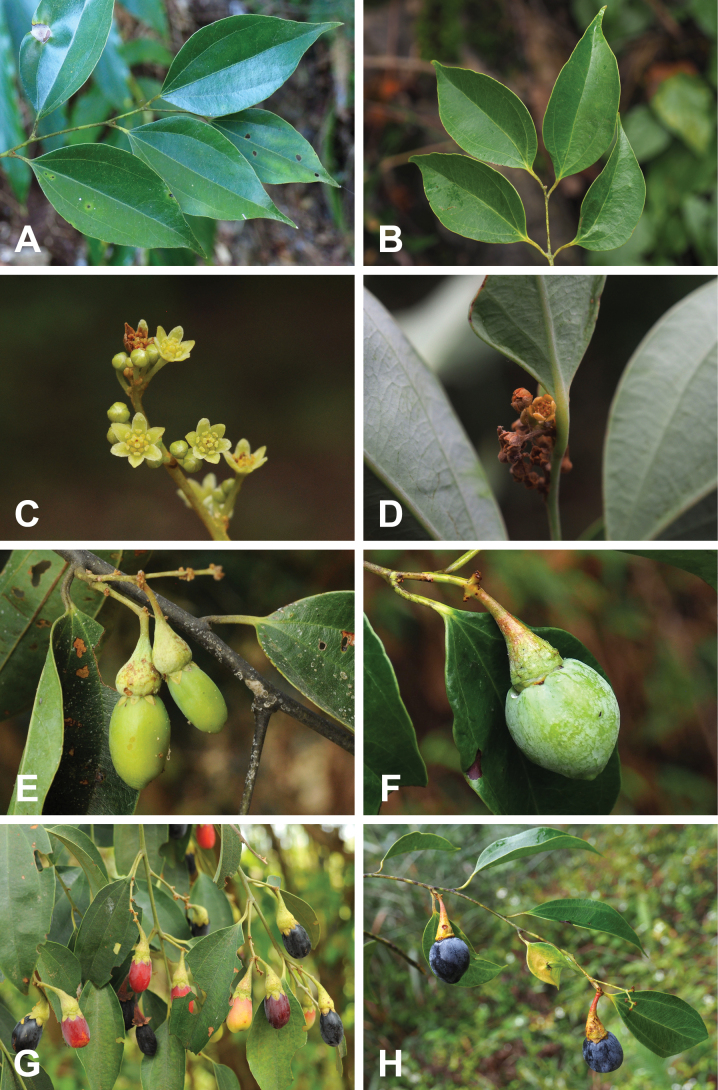 Figure 1
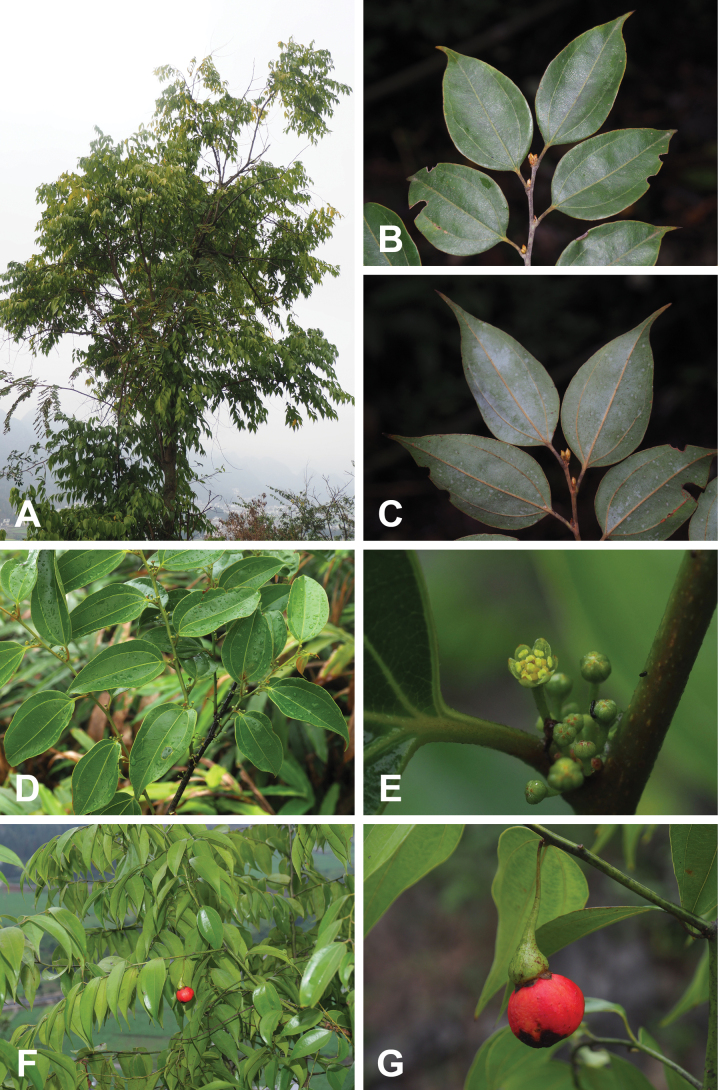 Figure 2
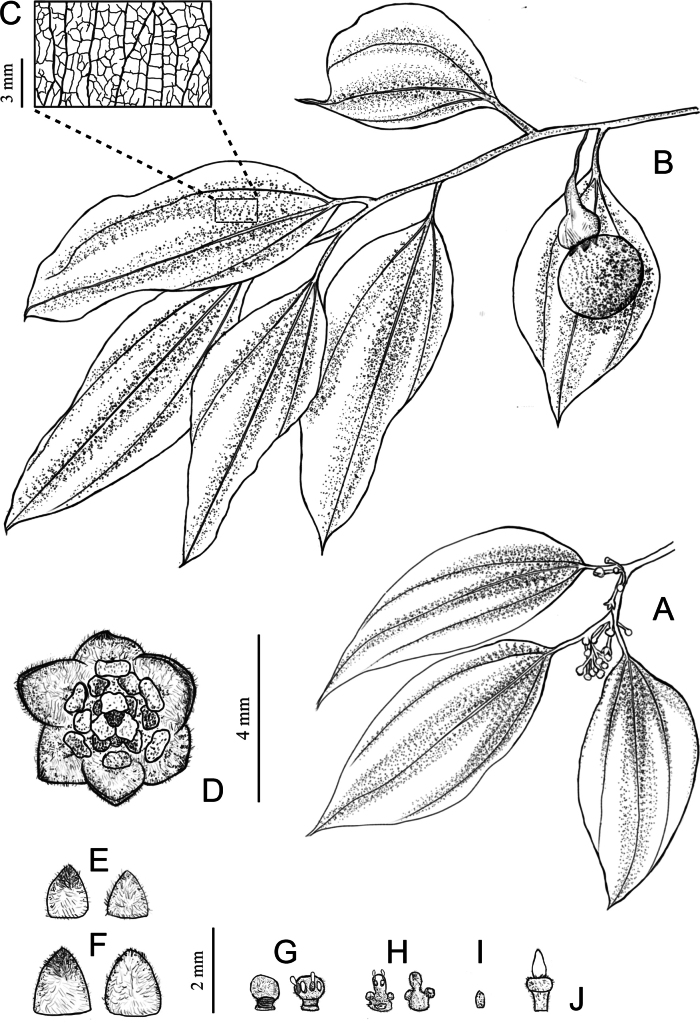 Figure 3
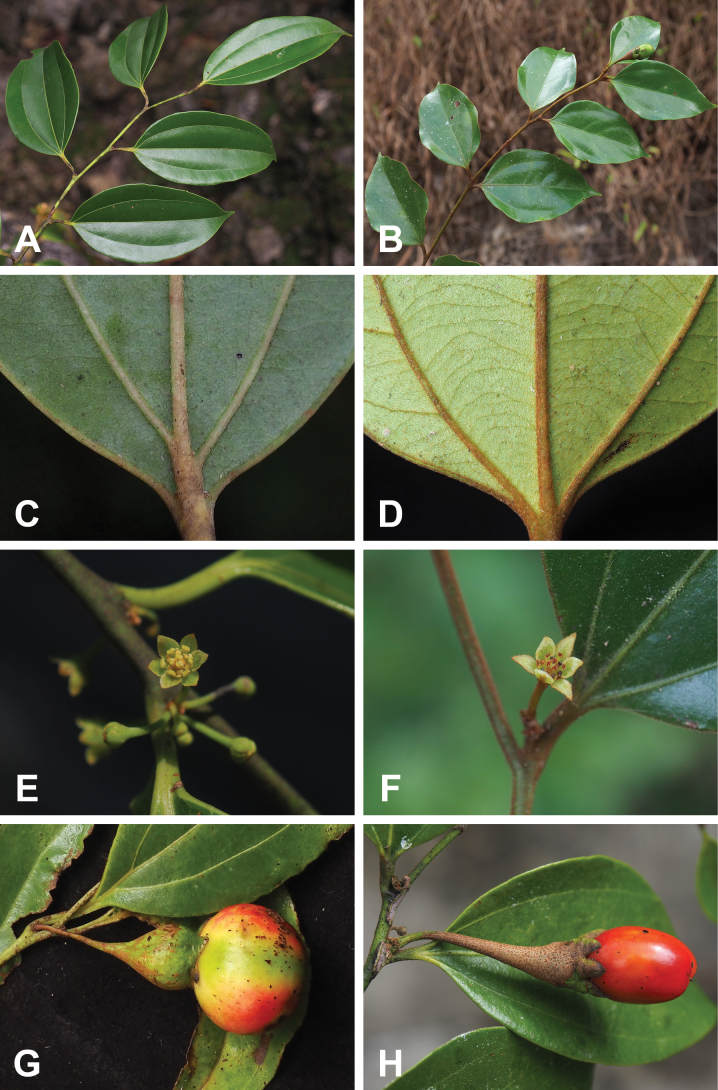 Figure 4
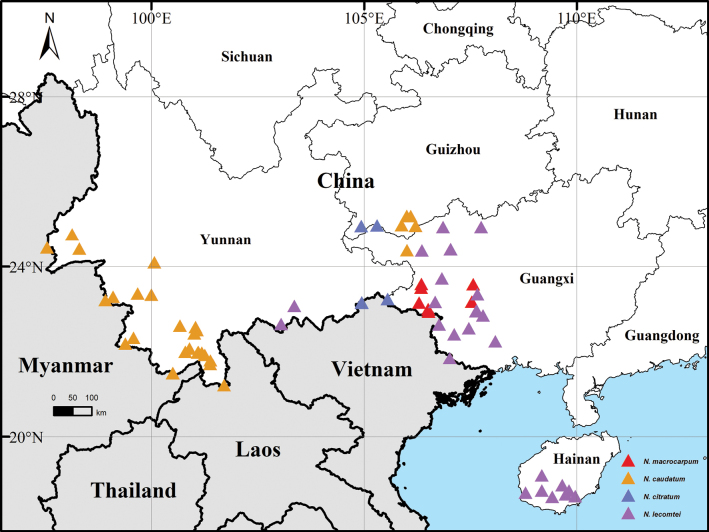 Figure 5
| Character |
|
|
|
|
|---|---|---|---|---|
| Branchlet | puberulent to glabrous | puberulent to glabrous | rusty or white pubescent but soon glabrous | densely pubescent initially but puberulent when mature |
| Leaf pubescence | glabrous on both surfaces | glabrous on both surfaces | sparsely white sericeous on abaxial surface when young and glabrous on both surfaces when mature | densely rusty pubescent on both surfaces when young and abaxially when mature |
| Leaf blade size (cm) | 3–9 × 2.5–7 | 4–12 × 2–4.5 | 3.5–13 × 1.5–5.3 | (5.5–) 8–12 × (2.5–) 4–7.5 |
| Leaf vein | triplinerved | trinerved | trinerved | trinerved |
| Inflorescence | cymules axillary or rarely arranged in terminal panicles | panicle terminal and axillary | cymules axillary, rarely terminal | cymules axillary |
| Flower size (mm) | 3–4 | 6–8 | 4–4.5 | 4–4.5 |
| Tepals pubescence | rusty puberulent on two sides | rusty puberulent on two sides | densely rusty puberulent on two sides | densely rusty puberulent on two sides |
| Fruit shape | widely ovoid | narrowly ellipsoid | oblate to globose | ellipsoid |
| Fruit size (cm) | 2–3 × 1.6–2.8 | 1.5–2 × 0.8–1 | 1.5–2 × 1.5–3 | 1.5–2.5 × 0.9–2 |
- —National Natural Science Foundation of China 501100001809 https://ror.org/01h0zpd94 http://doi.org/10.13039/501100001809
Peer Reviews
No public reviews on file for this paper yet. If you reviewed it on a platform where reviews are public (OpenReview, ICLR, NeurIPS, ICML), you can paste yours below so the community can read it here.
Videos
No videos yet. Explain this paper in a talk, walkthrough, or lecture? Add one.
Taxonomy
TopicsPlant Diversity and Evolution · Plant and Fungal Species Descriptions · Plant and animal studies
Introduction
The family Lauraceae is the largest family in the clade magnoliids, currently containing 63 genera and more than 3,300 species, of which only the genus Cassytha L. is a semiparasitic twiner, while the rest are trees or shrubs (Rohwer 1993; Li et al. 2025). Lauraceae are widely distributed in tropical and subtropical regions of the world, with the main centers of diversity located in tropical Asia and tropical America (Rohwer 1993; Chanderbali et al. 2001). There are about 25 genera and 445 species in China, including 316 endemic species, with a high endemism of 71%, many of which are narrowly distributed species (Li et al. 2008a).
Neocinnamomum H. Liu was established by Liu in 1934 based on the presence of four anther sacs arranged horizontally (Liu 1934). It is a small genus in the Perseeae group of the Lauraceae family, containing seven known species (including one variety) distributed in tropical and subtropical Asia (Kostermans 1974; Li et al. 1982, 2008b; Xu et al. 2017). Species of the genus are characterized as evergreen trees or shrubs; leaves alternate, with blades trinerved (the two lateral nerves arising from near the leaf blade base) or triplinerved (the two lateral nerves arising from the midrib above the leaf blade base by more than 0.5 cm); small cymules composed of one to multiple flowers, remotely arranged in an axillary or terminal panicle or solitary in leaf axils; flowers 3-merous, bisexual, with a very short perianth tube; anthers 4-celled, arranged in an almost transverse series; and enlarged cupules with persistent tepals, which together with the fruit form a gourd-like structure. The systematic position of Neocinnamomum within the Lauraceae family was not confirmed until recently. Previous studies have shown that Neocinnamomum, Cassytha, and Caryodaphnopsis are closely related and that all three represent isolated lineages within Lauraceae (Li et al. 2016; Song et al. 2017, 2020; Liu et al. 2021; Yang et al. 2023, 2025). Their systematic position lies between the tribe Cryptocaryeae and the core group of the Lauraceae family. Song et al. (2020) proposed a tribal classification for Lauraceae and established a new tribe, Neocinnamomeae, which consists of the single genus Neocinnamomum and was subsequently recognized by Li et al. (2025).
Several new members of Neocinnamomum were published after its establishment (Merrill 1934; Allen 1939; Kostermans 1974; Wei 1988; De Kok 2023). Neocinnamomum caudatum (Nees) Merr. was published by Merrill in 1934 based on Cinnamomum caudatum Nees and is characterized by numerous transverse veins on the leaf blade that are subhorizontal and subparallel, connected by remote vertical veinlets and forming a transversely elongate reticulum; trinerved leaves; inflorescences consisting of numerous, remote cymules arranged into a developed axillary or terminal panicle; and narrowly ellipsoid fruits, 1.5–2 × 0.8–1 cm, red when ripe (Merrill 1934; Li et al. 1982). In 2017, a variety, Neocinnamomum caudatum var. macrocarpum Wen B. Xu & B.S. Xia, was published based on specimens collected from Debao County, Guangxi Province, southwestern China (Xu et al. 2017). This variety differs from N. caudatum mainly by its triplinerved leaf blades and fruit shape.
We conducted field investigations in southwestern China (Guangxi, Yunnan, and Guizhou provinces) and collected a number of specimens bearing both flowers and fruits of Neocinnamomum. Our new investigations and observations have demonstrated the necessity of taxonomic changes. First, we observed significant differences between N. caudatum var. macrocarpum and N. caudatum var. caudatum, beyond fruit shape and leaf blade venation. This is corroborated by a recent plastome phylogenomic study, which showed that this variety alone forms a clade and is not nested within N. caudatum var. caudatum (Cao et al. 2023). Moreover, in addition to the type locality, we discovered multiple distribution locations of N. caudatum var. macrocarpum in Guangxi Province. We therefore elevate N. caudatum var. macrocarpum to species rank and name it Neocinnamomum macrocarpum (Wen B. Xu & B.S. Xia) Bing Liu, Wei L. Lin & Wen B. Xu. Second, we collected a notable species of Neocinnamomum that has a strong lemon fragrance in its branches and leaves, which clearly distinguishes it from other known species of the genus. Further morphological studies indicate that this taxon represents a new species of Neocinnamomum. As a result, we describe this species here as new to science.
Materials and methods
Morphology and anatomy
We conducted several field investigations in southern China, including Guangxi, Guizhou, Yunnan, and Hainan, in December 2024 and January and May 2025. Voucher specimens were collected, flowers were preserved in FAA for morphological observations, and leaf materials were dried with silica gel for DNA extraction. Photographs of vegetative and reproductive characters were taken using an Olympus EM One Mark II. Preserved flowers were dissected and observed, and photographs were taken under a stereo microscope (Leica S8 APO) at the State Key Laboratory of Plant Diversity and Specialty Crops, Institute of Botany, Chinese Academy of Sciences.
Figure treatments
Line drawings were produced manually using black ink. Line drawings and figures showing morphological characters were edited and merged using Adobe Photoshop CS2 ver. 9.0. The distribution map was generated using ArcMap ver. 10.0 and Microsoft Paint (Windows 10).
Taxonomic treatment
Neocinnamomum
macrocarpum
Taxon classificationPlantaeLauralesLauraceae
(Wen B.Xu & B.S.Xia) Bing Liu, Wei L. Lin & Wen B. Xu, comb. et stat. nov.
A8F987F7-6AC1-56C5-B124-55E8CE02F27F
urn:lsid:ipni.org:names:77375095-1
Basionym.
Neocinnamomum caudatum var. macrocarpum Wen B. Xu & B.S. Xia, Guihaia, 37: 856. 2017.
Side-by-side morphological comparison of Neocinnamomum caudatum (ACEG) and Neocinnamomum macrocarpum (BDFH). A, B. Branch and leaves; C, D. Inflorescence; E, F. Young fruits; G, H. Mature fruits.
Type.
China. Guangxi Province • Debao County, Dongling; 25 Nov 2014; fruit; Shou-Jun Zhang & Wen-Bin Xu 140607 (holotype: HIB!).
Additional specimens examined.
China. Guangxi Province • Debao County, Dongling; 1 Aug 2016; flower; Wen-Bin Xu & Bo-Shun Xia 160801 (paratype, HIB!), Wen-Bin Xu & Bo-Shun Xia 160802 (paratype: HIB!); • Long’an County, Dujie, Sanle, Zhusha; 8 Dec 2024; fruit; Bing Liu, Wei-Lan Lin, Zhi Yang 17840, 17842, 17843 (PE); • Long’an County, Dujie, Sanle, Zhusha; 14 May 2025; flower; Bing Liu, Wei-Lan Lin, Zhi-Yong Tang 18478 (PE); • Debao County, Dongling, Duomo, Duoli; 9 Dec 2024; fruit; Bing Liu, Wei-Lan Lin, Zhi Yang 17850, 17855 (PE); • Debao County, Dongling, Duole; 9 Dec 2024; fruit; Bing Liu, Wei-Lan Lin, Zhi Yang 17856, 17857 (PE); • Pingguo City, Haicheng, Yongliang, Longhe; 21 Jan 2025; Bing Liu, Wei-Lan Lin 18132 (PE); • Jingxi City, Ande, Xincun; 10 Nov 1956; Yin-Kun Li P00834 (PE); • Jingxi City, Yuexu, Xiamin; 20 Aug 2021; Xi-Tao Li, Huan Xiao ZYA01534 (PE); • Jingxi City, Huadong, Lixing; 1 Jun 2021; Shi-Yue Nong, Qiu-Yan Lu ZYB00171 (PE); • Jingxi City, Huadong, Wuquan, Quantun; 10 Dec 2024; fruit; Bing Liu, Wei-Lan Lin, Zhi Yang 17877, 17878, 17879 (PE); • Jingxi City, Huadong, Wuquan, Quantun; 15 May 2025; flower; Bing Liu, Wei-Lan Lin, Zhi-Yong Tang 18517, 18519 (PE).
Notes.
Neocinnamomum caudatum var. macrocarpum was published as a variety of N. caudatum. The two taxa share several characters, such as puberulent branchlets, glabrous leaf blades with numerous transverse veins, and dark purple fruits when mature. However, morphological differences indicate that N. caudatum var. macrocarpum should be elevated to species rank, namely N. macrocarpum. The main differences between the two species lie in leaf blade venation, inflorescence structure, flower size, and fruit shape. N. macrocarpum differs from N. caudatum by its triplinerved leaves (vs. trinerved leaves), axillary cymules or cymules rarely arranged in terminal panicles (vs. numerous cymules arranged in both axillary and terminal panicles), small flowers (3–4 mm in diameter vs. 6–8 mm in diameter), and widely ovoid fruits (2–3 × 1.6–2.8 cm vs. narrowly ellipsoid fruits, 1.5–2 × 0.8–1 cm) (Table 1).
Table 1.: A morphological comparison among Neocinnamomum macrocarpum, N. caudatum, N. citratum, and N. lecomtei.
The native range of N. macrocarpum is considerably larger than its type locality. Based on our field investigations, this species is widely distributed in southwestern Guangxi (Fig. 5, red triangles). Moreover, N. macrocarpum grows on limestone mountains, whereas N. caudatum occurs on granite or other non-limestone mountains.
Neocinnamomum
citratum
Taxon classificationPlantaeLauralesLauraceae
C.Y.Deng, Bing Liu & Wei L.Lin sp. nov.
E863C4D9-C339-5A29-BD73-AAEB71A75FB8
urn:lsid:ipni.org:names:77375096-1
Type.
China. Guizhou Province • Qianxinan Buyi and Miao Autonomous Prefecture, Xingyi City, Wanfenglin, Wanfu Village; alt. ca. 1178 m elev.; 17 Dec 2024; fruit; Bing Liu, Wei-Lan Lin, Zhi Yang & Chao-Yi Deng 17921 (holotype: PE!; isotypes: PE!).
Morphology of Neocinnamomum citratum sp. nov. A. Habit; B. Adaxial view of leaf blade; C. Abaxial view of leaf blade; D. Flowering branch; E. Inflorescence; F. Fruiting branch; G. A fruit with persistent perianth lobes.
Diagnosis.
This new species is close to N. lecomtei but differs from sparsely white sericeous leaf blade on abaxial surface when young and glabrous when mature (vs. densely rusty pubescent on both surfaces when young and abaxially when mature) and oblate to globose fruits (vs. ellipsoid fruits), as well as its strong lemon fragrance of branches, leaves, and bark (vs. faint fragrance in the latter species).
Illustrations of Neocinnamomum citratum sp. nov. showing morphological details. A. Flowering branch; B. Fruiting branch; C. Leaf blade venation; D. A flower showing the spreading perianth lobes and four whorls of stamens; E. Abaxial (left) and adaxial (right) views of outer perianth lobes; F. Abaxial (left) and adaxial (right) views of inner perianth lobes; G. Abaxial (left) and adaxial (right) sides of fertile stamens of the first and second whorls; H. Abaxial (right) and adaxial (left) sides of fertile stamens of the third whorl; I. The fourth-whorl staminode; J. Pistil. Drawn by Zi-Yi Zhang.
Description.
Trees, 4.5–20 m tall. Bark yellowish brown, old bark gray. Branchlets terete, rusty, or white pubescent initially but soon glabrous. Leaves alternate. Petiole 0.6–1.4 cm long, rusty, or white tomentose when young. Leaf blade papyraceous, narrowly ovate to ovate, 3.5–13 × 1.5–5.3 cm, apex acuminate, base acuminate to obtuse; sparsely white sericeous on abaxial surface when young and glabrous on both surfaces when mature, abaxially white farinose, trinerved, secondary lateral veins inconspicuous, veinlets densely reticulate. Inflorescences cymules, axillary, rarely terminal, with 2 to more than ten flowers, peduncle 0.2–4 mm long, pedicels 0.5–1.0 cm long, peduncle and pedicels rusty pubescent. Bracts subulate, 1.5 mm long, densely rusty puberulent. Flowers bisexual, yellowish green, ca. 4 mm in diam. Perianth lobes 6, subequal, triangular-ovate, ca. 1.2–1.5 mm long, densely rusty puberulent outside and inside. Fertile stamens 9, ca. 1 mm long, rusty puberulent; filaments as long as anthers, those of 3^rd^ whorl each with 2 glands, others glandless; those of 1^st^ and 2^nd^ whorls each with 2 introrse cells and 2 lateral cells, 4 oval cells arranged in an almost transverse series; those of 3^rd^ whorl each with 2 extrorse cells and 2 lateral cells. Staminodes ovoid, ca. 0.4 mm long, nearly estipitate. Ovary ellipsoid-ovoid, ca. 0.8 mm long. Style short, stigma discoid. Fruit oblate to globose, 1.5–2 × 1.5–3 cm, red when mature. Perianth cup in fruit crateriform, 0.6–1 cm wide on top; perianth lobes in fruit persistent.
Side-by-side morphological comparison of Neocinnamomum citratum (ACEG) and Neocinnamomum lecomtei (BDFH). A, B. Branch and leaves; C, D. Abaxial surface of leaf blade base; E, F. Inflorescence; G, H. Mature fruits.
Distribution.
Southwestern China (Guangxi, Guizhou, Yunnan) (Fig. 5, blue triangles).
Map showing the distribution of Neocinnamomum caudatum (yellow), N. macrocarpum (red), N. citratum (blue), and N. lecomtei (purple).
Habitat.
This species occurs in evergreen forests of limestone mountains with an altitudinal range of 1000 to 1300 m. It blooms in May and June, and the fruits are mature during September and December.
Etymology.
The specific epithet “citratum” refers to the strong lemon fragrance of the branches, leaves, and bark of this species.
Additional specimens examined (paratypes).
CHINA. Guangxi Province • Napo County, Baidu, Nonghua, Nongbu; 16 May 2025; flower; Bing Liu, Wei-Lan Lin, Zhi-Yong Tang 18531 (PE!, KUN!, CSH!), 18535 (PE!). Guizhou Province • Anlong County, Dewo, Tingxi; 18 Sep 1991; fruit; Chao-Yi Deng 50462 (KUN!); • Anlong County, Dewo, Dewo Village; 28 April 2025; flower; Chao-Yi Deng 20250428001 (XIN!); • Xingyi City, Wanfenglin, Wanfu Village; 11 May 2025; flower; Chao-Yi Deng 20250511001 (XIN!, PE!, KUN!); • Anlong County, Panlong, Yangjiawan; 13 May 2025; cultivated, flower; Bing Liu, Wei-Lan Lin, Zhi-Yong Tang 18456 (PE!). Yunnan Province • Malipo County, Babu, Nadeng, Danong; 14 Oct 2010; fruit; Bing Liu 1175 (PE!); • Malipo County, Babu, Nadeng, Danong; 15 Dec 2024; fruit; Bing Liu, Wei-Lan Lin, Zhi Yang, Chao-Yi Deng 17901 (PE!, KUN!, CSH!); • Malipo County, Babu, Nadeng, Danong; 18 May 2025; flower; Bing Liu, Wei-Lan Lin, Zhi-Yong Tang 18563 (PE!, KUN!, CSH!), 18565 (PE!, CSH!), 18567 (PE!).
Uses.
The branches, leaves, and bark of Neocinnamomum citratum have a strong lemon fragrance. Therefore, its leaves and branches are collected by the local people in Malipo County and used as spices for cooking.
Conservation.
There are five populations with more than 100 individuals. Based on IUCN Red List Categories and Criteria (IUCN 2024), the new species is categorized as “Not Threatened” (NT Blab (v) + D).
Notes.
The new species has a strong lemon fragrance in its branches, leaves, and bark, whereas other species of Neocinnamomum have only a faint fragrance. The rusty pubescence on the branchlets and the sparsely white sericeous pubescence on the abaxial surface of the leaf blade when young, becoming glabrous when mature, distinguish it from N. caudatum, N. fargesii, N. macrocarpum, and N. mekongense, which are nearly glabrous, as well as from N. delavayi and N. lecomtei, which are densely pubescent on both leaf surfaces when young and abaxially when mature. The oblate to globose fruits also distinguish this species from the ellipsoid to narrowly ellipsoid fruits of N. caudatum and N. lecomtei and from the ovoid to ellipsoid-ovoid fruits of N. fargesii, N. delavayi, N. macrocarpum, and N. mekongense (Table 1).
Supplementary Material
XML Treatment for Neocinnamomum macrocarpum
XML Treatment for Neocinnamomum citratum
The reference list from the paper itself. Each links out to its DOI / PubMed record.
- 1Allen CK (1939) Studies in the Lauraceae. II: Some critical and new species of Cinnamomum and Neocinnamomum.Journal of the Arnold Arboretum 20(1): 44–63. 10.5962/p.324598 · doi ↗
- 2Cao ZY Yang LY Xin YX Xu WB Li QS Zhang HR Tu YX Song Y Xin PY (2023) Comparative and phylogenetic analysis of complete chloroplast genomes from seven Neocinnamomum taxa (Lauraceae). Frontiers in Plant Science 14: 1205051. 10.3389/fpls.2023.1205051 PMC 1036244737484476 · doi ↗ · pubmed ↗
- 3Chanderbali AS Hvan der Werff H Renner SS (2001) Phylogeny and historical biogeography of Lauraceae: evidence from the chloroplast and nuclear genomes.Annals of the Missouri Botanical Garden 88: 104–134. 10.2307/2666133 · doi ↗
- 4De Kok RPJ (2023) The Lauraceae Juss. of Indo-China: Fifteen new species, four new combinations and two neotypifications.Adansonia 45(1): 1–25. 10.5252/adansonia 2023 v 45a 1 · doi ↗
- 5IUCN (2024) Guidelines for using the IUCN Red List Categories and Criteria. Version 16. http://www.iucnredlist.org/documents/Red List Guidelines.pdf
- 6Kostermans AJGH (1974) A monograph of the genus Neocinnamomum Liou Ho.Reinwardtia 9: 85–96.
- 7Li HW Pai PY Li YR Lee SK Wei FN Wei YT Yang YC Huang PH Tsui HP Shia ZD Li JL (1982) Lauraceae. In: Li HW (Ed.) Flora Reipublicae Popularis Sinicae, vol.31. Science Press, Beijing, 1–463.
- 8Li HW Li J Huang PH Wei FN Tsui H Pvan der Werff H (2008 a) Lauraceae. In: Wu ZY Raven PH Hong DY (Eds) Flora of China, vol.7. Science Press & Missouri Botanical Garden Press, Beijing & St. Louis, 102–254.