Prolonged exciton lifetime via conjugation-length engineering in M-series acceptors for 19.39% efficiency polymer solar cells
Wenxiong Shen, Xiaoying Xiong, Dongdong Cai, Li Liu, Junlu Lin, Shuo Wan, Jin-Yun Wang, Yi Li, Yunlong Ma, Huiting Fu, Chunfeng Zhang, Qingdong Zheng

TL;DR
Researchers developed new non-fullerene acceptors with improved efficiency and stability for polymer solar cells.
Contribution
The study introduces dimerized M-series acceptors with extended conjugation and enhanced exciton lifetime.
Findings
DM-8F achieved 19.39% efficiency in small-area solar cells and 15.72% in minimodules.
DM-8F-based devices showed better thermal and photostability compared to M68-based devices.
Halogen atoms in terminal groups significantly influenced π–π-packing and photovoltaic performance.
Abstract
Developing non-fullerene acceptors (NFAs) that combine high device efficiency with superior stability remains a significant challenge. Based on M-series acceptors featuring an acceptor-donor-acceptor (A-D-A)-type framework, we report two dimerized NFAs (DM-8F and DM-8Cl) containing different halogen atoms in their terminal groups. Compared to the small-molecule acceptor M68, both dimerized acceptors exhibit increased glass transition temperatures and enlarged dielectric constants. The choice of halogen atoms in the terminal groups significantly affects their π–π-packing distances, exciton diffusion lengths, and ultimately, photovoltaic performance. Owing to enhanced charge transport, reduced exciton binding energy, and extended exciton diffusion length, DM-8F achieves an efficiency of 19.39% (certified at 19.20%) in small-area polymer solar cells (PSCs) and 15.72% in minimodules with an…
Genes, proteins, chemicals, diseases, species, mutations and cell lines named across the full text — each resolved to its canonical identifier and authoritative record.
Click any figure to enlarge with its caption.
 Scheme 1
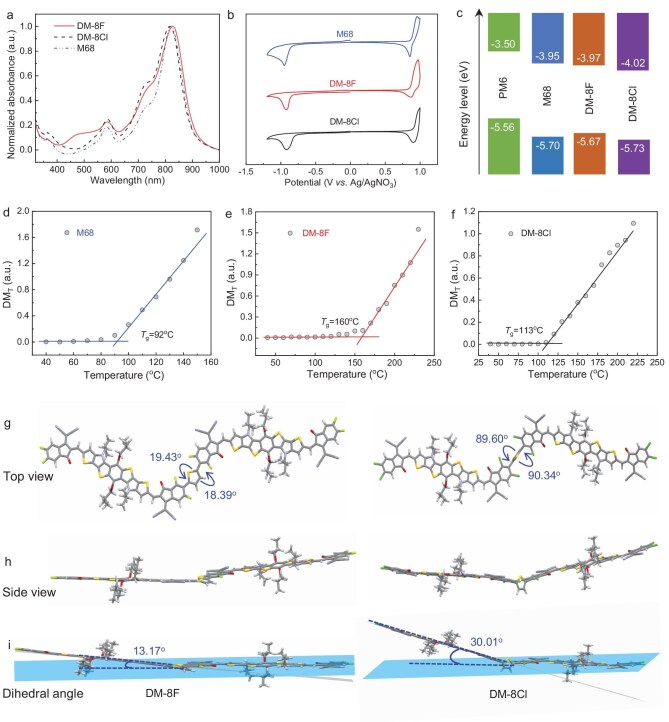 Figure 1
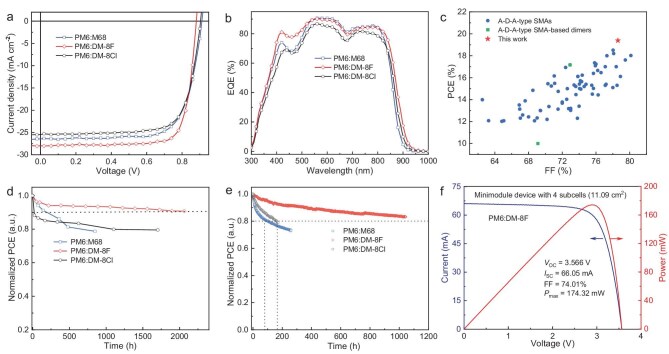 Figure 2
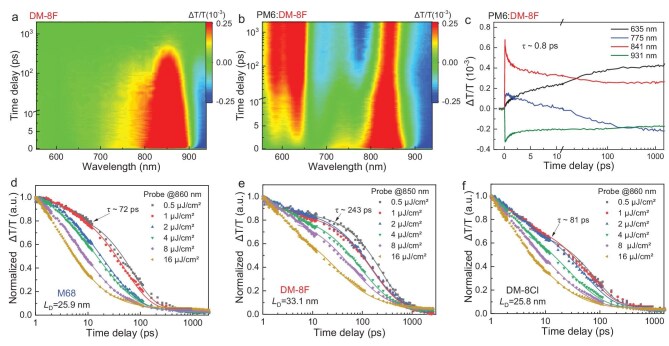 Figure 3
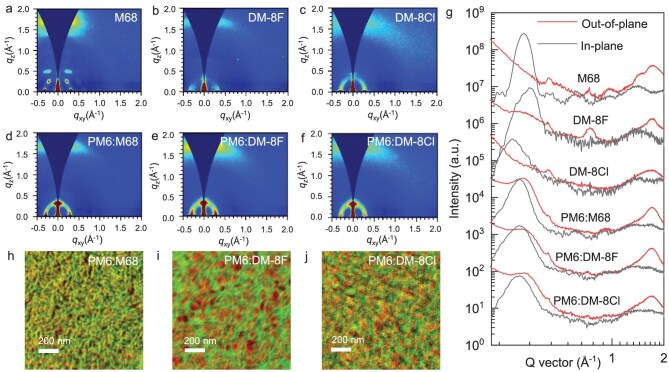 Figure 4
| Active layer | PCE (%) | FF |
|
|
|
|---|---|---|---|---|---|
| PM6:M68 | 17.92 (17.54 ± 0.25) | 0.737 | 0.914 | 26.6 | 25.5 |
| PM6:DM-8Cl | 17.02 (16.60 ± 0.20) | 0.742 | 0.903 | 25.4 | 24.5 |
| PM6:DM-8F | 19.39 (19.09 ± 0.15) | 0.786 | 0.881 | 28.0 | 26.7 |
| PM6:DM-8F (Certified) | 19.20 | 0.794 | 0.874 | 27.7 |
- —National Natural Science Foundation of China10.13039/501100001809
- —National Key Research and Development Program of China10.13039/501100012166
- —Fundamental Research Funds for the Central Universities10.13039/501100012226
- —Chinese Academy of Sciences10.13039/501100002367
- —Program of Youth Innovation Promotion Association
Peer Reviews
No public reviews on file for this paper yet. If you reviewed it on a platform where reviews are public (OpenReview, ICLR, NeurIPS, ICML), you can paste yours below so the community can read it here.
Videos
No videos yet. Explain this paper in a talk, walkthrough, or lecture? Add one.
Taxonomy
TopicsOrganic Electronics and Photovoltaics · Conducting polymers and applications · Perovskite Materials and Applications
INTRODUCTION
Polymer solar cells (PSCs) are photovoltaic devices capable of converting light energy into electrical energy by utilizing a blend of organic semiconducting electron donor and acceptor materials. Compared to traditional silicon-based solar cells, PSCs offer several advantages, including greater semitransparency, reduced weight, enhanced flexibility and stretchability, and the potential for large-area printing during manufacturing [1–6]. As a result, PSCs hold significant promise for applications in renewable energy, particularly in wearable optoelectronic devices [1,7,8]. However, for practical applications, further improvements in their power conversion efficiencies (PCEs) and stability are required.
Over the past decade, the development of new non-fullerene acceptor (NFA) materials has been at the forefront of research in organic photovoltaics [9–14]. Notably, the ITIC acceptor, featuring an acceptor-donor-acceptor (A-D-A)-type molecular architecture pioneered by Zhan and colleagues in 2015, marked a significant breakthrough by demonstrating device performance comparable to that of conventional fullerene-based acceptors. This advancement propelled the field of PSCs into a new era of research and development [15]. Since this seminal work, a significant number of ITIC-derived NFAs have been synthesized, leading to PSCs that achieved PCEs of ∼14% by 2018 [16–19]. Subsequently, Zou et al. incorporated an electron-deficient (A′) unit at the center of the fused-ring structure of the A-D-A molecule, resulting in the formation of an A-DA′D-A-type structure (Y6). Binary PSCs based on Y6 achieved an initial PCE of up to 15.7%, representing a significant advancement in the pursuit of high-efficiency PSCs [20]. Following this, efforts have focused on chemical modifications of Y6 to further enhance the PCE of PSCs. Several modified versions of Y6 have been developed, leading to high-performance binary PSCs with PCEs ranging from 16.1% to 19.1% [6,21–30]. Simultaneously, with the aid of a ternary blending strategy, the highest PCE based on these A-DA'D-A-structured Y6-derived NFAs was further increased to ∼20% [31,32]. In an effort to enhance the thermal stability of monomeric Y6-derived NFAs, dimerized acceptors (DAs) characterized by extended molecular backbones and monodisperse molecular weights have been developed by linking two banana-shaped Y6-derived acceptors. PSCs based on these DAs achieved both good stability and high efficiencies of up to 19% [33–42]. The widely recognized performance of devices based on Y6-derived acceptors (including DAs) has motivated researchers to investigate the fundamental molecular design principles underlying Y6. It is often assumed that strong electron-withdrawing aromatic cores (A′), such as benzothiadiazole and benzotriazole, along with a banana-shaped (curved) molecular structure, are two fundamental design criteria for high-performance NFAs [43–45]. To date, it remains rare for NFAs (including DAs) to achieve comparable or higher PCEs than Y-series acceptors without incorporating a banana-shaped backbone and an electron-deficient unit in the core.
Recently, our group developed a new class of A-D-A-type NFAs (i.e. M-series acceptors) by utilizing a linear-shaped, electron-rich heteroheptacene donor core. This core was constructed by substituting all sp^3^-hybridized carbon atoms with sp^2^-hybridized nitrogen atoms [46–51]. By controlling π–π stacking and molecular orientation through the neighboring side chains on the heteroheptacene donor core, the resulting M-series acceptors achieved impressive PCEs exceeding 16%. This highlights the significant potential of the novel molecular design strategy, which utilizes an A-D-A-type configuration featuring a linear-shaped molecular backbone. We further incorporated partially fluorinated side chains into the heteroheptacene donor core to enhance the fill factor (FF) [51]. Additionally, we employed a dimerization strategy to increase the photocurrent values and stability of PSCs based on the M-series acceptors, resulting in PSCs with PCEs up to 17.2% [52]. The removal of sp^3^-hybridized carbon atoms from the heteroheptacene core endows these M-series acceptors with relatively planar conjugated backbones, in contrast to Y-series acceptors, which possess longer and more twisted conjugated backbones. Consequently, M-series acceptors are expected to have advantages in forming stable phase morphologies with ordered intermolecular packing and reduced diffusion coefficients. However, it remains challenging to leverage the more planar conjugated backbones of M-series acceptors to achieve PSCs with both good stability and high efficiencies comparable to or exceeding those of Y-series acceptors.
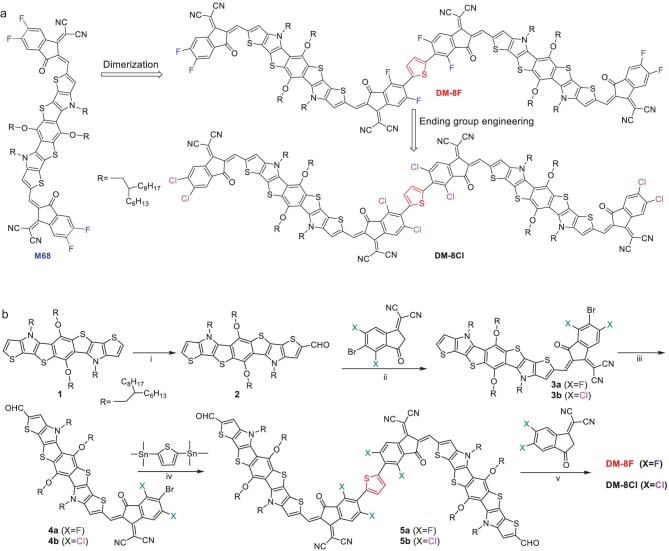
In this study, we designed and synthesized two dimerized M-series acceptors (DM-8F and DM-8Cl, shown in Scheme 1a) featuring an A-D-A-type configuration. For comparison, we also prepared the corresponding monomeric acceptor (M68 in Scheme 1a), which possesses the same side-chains and terminal groups as DM-8F. The structural differences between DM-8F and DM-8Cl arise from the varying halogen atoms in their terminal groups, which influence the planarity of their backbones. We conducted a systematic investigation into how molecular structure influences various properties, including optical absorption, dipole moments, dielectric constants, blend film morphology, charge transport characteristics, exciton diffusion length, photovoltaic efficiency, and both photo- and thermal stability of PSCs. When blended with the wide bandgap polymer PM6, the DM-8F–based PSC exhibited an outstanding PCE of 19.39% (certified at 19.20%), with an open-circuit voltage (VOC) of 0.881 V, a short-circuit current density (JSC) of 28.0 mA/cm^2^, and an FF of 0.786. To the best of our knowledge, the certified PCE of 19.20% is the highest reported among all A-D-A-type NFAs. Additionally, an impressive PCE of 15.72% was achieved for minimodule devices with an effective area of 11.09 cm^2^ using DM-8F as the acceptor material. Furthermore, the DM-8F–based PSCs exhibited excellent photo- and thermal stability due to the higher glass transition temperature (Tg) and lower diffusion coefficient of DM-8F.
(a) Molecular structures of M68, DM-8F, and DM-8Cl. (b) Synthetic route for the dimerized acceptors DM-8F and DM-8Cl. Reagents and conditions: (i) POCl3/DMF, 83%; (ii) pyridine, 73% for 3a and 83% for 3b; (iii) POCl3/DMF, 89% for 4a and 81% for 4b; (iv) Pd2(dba)3/P(o-tolyl)3, 65% for 5a and 72% for 5b; (v) BF3·OEt2/Ac2O, 88% for DM-8F and 85% for DM-8Cl.
RESULTS AND DISCUSSION
The synthetic routes for DM-8F and DM-8Cl are illustrated in Scheme 1b, while the synthesis of the monomeric acceptor M68 is described in the Supplementary Notes. As shown in the scheme, we employed a mono Vilsmeier–Haack reaction to functionalize the electron-rich heteroheptacene donor core (1) with a single aldehyde group. A 1-fold Knoevenagel condensation reaction between Compound 2 and 2-(5-bromo-4,6-difluoro-3-oxo-2,3-dihydro-1H-inden-1-ylidene)malononitrile (or 2-(5-bromo-4,6-dichloro-3-oxo-2,3-dihydro-1H-inden-1-ylidene) malononitrile) resulted in the formation of Compounds 3a-b, which were subsequently subjected to another 1-fold Vilsmeier–Haack reaction. Following this, a 2-fold Stille coupling reaction between Compounds 4a-b and 2,5-bis(trimethylstannyl)thiophene yielded Compounds 5a-b. The final dimerized acceptors (DM-8F and DM-8Cl) were obtained through a 2-fold Knoevenagel condensation reaction between Compounds 5a-b and 2-(5,6-difluoro-3-oxo-2,3-dihydro-1H-inden-1-ylidene)malononitrile (or 2-(5,6-dichloro-3-oxo-2,3-dihydro-1H-inden-1-ylidene)malononitrile). The chemical structures of DM-8F and DM-8Cl were confirmed by nuclear magnetic resonance (NMR) spectroscopy and high-resolution mass spectrometry.
The optical properties of DM-8F, DM-8Cl, and M68 in thin films and chloroform solutions were studied using UV–vis-NIR absorption spectroscopy (Fig. 1a and Fig. S3d). Notably, both DM-8F and DM-8Cl exhibit broader absorption bands, with full width at half maximum (FWHM) values of 137 nm and 118 nm, respectively, compared to M68 which has a smaller FWHM value of 93 nm. The broader absorption of DM-8F was also observed in thin film which is attributed to its extended conjugation length and increased molecular interaction modes compared to M68. In the two DAs, DM-8F displays a red-shifted absorption compared to DM-8Cl. Notably, DM-8F exhibits stronger absorption in the 400–550 nm range, which can be attributed to the shorter effective π-conjugation and weaker intramolecular charge transfer (ICT) effect in DM-8Cl [9]. Detailed optical parameters are provided in Table S1. The energy levels of the lowest unoccupied molecular orbital (LUMO) and the highest occupied molecular orbital (HOMO) for the three acceptors were estimated based on cyclic voltammetry (CV) (Supplementary Notes) and the resulting CV curves are depicted in Fig. 1b. From the monomeric M68 to the dimerized acceptor DM-8F, the EHOMO slightly increased from −5.70 to −5.67 eV, while the ELUMO slightly decreased from −3.95 to −3.97 eV. This change resulted in a marginally reduced bandgap for DM-8F, consistent with the optical absorption results. From DM-8F to DM-8Cl, both EHOMO and ELUMO decreased, from −5.67 to −5.73 eV and from −3.97 to −4.02 eV, respectively, indicating differing effects of halogenation between the two DAs. The energy diagram for the three acceptors and the polymer donor PM6, is depicted in Fig. 1c. The electronic properties and optimized geometries of the three acceptors were further investigated using density functional theory (DFT) calculations. To simplify computations, the 2-hexyldecyl chains were replaced with isobutyl groups. The calculated HOMO energy levels of M68, DM-8F, and DM-8Cl are −5.72, −5.69, and −5.74 eV, respectively, while the LUMO energy levels are −3.68, −3.78, and −3.76 eV. The energy level variations from the DFT calculations generally align with the CV results. The distributions of electrostatic surface potentials (ESPs) for the DAs (DM-8F and DM-8Cl) are quite similar to that of the monomeric M68 (Fig. S1). For all three acceptors, negative ESPs are primarily concentrated on strongly electronegative units, such as fluorine, chlorine, cyano, and carbonyl groups. In contrast, positive ESPs are located on the conjugated surfaces and alkyl chains. The ESP distribution reflects the uneven charge density, which, in turn, influences intramolecular electrostatic interactions.
(a) Normalized absorption spectra of M68, DM-8F, and DM-8Cl in thin films. (b) Cyclic voltammograms of M68, DM-8F, and DM-8Cl. (c) Energy level diagram of M68, DM-8F, and DM-8Cl. (d–f) Plots of the absorbance deviation metric for M68 (d), DM-8F (e), and DM-8Cl (f) films as a function of annealing temperature. (g–i) Top views (g), side views (h), and dihedral angles (i) of optimized geometries of the dimerized acceptors obtained by DFT calculations.
All three acceptors exhibit excellent thermal stability, with decomposition temperatures (Td) exceeding 300°C (Table S1 and Fig. S2a). Due to the amorphous and disordered nature of the two DAs and M68, they do not exhibit any distinct transition peaks in the differential scanning calorimetry (DSC) measurements (Fig. S2b). The Tg is a crucial parameter for predicting morphological stability. The Tg values of acceptor materials are associated with their diffusion and crystallization processes in the active layer, and a higher Tg value is believed to promote the formation of a stable microstructural morphology. In this study, the Tg values of the acceptors were estimated by quantifying the deviation metric based on the change in absorbance of each film during continuous thermal annealing (Fig. S3), following the method reported by Ade et al. [53]. Figure 1d–f shows the deviation metric plotted against the annealing temperature for the three acceptor films. Through linear fitting, the Tg values (from the optical deviation metric) of M68, DM-8F, and DM-8Cl were estimated to be 92, 160, and 113°C, in that order. A notable increase in Tg is observed from M68 to the dimerized acceptor DM-8F. However, when the fluorine atoms in the ending groups are replaced by chlorine atoms, a significant decrease in Tg is noted, likely related to their geometric differences. From the top views of the molecular geometries (Fig. 1g–i), it can be observed that the connecting thiophene ring in DM-8Cl is nearly perpendicular to the benzene ring in the indanone units, with dihedral angles of ∼90°. In contrast, the connecting thiophene ring in DM-8F is coplanar with the benzene ring in the indanone units, exhibiting dihedral angles of ∼19°. This difference can be attributed to the relatively larger size of chlorine atoms compared to fluorine atoms. From the side views, it can be observed that the dihedral angles between two neighboring electron-withdrawing groups (the central indanone groups) of DM-8F are theoretically calculated to be ∼13°, which is significantly smaller than the 38.74° observed in the counterpart based on the Y6 derivative [36]. However, when the fluorine atoms are replaced with chlorine atoms, the corresponding dihedral angles increase significantly to 30.01° (Fig. 1i). It has been shown that there is a significant correlation between the inferred diffusion coefficients at 85^o^C (D85) of acceptors blended with specific donor materials and their Tg values. According to the method proposed by Ade et al. (Supplementary Notes), D85 decreases exponentially with increasing Tg value [53]. Thus, D85 values of DM-8F, DM-8Cl, and M68 were determined to be 9.3 × 10^−22^, 1.2 × 10^−18^, and 1.5 × 10^−17^ cm^2^ s^−1^, respectively. The markedly reduced D85 value of DM-8F may contribute to improved thermal stability of the resulting solar cells, as discussed in the following section. Furthermore, DFT calculations revealed that the dipole moments of M68, DM-8F, and DM-8Cl are 0.00, 1.11, and 1.04 Debye, respectively (Fig. S1d). Owing to its symmetrical structure, M68 exhibits no dipole moment. In contrast, the dimerized acceptors show significantly enhanced dipole moments, which are advantageous for achieving higher dielectric constants.
To evaluate the photovoltaic performance of the three NFAs, we fabricated conventional PSCs using PM6 as the donor material. The PSCs were optimized under various conditions (Tables S2–S8). Detailed device fabrication procedures are provided in the Supplementary Notes. Following optimization of the solvent, solvent additives, and thermal annealing conditions, the performance of the layer-by-layer (LBL) processed devices was further enhanced by using the DM-8F acceptor at various concentrations to optimize the thickness of the active layer (Table S5). Figure 2a and b illustrates the current density versus voltage (J–V) curves and the EQE spectra, respectively, while Table 1 and Fig. S4 present the corresponding device parameters. The best-performing PM6:M68-based device showed a PCE of 17.92%, with a JSC of 26.6 mA cm^−2^, a VOC of 0.914 V, and an FF of 0.737. The best-performing PM6:DM-8Cl–based device delivered a PCE of 17.02%, with a VOC of 0.903 V, a JSC of 25.4 mA cm^−2^, and an FF of 0.742. In contrast, the best-performing PM6:DM-8F–based device exhibited a PCE of 19.39%, with a JSC of 28.0 mA cm^−2^, a VOC of 0.881 V, and an FF of 0.786. Notably, the PM6: DM-8F–based device displayed a decreased VOC value, which can be attributed to the deeper LUMO energy level of DM-8F. The PM6:DM-8F–based device showed an increased JSC value in comparison with the PM6:M68-based device primarily due to the increased EQE values in the 400–500 nm range. This improvement in current density results partly from the stronger intrinsic absorption of the DM-8F film in this wavelength range (Fig. 1a) and partly from the improved blend film morphology, which further increases the absorption intensity (Fig. S5a). The best-performing PM6:DM-8F–based device was assessed by the National Photovoltaic Product Quality Inspection and Testing Center of China, where a certified PCE of 19.20% was achieved, as illustrated in Fig. S6. Importantly, the certified PCE of 19.20% is the highest reported to date for single-junction PSCs utilizing A-D-A-type acceptors (Fig. 2c and Table S9), and it is also higher than those of many Y6-derived dimerized acceptors (Table S10 and Fig. S7). In addition, a series-connected four-subcell minimodule device (schematic and photograph shown in Fig. S8a and S8b) with an active area of 11.09 cm^2^ was successfully fabricated employing the PM6:DM-8F active layer. Figure 2f depicts the measured I-V curve and output power of the minimodule device, along with the corresponding photovoltaic parameters. The minimodule achieved a PCE of 15.72% with a VOC of 3.566 V, an ISC of 66.05 mA, and an FF of 0.740.
(a) J-V curves of best-performing PSCs based on the PM6:M68, PM6:DM-8F, and PM6:DM-8Cl blends. (b) EQE spectra of the best-performing PSCs. (c) Comparison of device parameters of A-D-A-type acceptor-based OSCs between this work and the previously reported systems (the original data are provided in Table S9). (d) Normalized PCEs of the PSCs based on PM6:M68, PM6:DM-8F, and PM6:DM-8Cl under thermal annealing at 80°C for different times. (e) MPP stability tests of the unencapsulated PSCs based on PM6:M68, PM6:DM-8F, and PM6:DM-8Cl. (f) I-V and power curves of the minimodule based on PM6:DM-8F.
The thermal stability of PSCs was further investigated by continuously heating the devices at 80^o^C in an inert atmosphere. In this study, we fabricated inverted devices with the structure of indium tin oxide (ITO)/ZnO/active layer/MoO_3_/Ag for thermal stability testing, aiming to mitigate the negative effects of organic interlayers on device stability. The fabrication and optimization details of the inverted devices are presented in the Supplementary Notes and Table S8. The dependence of PCEs on annealing time for the three devices is illustrated in Fig. 2d. After thermal annealing at 80°C for 2060 hours, the efficiency of PM6:DM-8F–based PSC remained at 90.7% of its initial value. For the device based on the PM6:DM-8Cl blend, 79.5% of its initial PCE was maintained after annealing at 80°C for 1704 hours. In contrast, the PM6:M68-based PSC only maintained 78.8% of its initial PCE after being annealed at 80°C for 848 hours. Based on this data, their T90 lifetimes (the duration of time it takes for the PCE to degrade to 90% of its initial value) can be estimated. As shown in Fig. 2d, the PM6:DM-8F–based device offers a T90 lifetime of >2060 hours, which is around 13 times greater than that of the PM6:M68-based device (T90 = 150 hours). The greatly improved thermal stability of the PM6:DM-8F–based PSC is primarily related to the higher Tg value of 160°C for DM-8F compared to the other two PSCs based on PM6:DM-8Cl and PM6:M68. The exceptional thermal stability of DM-8F–based devices makes them highly competitive for future practical applications. At the same time, the light stability of the PSCs based on the three acceptors was investigated. As shown in Fig. 2e, after continuous one-sun-equivalent illumination for 1044 hours, the PM6:DM-8F–based device retained 83.2% of its initial PCE indicating a T80 lifetime of >1044 hours. In contrast, the PM6:DM-8Cl–based and the PM6:M68-based devices exhibited relatively shorter T80 lifetimes of 163 hours and 103 hours, respectively. These findings reveal that employing dimerized M-series acceptors characterized by an elevated Tg in PSC fabrication leads to both enhanced thermal- and photostability in the resulting devices. It should be noted that the PM6:DM-8F–based device showed comparable or superior thermal stability under continuous heating at 80°C compared to the counterparts based on Y6-derived dimerized acceptors [33–36].
We carried out a comprehensive analysis of energy loss (Eloss) in the three PSCs by obtaining their electroluminescence (EL) spectra and Fourier-transform photocurrent spectroscopy external quantum efficiency (FTPS-EQE) (Supplementary Notes). Generally, the Eloss in PSCs can be categorized into three components, expressed by the following equation: Eloss=ΔE1+ΔE2+ΔE3=(Eg- \documentclass[12pt]{minimal} \usepackage{amsmath} \usepackage{wasysym} \usepackage{amsfonts} \usepackage{amssymb} \usepackage{amsbsy} \usepackage{upgreek} \usepackage{mathrsfs} \setlength{\oddsidemargin}{-69pt} \begin{document} qV_{{\mathrm{oc}}}^{{\mathrm{SQ}}}\end{document} )+( \documentclass[12pt]{minimal} \usepackage{amsmath} \usepackage{wasysym} \usepackage{amsfonts} \usepackage{amssymb} \usepackage{amsbsy} \usepackage{upgreek} \usepackage{mathrsfs} \setlength{\oddsidemargin}{-69pt} \begin{document} qV_{{\mathrm{oc}}}^{{\mathrm{SQ}}} - qV_{{\mathrm{oc}}}^{{\mathrm{rad}}}\end{document} )+( \documentclass[12pt]{minimal} \usepackage{amsmath} \usepackage{wasysym} \usepackage{amsfonts} \usepackage{amssymb} \usepackage{amsbsy} \usepackage{upgreek} \usepackage{mathrsfs} \setlength{\oddsidemargin}{-69pt} \begin{document} qV_{{\mathrm{oc}}}^{{\mathrm{rad}}} - q{V}{{\mathrm{oc}}}\end{document} ), where \documentclass[12pt]{minimal} \usepackage{amsmath} \usepackage{wasysym} \usepackage{amsfonts} \usepackage{amssymb} \usepackage{amsbsy} \usepackage{upgreek} \usepackage{mathrsfs} \setlength{\oddsidemargin}{-69pt} \begin{document} qV{{\mathrm{oc}}}^{{\mathrm{SQ}}}\end{document} is the possible VOC under the Shockley–Queisser limit, and \documentclass[12pt]{minimal} \usepackage{amsmath} \usepackage{wasysym} \usepackage{amsfonts} \usepackage{amssymb} \usepackage{amsbsy} \usepackage{upgreek} \usepackage{mathrsfs} \setlength{\oddsidemargin}{-69pt} \begin{document} qV_{{\mathrm{oc}}}^{{\mathrm{rad}}}\end{document} is the VOC only considering the radiative recombination (Supplementary Notes). ΔE1 results from the radiative energy loss exceeding the bandgap, an occurrence that is inevitable for all solar cells. In this study, the ΔE1 values for PM6:DM-8F, PM6:DM-8Cl, and PM6:M68 are 0.262, 0.263, and 0.264 eV, respectively (Fig. S9a). ΔE2 represents the radiative energy loss occurring below the bandgap and is correlated with the energy difference (ΔECT) between the bandgap (Eg^PV^) and the charge-transfer state (ECT) of the PSCs. For the PM6:DM-8F–, PM6:DM-8Cl–, and PM6:M68-based devices, the Eg^PV^ values were determined to be 1.446, 1.456, and 1.472 eV, in that order, by measuring the emission and absorption spectra of the corresponding blend films (Fig. S5). By fitting the FTPS-EQE and EL spectra, the ECT values for PM6:DM-8F–, PM6:DM-8Cl–, and PM6:M68-based devices were determined to be 1.411, 1.426, and 1.450 eV, in that order (Fig. S9d–S9f). Consequently, the ΔECT values for the PM6:DM-8F–, PM6:DM-8Cl–, and PM6:M68-based devices are 0.035, 0.030, and 0.022 eV, in that order. As illustrated in Fig. S9a, the observed variations in ΔECT values show a direct correlation with the corresponding ΔE2 values. The PM6:DM-8F–, PM6:DM-8Cl–, and PM6:M68-based devices exhibit progressively lower ΔE2 values of 0.050, 0.041, and 0.038 eV, respectively. As a non-radiative recombination loss, ΔE3 can be quantified as (-kT/q)ln(EQE_EL_), where T is the Kelvin temperature, k is the Boltzmann constant, and EQE_EL_ is the electroluminescence quantum efficiency of the PSC. The reduction of ΔECT in PSCs is widely recognized to promote electronic coupling between CT and localized excitation (LE) states. This synergistic interaction allows the CT state to harness the strong luminescent characteristics of the LE state, thereby enhancing its emission efficiency [54]. Furthermore, diminished ΔECT values facilitate the reverse transition from the CT to LE state, creating an energy transfer pathway that enables radiative recombination of the CT state through the emissive LE state. This photophysical process effectively mitigates non-radiative recombination losses (quantified as ΔE3) in PSCs. To experimentally verify this mechanism and establish quantitative correlations with ΔE3, we conducted external quantum electroluminescence EQE_EL_ measurements across three PSCs (Supplementary Notes). As shown in Fig. S9b, the PM6:DM-8F–based device exhibited an EQE_EL_ of 1.43 × 10^−4^, corresponding to a ΔE3 of 0.229 eV. In contrast, the PM6:DM-8Cl– and PM6:M68-based devices showed higher EQE_EL_ values of 1.59 × 10^−4^ and 1.69 × 10^−4^, leading to lower ΔE3 values of 0.226 and 0.224 eV, respectively. These variations in ΔE3 are consistent with the PLQY trends observed for the three acceptor materials (Table S1). Based on this data, the Eloss of the PM6:DM-8F–based device was calculated to be 0.541 eV, which is slightly higher than the values of 0.530 and 0.526 eV observed for the PM6:DM-8Cl– and PM6:M68-based devices (Table S11). These findings demonstrate that the enhanced VOC values in the PM6:DM-8Cl– and PM6:M68-based devices arise from the upshifted ECT caused by the higher LUMO energy levels of DM-8Cl and M68, which simultaneously suppress radiative and non-radiative recombination processes.
It has been established that a higher dielectric constant (εr) of an organic photovoltaic material typically results in a lower exciton binding energy (Eb) [54]. In this study, we employed impedance spectroscopy with parallel-plate capacitance devices to determine the dielectric constants of the three acceptors and the corresponding blend films (Supplementary Notes). The frequency dependence of the dielectric constants for DM-8F, DM-8Cl, and M68, within the range of 20 to 2 × 10^5^ Hz, is illustrated in Fig. S10a. In the wide frequency range, the εr values for DM-8F and DM-8Cl are significantly higher than that of M68. For example, at the frequency of 20 Hz, the εr values for DM-8F and DM-8Cl are 5.02 and 4.81, respectively, which are both higher than the εr value of 3.42 for M68. The increased εr values of both DAs (DM-8F and DM-8Cl) can be attributed to their larger dipole moments compared to M68, as we previously discussed (Fig. S1d). In addition, when both DAs were blended with PM6, the resulting blend films of PM6:DM-8F and PM6:DM-8Cl still exhibit higher εr values compared to PM6:M68 (Fig. S10b).
The energy barrier or activation energy (Ea) that governs exciton dissociation into free charge carriers is a critical parameter in the characterization of optoelectronic materials. Ea can be quantitatively determined through temperature-dependent photoluminescence analysis (Supplementary Notes) using the modified Arrhenius relationship: I(T) = I0/[1 + Aexp(−Ea/kBT)], where I0 denotes the extrapolated emission intensity at absolute zero, T is the measurement temperature, and kB represents the Boltzmann constant [54]. To systematically investigate the correlation between the dielectric constant and exciton dissociation dynamics, we employed temperature-modulated photoluminescence spectroscopy to extract Ea values across three acceptors with varying dielectric constants. As illustrated in Figs S11–S13, the total photoluminescence (PL) intensity for the three samples varied as a function of temperature, ranging from 80 to 300 K. For all three samples, the PL intensity decreased with increasing temperature, suggesting that the photogenerated excitons tend to dissociate into free charge carriers at higher temperatures. The estimated Ea values for DM-8F and DM-8Cl are 24.51 meV and 24.42 meV (Fig. S9c), respectively, both of which are significantly lower than that for M68 (31.65 meV). The reduced Ea values for the DAs indicate lower exciton dissociation barriers, which favorably facilitate exciton dissociation and the charge transfer process. Considering that Eb represents the energy difference between the charge-separated (CS) state and the first singlet excited state (S_1_), the reduced Ea values for the DAs indicate a corresponding decrease in their Eb values [55]. Thus, our findings suggest that DAs offer the advantage of a higher dielectric constant, which subsequently reduces exciton binding energy. This reduction is beneficial for enhancing charge currents in the resulting photovoltaic devices. We then fabricated photovoltaic devices using active layers composed solely of electron acceptor materials to evaluate the exciton dissociation capabilities of DM-8F, DM-8Cl, and M68 films. The external quantum efficiency (EQE) spectra and the corresponding integrated current density curves of the photovoltaic devices based on DM-8F, DM-8Cl, and M68 are presented in Fig. S14. Both the DM-8F– and DM-8Cl–based devices demonstrate an enhanced photoresponse across the absorption range of 300 to 900 nm compared to the M68-based device. Additionally, the current densities obtained by integrating the EQE curves with the AM 1.5 G photon flux were 0.46 mA cm^−2^ and 0.47 mA cm^−2^ for the devices based on DM-8F and DM-8Cl, respectively. These values are significantly larger than the current density for the M68-based device (0.19 mA cm^−2^). The improved current densities and EQEs of the DM-8F– and DM-8Cl–based devices, in comparison to the M68-based device, can be attributed to the lower binding energy resulting from their higher dielectric constants.
To gain a deeper understanding of the highest JSC value in the PM6:DM-8F–based device, we conducted measurements of the photocurrent density (Jph) as a function of effective voltage (Veff) (Supplementary Notes). This analysis enabled us to evaluate the charge dissociation process, from which we determined the exciton dissociation efficiency (Pdiss). As shown in Fig. S15, the Pdiss of the PM6:DM-8F device is 98.5%, which is higher than that of PM6:M68 (98.1%) and PM6:DM-8Cl (98.1%). The elevated Pdiss value suggests a more efficient charge dissociation in the PM6:DM-8F–based device. The dependencies of Jsc values on light intensity (Plight) were studied to reveal the charge recombination behavior within the devices based on the three acceptors. The equation Jsc ∝ (Plight)^α^ can be used to express the relationship between JSC and Plight, where the exponential factor α indicates the extent of bimolecular recombination. By fitting the corresponding curves, α values of 0.992, 0.978, and 0.974 were obtained for the PM6:DM-8F–, PM6:DM-8Cl–, and PM6:M68-based devices, respectively (Fig. S16). The highest α value for the PM6:DM-8F–based device suggests that charge recombination is most efficiently suppressed in the device, which accounts for its highest FF and Jsc values.
To assess the performance variation of PSCs based on three different acceptor materials, the space charge limited current (SCLC) method was used to determine their charge transport properties (Supplementary Notes). As shown in Fig. S17, the calculated electron mobilities (μe) for PM6:DM-8F, PM6:DM-8Cl, and PM6:M68 blend films are 3.73 × 10^−4^, 3.33 × 10^−4^, and 1.40 × 10^−4^ cm^2^ V^−1^ s^−1^, in that order. And the hole mobilities (μh) for PM6:DM-8F, PM6:DM-8Cl, and PM6:M68 are 3.63 × 10^−4^, 2.71 × 10^−4^, and 2.94 × 10^−4^ cm^2^ V^−1^ s^−1^, in that order (Table S12). This data suggests that both DAs exhibit an increased electron mobility compared to M68. Owing to the highest carrier mobilities and well-balanced electron-hole transport characteristics in the PM6:DM-8F blend, the resulting PSCs demonstrate superior performance with enhanced FF and JSC values.
The charge-transfer dynamics were further investigated using femtosecond transient absorption (TA) spectroscopy (Supplementary Notes), as illustrated in Fig. 3a–c. Figure 3a and b compares the TA data recorded from a neat film of DM-8F and a blend film of PM6:DM-8F by selective excitation of the acceptor using 860 nm laser pulses. In the neat film of DM-8F, the TA kinetics are dominated by the decay of the acceptor’s ground-state bleach (GSB), which has a lifetime of ∼243 ps within its resonant band. However, in the blend film, the acceptor’s GSB signal decreases rapidly, coinciding with the emergence of the donor’s GSB signal at ∼630 nm. This observation suggests an ongoing hole transfer process from the acceptor (DM-8F) to the donor (PM6). Subsequently, a pronounced excited-state absorption (ESA) feature at ∼760 nm, associated with free carriers, emerges at longer timescales in the blend. Notably, the blend sample exhibits an ultrafast decay component of the acceptor GSB (∼0.8 ps) at the earliest time scale (Fig. 3c), which can be attributed to rapid hole transfer across the donor-acceptor interface. Given the long-lived nature of the acceptor species, the near-unity efficiency of hole transfer suggests that most excitons at the interface successfully contribute to charge generation. Such efficient interfacial charge transfer dynamics are also observed in the blends incorporating the other two acceptors (M68 and DM-8Cl in Fig. S18), highlighting the general applicability of this mechanism.
(a and b) 2D TAS images of DM-8F and PM6:DM-8F. (c) TA spectra of PM6:DM-8F at different time delays. (d–f) Decay dynamics of excitons in M68 (d), DM-8F (e), and DM-8Cl (f) films with varying pump fluences.
Although the interfacial charge separation efficiencies are comparable across all three blends, the resulting free charge signals exhibit distinct characteristics (Fig. S18). This discrepancy is likely attributed to differences in bulk exciton dynamics, which was investigated by using fluence-dependent TA spectroscopy. Following established literature methods [56,57], exciton diffusion lengths (LD) are determined through exciton-exciton annihilation (EEA) analysis (Supplementary Notes). Figure 3d-f depicts the decay dynamics of the excitons in the DM-8F, DM-8Cl, and M68 films, in that order. Bimolecular exciton annihilation rate constants (α) and intrinsic exciton decay rate constants (κ) were obtained by globally fitting the decay dynamics of the three acceptors. Based on the α and κ values, the corresponding LD values were calculated, and the detailed calculation processes, along with related parameters, are provided in Table S13. Notably, DM-8F exhibits a significantly longer LD of 33.1 nm compared to M68 (25.9 nm) and DM-8Cl (25.8 nm), indicating the enhanced exciton transport capability of the DM-8F films. This finding is consistent with the exceptional exciton lifetime of DM-8F (243 ps), which is considerably longer than those of the other two acceptors (72 ps for M68 and 81 ps for DM-8Cl). The extended conjugation length and more planar molecular backbone in DM-8F could enhance molecular interactions and potentially slow down recombination pathways thereby extending the exciton diffusion range. This increased transport range promotes more efficient charge collection at the donor-acceptor interface, ultimately improving device performance.
Grazing-incidence wide-angle X-ray scattering (GIWAXS) measurements were conducted to investigate the π–π-packing and molecular orientation of the acceptor materials in both pristine and blended films (Supplementary Notes). Figure 4a–g depicts the 2D GIWAXS patterns as well as the corresponding 1D line-cut profiles in the in-plane (IP) and out-of-plane (OOP) directions. All three acceptor materials showed a face-on orientation relative to the substrate, as evidenced by the intense lamellar (100) peak in the IP direction and a distinct (010) peak corresponding to π–π stacking in the OOP direction. However, both the pristine DM-8F film and the PM6:DM-8F blend film showed a more compact π–π-packing with the smallest packing distances of 3.62 and 3.68 Å, respectively. In contrast, the pristine DM-8Cl film and the PM6:DM-8Cl blend film exhibited π–π-packing distances of 3.77 and 3.73 Å. Additionally, a π–π-packing distance of 3.69 Å was observed for both the pristine M68 film and the PM6:M68 blend film. In going from the small-molecule acceptor (M68) to the DAs (DM-8Cl or DM-8F), a reduced crystal correlation length (CCL) was observed indicating the relatively high crystallinity of the small-molecule acceptor (Table S14). Among the three acceptors, DM-8F showed the shortest π–π-packing distance in its pure film as well as its blend film which can be attributed the extended and more planar conjugation backbone of DM-8F. We further used the GIWAXS measurement to learn the morphology stability of the blend films of PM6:DM-8F and PM6:M68 before and after thermal annealing at 100°C. As shown in Fig. S19, 2D GIWAXS patterns indicated that after thermal aging at 100°C for 72 hours, more edge-on orientations can be found for the PM6:M68 blend which is harmful to device performance. However, 2D GIWAXS patterns of PM6:DM-8F blend film barely change under the same thermal annealing conditions. The results suggest that the morphology of PM6:DM-8F is more thermally stable at elevated temperatures, explaining the enhanced thermal stability of devices based on PM6:DM-8F, in comparison with those based on PM6:M68.
2D GIWAXS patterns (a–f) and 1D line-cut profiles (g) of the neat acceptors and blend films. (h–j) Combined PiFM images at the wavenumbers of 1540 cm−1 (green representing acceptor) and 1650 cm−1 (red representing PM6).
The surface morphology of blend films based on PM6:DM-8F, PM6:DM-8Cl, and PM6:M68 was assessed using atomic force microscopy (AFM) as illustrated in Fig. S20. Fiber-like morphology is evident in all three blend films. However, the PM6:DM-8F and PM6:M68 blend films exhibited lower roughness (Rq) values (1.18 nm for PM6:DM-8F and 1.14 nm for PM6:M68) compared to the PM6:DM-8Cl blend (1.42 nm), which can be attributed to the more planar molecular structures of the former two. The reduced roughness indicates a more uniform surface, which is beneficial for forming an ohmic contact with decreased series resistance. Furthermore, photo-induced force microscopy (PiFM), which employs localized near-field infrared imaging to identify the chemical properties associated with thin-film morphology, was utilized to assess this morphology (Supplementary Notes). According to the characteristic peaks of the acceptors (DM-8F, DM-8Cl, and M68) and the donor (PM6), the absorption wavenumbers of 1540 cm^−1^ and 1650 cm^−1^ were used to distinguish the acceptor and donor phases in the blend films [26,58]. The corresponding PiFM phase images of the PM6:DM-8F, PM6:DM-8Cl, and PM6:M68 blends are presented in Fig. S21. Again, fibril network structures can be observed in all three blend films. The overlay of the two images (Fig. 4h–j) reveals clear phase separation, with the acceptor and donor domains in close contact. Figure S22 depicts line profiles across the PiFM images, and the FWHM value of the peaks was utilized to estimate the diameter of the fibrils. An average diameter of 14.9 nm was found for the PM6:DM-8F blend, which is slightly smaller than those for the PM6:DM-8Cl blend (17.1 nm) and the PM6:M68 blend (18.3 nm). The fibril-like morphology with smaller fibril sizes in the PM6:DM-8F blend is consistent with the high FF and JSC values observed in the corresponding device.
CONCLUSION
We have designed and synthesized two dimerized acceptors, DM-8F and DM-8Cl, along with their corresponding A-D-A-type small-molecule counterpart M68. Through comprehensive characterizations, we systematically elucidated the structure-property relationships of these acceptors, focusing on their optical absorption bandgaps, energy level alignments, dielectric constants, glass transition temperatures, charge carrier mobilities, exciton diffusion lengths, and ultimately, photovoltaic performance. The dimerized acceptors exhibit broader absorption spectra, higher Tg values, and greater dielectric constants than the small-molecule reference M68. Theoretical calculations reveal that in DM-8Cl, the chlorinated end group forms a larger dihedral angle with the central thiophene ring, resulting in a less planar dimerized structure compared to its fluorinated counterpart, DM-8F. This structural distortion results in a lower Tg and a larger π–π stacking distance in DM-8Cl. PSCs were fabricated by blending each acceptor with the polymer donor PM6. The best-performing DM-8F–based device achieved a PCE of 19.39%, significantly outperforming the devices based on DM-8Cl (PCE = 17.02%) and M68 (PCE = 17.92%). Notably, the best-performing DM-8F–based device attained a third-party certified PCE of 19.20%, which, to the best of our knowledge, represents the highest reported value to date among all A-D-A-type acceptor materials. A minimodule device based on PM6:DM-8F blend with an effective area of 11.09 cm^2^ also delivered an outstanding PCE of 15.72%. Furthermore, the PM6:DM-8F–based PSC achieved a long T90 lifetime exceeding 2060 hours under continuous heating at 80^o^C, which is around 13 times greater than those of the PM6:M68- and PM6:DM-8Cl–based devices (both <150 hours). This markedly improved thermal stability of the PM6:DM-8F–based PSC is attributed to the higher Tg of DM-8F compared to the other two acceptors. The PM6:DM-8F–based device also exhibited improved photostability, with a T80 lifetime exceeding 1000 hours, far in excess of the PM6:DM-8Cl– and PM6:M68-based devices (<200 hours). Our findings reveal that the dimerized acceptor DM-8F, derived from the planar M-series A-D-A-type acceptor, constitutes a highly promising class of electron acceptor materials with great potential for developing highly efficient and stable PSCs.
Supplementary Material
nwaf537_Supplemental_File
The reference list from the paper itself. Each links out to its DOI / PubMed record.
- 1Wang ZY, Bo YW, Bai PJ et al. Self-sustaining personal all-day thermoregulatory clothing using only sunlight. Science 2023; 382: 1291–6.10.1126/science.adj 365438096305 · doi ↗ · pubmed ↗
- 2Wang Z, Zhang D, Yang L et al. Mechanically robust and stretchable organic solar cells plasticized by small-molecule acceptors. Science 2025; 387: 381–7.10.1126/science.adp 970939847644 · doi ↗ · pubmed ↗
- 3Zhang GC, Lin FR, Qi F et al. Renewed prospects for organic photovoltaics. Chem Rev 2022; 122: 14180–274.10.1021/acs.chemrev.1c 0095535929847 · doi ↗ · pubmed ↗
- 4Cheng P, Li G, Zhan XW et al. Next-generation organic photovoltaics based on non-fullerene acceptors. Nat Photon 2018; 12: 131–42.10.1038/s 41566-018-0104-9 · doi ↗
- 5Meng LX, Zhang YM, Wan XJ et al. Organic and solution-processed tandem solar cells with 17.3% efficiency. Science 2018; 361: 1094–8.10.1126/science.aat 261230093603 · doi ↗ · pubmed ↗
- 6Lu X, Xie C, Liu Y et al. Increase in the efficiency and stability of large-area flexible organic photovoltaic modules via improved electrical contact. Nat Energy 2024; 9: 793–802.10.1038/s 41560-024-01501-1 · doi ↗
- 7Wang JQ, Zheng Z, Bi PQ et al. Tandem organic solar cells with 20.6% efficiency enabled by reduced voltage losses. Natl Sci Rev 2023; 10: nwad 085.10.1093/nsr/nwad 08537448581 PMC 10337743 · doi ↗ · pubmed ↗
- 8Son SY, Lee G, Wang HY et al. Integrating charge mobility, stability and stretchability within conjugated polymer films for stretchable multifunctional sensors. Nat Commun 2022; 13: 2739.10.1038/s 41467-022-30361-035585062 PMC 9117230 · doi ↗ · pubmed ↗