Unexpected migration patterns in a high-latitude breeding songbird: evidence from multi-sensor geolocators and isotopes
Stephanie J. Szarmach, Johanna K. Beam, Mads Moore, Benjamin M. Van Doren, Alan Brelsford, David P. L. Toews

TL;DR
High-latitude myrtle warblers migrate farther than expected, likely due to historical patterns rather than optimal routes.
Contribution
New evidence that migration routes in high-latitude myrtle warblers are shaped by historical contingency rather than energy efficiency.
Findings
Most myrtle warblers migrate to the southeastern U.S., contradicting prior assumptions of a shorter route to the Pacific Coast.
Atmospheric pressure data from geolocators improves migration tracking accuracy, revealing fine-scale details like flight altitude.
Migration patterns align with the historical contingency hypothesis, suggesting routes are shaped by past range expansions.
Abstract
Migratory birds often exhibit within-species variation in migration routes and non-breeding areas, yet the mechanisms shaping these patterns remain poorly understood, particularly in high-latitude breeding populations. Several hypotheses have been proposed to explain why birds follow particular routes: optimal migration theory proposes that routes minimizing time or energy expenditure are favored, whereas the historical contingency hypothesis posits that routes are shaped by past range expansion, sometimes resulting in “suboptimal” migrations. We investigated whether distance minimization or historical contingency more strongly influenced migration routes in high-latitude breeding myrtle warblers (Setophaga coronata coronata), which indirect evidence previously suggested follow a shorter route to the Pacific Coast rather than the core Gulf Coast nonbreeding area. We tracked the…
Genes, proteins, chemicals, diseases, species, mutations and cell lines named across the full text — each resolved to its canonical identifier and authoritative record.
Click any figure to enlarge with its caption.
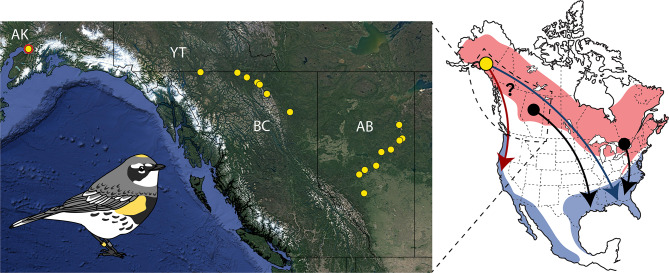 Figure 1
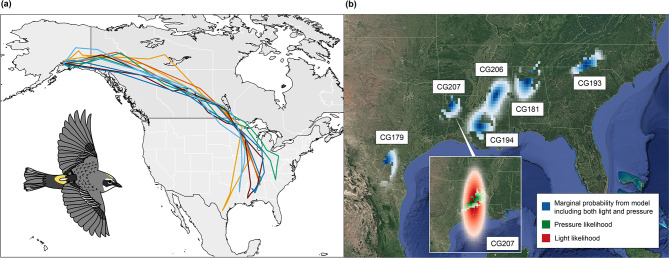 Figure 2
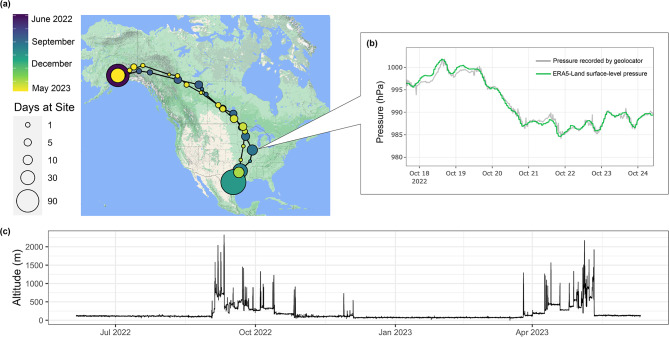 Figure 3
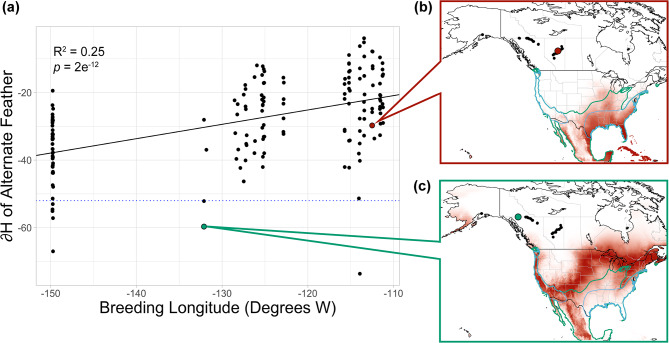 Figure 4
Peer Reviews
No public reviews on file for this paper yet. If you reviewed it on a platform where reviews are public (OpenReview, ICLR, NeurIPS, ICML), you can paste yours below so the community can read it here.
Videos
No videos yet. Explain this paper in a talk, walkthrough, or lecture? Add one.
Taxonomy
TopicsAvian ecology and behavior · Animal Vocal Communication and Behavior · Species Distribution and Climate Change