Endoscopic ultrasound-guided radiofrequency ablation for large branch-duct intraductal papillary mucinous neoplasms: Safety and efficacy trial
Somashekar G. Krishna, Erica Park, Jennifer Rath, Zarine Shah, Ahmed Abdelbaki, Stacey Culp, Fadi Hawa, Dan Jones, Wei Chen, Peter Lee, Hamza Shah, Jordan Burlen, Raj Shah, Mitchell L. Ramsey, Georgios I. Papachristou, Zobeida Cruz-Monserrate, Timothy Pawlik, Mary E Dillhoff

TL;DR
This study evaluates the safety and effectiveness of a nonsurgical treatment for large pancreatic tumors using endoscopic ultrasound-guided radiofrequency ablation.
Contribution
The study presents the first prospective trial of EUS-RFA for large branch-duct intraductal papillary mucinous neoplasms.
Findings
78.6% of tumors showed at least 50% reduction in volume after treatment.
39.3% of tumors demonstrated complete (≥90%) response.
88.2% of tumors with KRAS/GNAS mutations showed loss of detectable mutations post-treatment.
Abstract
Endoscopic ultrasound-guided radiofrequency ablation (EUS-RFA) is a nonsurgical treatment option for managing pancreatic lesions. We sought to evaluate the safety and efficacy of EUS-RFA for large (≥4 cm) branch-duct intraductal papillary mucinous neoplasms (BD-IPMNs). Patients with a definitive diagnosis of BD-IPMN who declined or were unfit for surgery underwent EUS-RFA in a single-arm prospective trial. Ablation was performed using a 19G EUS-RFA needle. RFA applications were delivered up to a maximum threshold of 45 seconds or 400 ohms impedance. Safety was assessed using AGREE guidelines. Potential for efficacy was assessed using cyst volume and cyst fluid KRAS GNAS mutations using next-generation sequencing (NGS). Adverse events (AEs) were analyzed per RFA session, while response was analyzed per BD-IPMN. Thirty BD-IPMNs (mean diameter 4.6 ± 1.7 cm; 80% multilocular) in 25…
Genes, proteins, chemicals, diseases, species, mutations and cell lines named across the full text — each resolved to its canonical identifier and authoritative record.
Click any figure to enlarge with its caption.
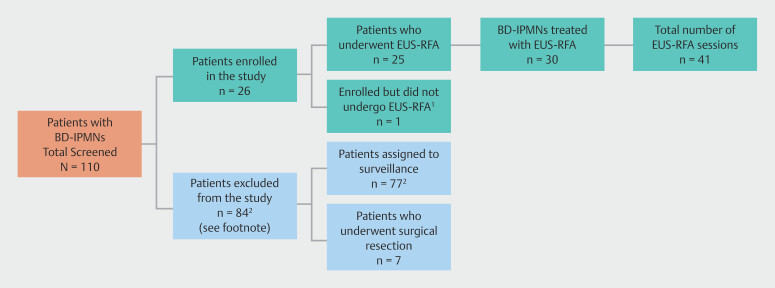 Figure 1
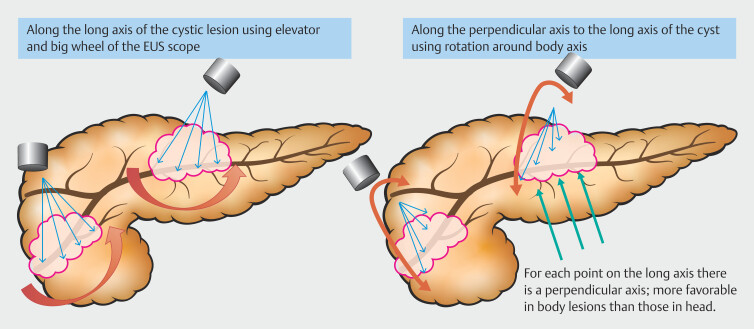 Figure 2
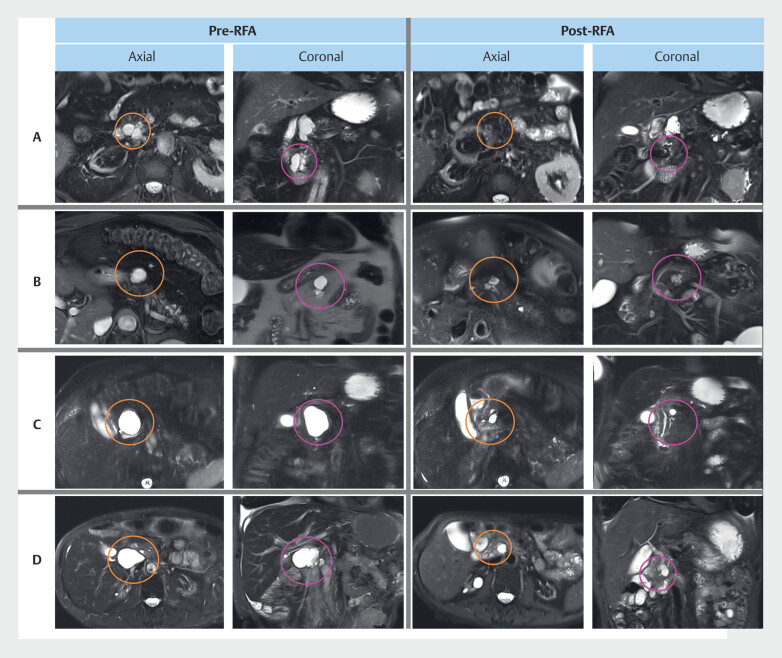 Figure 3
Peer Reviews
No public reviews on file for this paper yet. If you reviewed it on a platform where reviews are public (OpenReview, ICLR, NeurIPS, ICML), you can paste yours below so the community can read it here.
Videos
No videos yet. Explain this paper in a talk, walkthrough, or lecture? Add one.
Taxonomy
TopicsPancreatic and Hepatic Oncology Research · Gallbladder and Bile Duct Disorders · Cholangiocarcinoma and Gallbladder Cancer Studies