Warm Edge Kelp Populations Show Elevated Volatility to Marine Heatwaves
Jiaxin Shi, Scott Bennett, Jules B. Kajtar, Thomas Wernberg, Neville S. Barrett, Graham J. Edgar, Neil J. Holbrook

TL;DR
Kelp populations at the warm edge of their range are more vulnerable to marine heatwaves, showing greater declines in abundance compared to central and cooler-edge populations.
Contribution
The study introduces a hybrid thermal performance model showing that warm-edge populations experience higher volatility and vulnerability to marine heatwaves.
Findings
Warm-edge kelp populations showed steeper declines in abundance during marine heatwaves compared to central and cool-edge populations.
Realized impacts of marine heatwaves occurred at smaller thermal anomalies than predicted by experiments and distribution models.
A hybrid thermal performance model explains differing thermal limits and increased volatility at species' warm-edge.
Abstract
Reliable predictions of species responses to intensifying temperature extremes are crucial for managing climate change impacts. However, limited data of species' responses to heat stress across their distribution restricts prediction accuracy. Here we analyse three‐decades of kelp abundance observations in Australia, including cool to warm‐edge populations, relative to marine heatwaves (MHWs). As MHWs intensified, changes in kelp abundances shifted from positive to negative. Warm‐edge populations displayed steeper declines in abundance change than central and cool‐edge populations under comparable MHWs. Our results support a hybrid thermal performance model, whereby thermal limits differ between populations, but performance volatility increases toward species' warm‐edge, heightening vulnerability of warm‐edge populations. Importantly, realised impacts of MHWs were evident at smaller…
Genes, proteins, chemicals, diseases, species, mutations and cell lines named across the full text — each resolved to its canonical identifier and authoritative record.
Click any figure to enlarge with its caption.
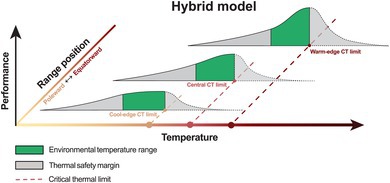 Figure 1
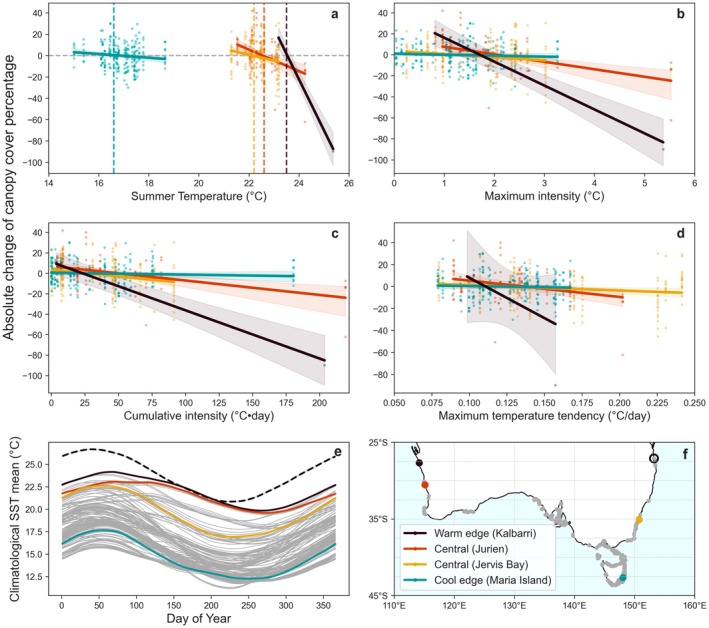 Figure 2
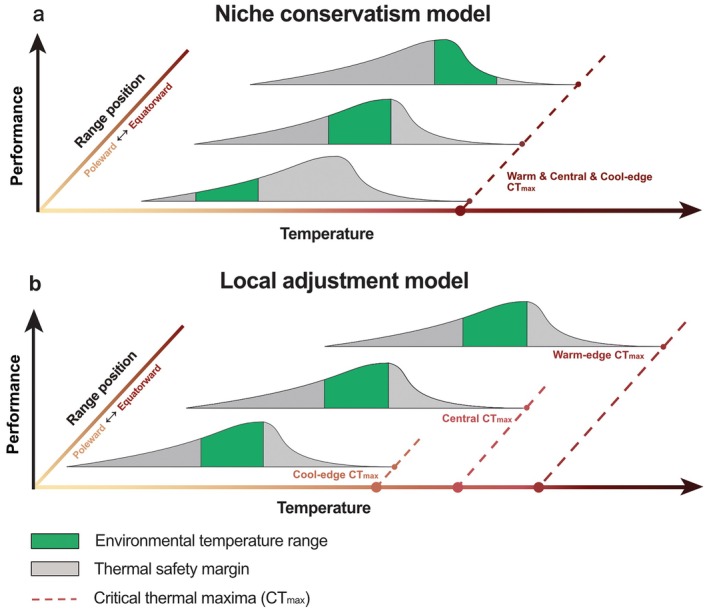 Figure 3
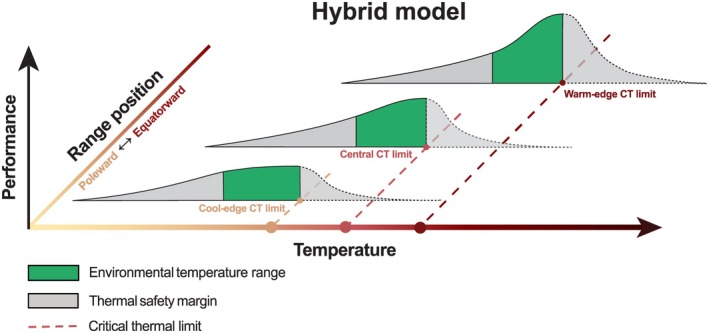 Figure 4
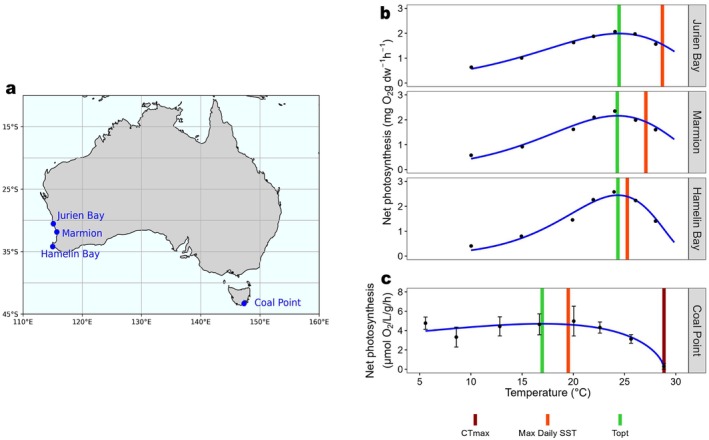 Figure 5
Peer Reviews
No public reviews on file for this paper yet. If you reviewed it on a platform where reviews are public (OpenReview, ICLR, NeurIPS, ICML), you can paste yours below so the community can read it here.
Videos
No videos yet. Explain this paper in a talk, walkthrough, or lecture? Add one.
Taxonomy
TopicsMarine and coastal plant biology · Marine Ecology and Invasive Species · Marine Bivalve and Aquaculture Studies