Auricular transcutaneous vagus nerve stimulation alters directed cortical communication during intentional actions
Moritz Mückschel, Jasmin Mayer, Bernhard Hommel, Christian Beste

TL;DR
Auricular vagus nerve stimulation affects brain communication during intentional actions, supporting and refining the ideomotor theory.
Contribution
The study reveals how atVNS alters cortical communication and provides neurobiological support for ideomotor theory.
Findings
atVNS modulates theta-band networks involving ATL, IC, and IFC.
Reduced directed information transfer suggests GABAergic modulation.
Connectivity effects distinguish action planning from perception.
Abstract
Understanding how intentional behavior emerges from neural dynamics requires linking cognitive theories with neurobiology. We combined auricular transcutaneous vagus nerve stimulation (atVNS) with EEG-based directed connectivity analyses to probe action-effect integration in a canonical theta-band network comprising the anterior temporal lobe (ATL), insular cortex (IC), and inferior frontal cortex (IFC). We show that this core network supports action-effect processing, but atVNS additionally recruited posterior temporal/ventral stream regions (PTL) and altered directed information transfer in the network. While some network properties (e.g., IFC-PTL asymmetry) were involved in both action-effect perception and planning, others (e.g., IC-IFC coupling) were specific to only one of these processes, suggesting that ideomotor theory would benefit from process-specific assumptions regarding…
Click any figure to enlarge with its caption.
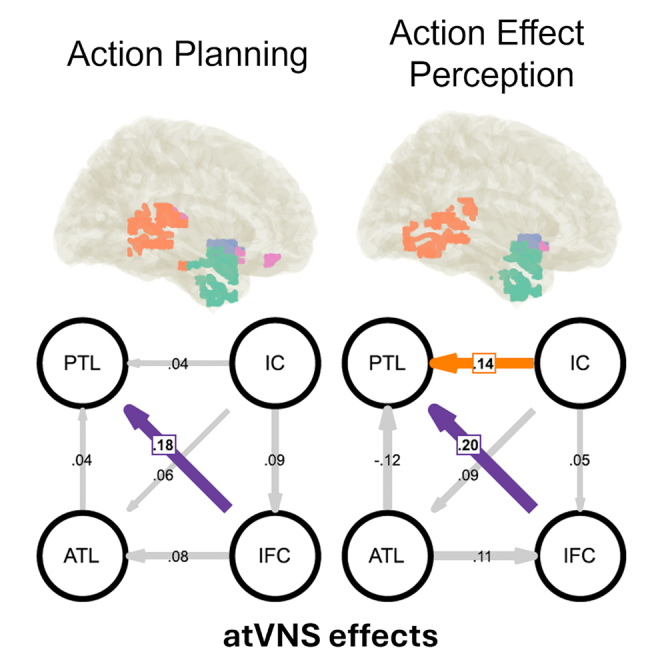 Figure 1
 Figure 2
 Figure 3
 Figure 4
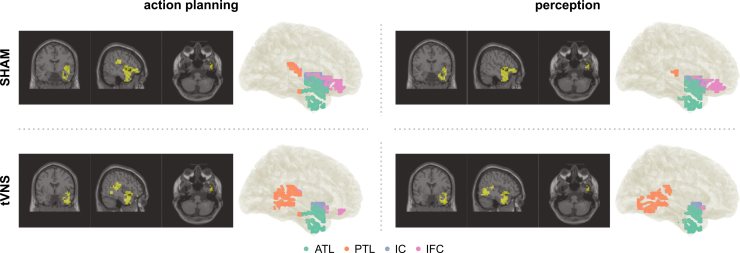 Figure 5
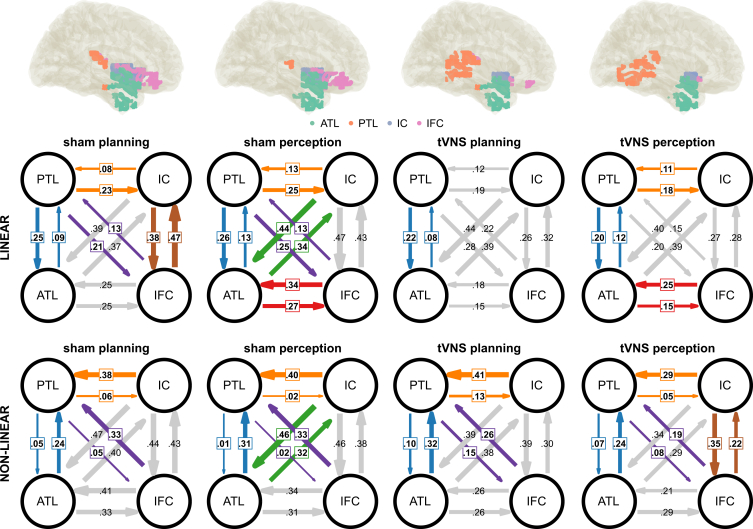 Figure 6
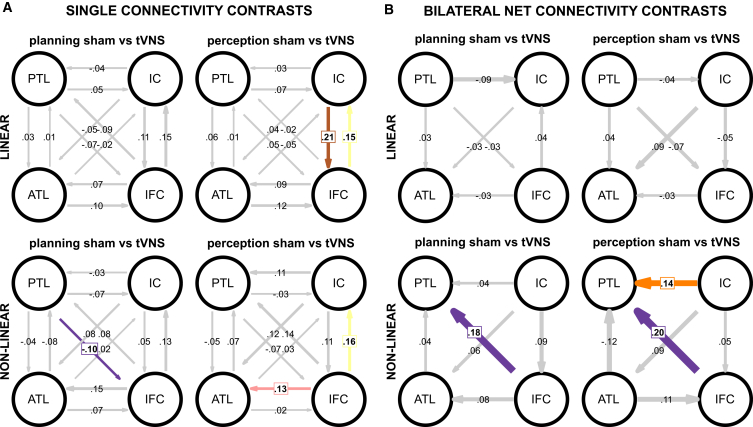 Figure 7
Peer Reviews
No public reviews on file for this paper yet. If you reviewed it on a platform where reviews are public (OpenReview, ICLR, NeurIPS, ICML), you can paste yours below so the community can read it here.
Videos
No videos yet. Explain this paper in a talk, walkthrough, or lecture? Add one.
Taxonomy
TopicsVagus Nerve Stimulation Research · EEG and Brain-Computer Interfaces · Neurological disorders and treatments