Association between postoperative urinary incontinence severity and anxiety in patients with prostate cancer: A chain mediation analysis of ehealth literacy and pelvic floor muscle training adherence
Qiuxia Qin, Juan Liu, Duo Zhang, Yuming Zhang, Xiaoqin Xie, Fan Yang, Lihong Huang, Xiaoqin Chen

TL;DR
This study finds that higher urinary incontinence severity after prostate cancer surgery is linked to anxiety, with eHealth literacy and pelvic floor muscle training adherence acting as key mediators.
Contribution
The study introduces a novel chain mediation model linking urinary incontinence severity to anxiety through eHealth literacy and pelvic floor muscle training adherence.
Findings
UI severity is indirectly linked to anxiety via eHealth literacy and PFMT adherence.
Combined mediation of eHealth literacy and PFMT adherence explains 34.6% of the total effect on anxiety.
Only 36.63% of patients showed high adherence to pelvic floor muscle training.
Abstract
This study aimed to examine the chain mediating roles of eHealth literacy and pelvic floor muscle training (PFMT) adherence in the association between urinary incontinence (UI) severity and anxiety. A cross-sectional study was conducted using convenience sampling to recruit 240 patients with prostate cancer one month after surgery. Validated instruments were used to assess PFMT adherence (PFMT Adherence Scale), eHealth literacy (eHEALS), UI severity (International Consultation on Incontinence Questionnaire-Short Form), and anxiety (Generalized Anxiety Disorder-7). Structural equation modeling (SEM) was performed using AMOS 24.0 to evaluate direct and indirect effects. Mediation effects were tested using bias-corrected bootstrap analyses with 5000 resamples and 95% CI. At one month postoperatively, 45.05% of patients experienced anxiety, 60.40% reported moderate-to-severe urinary…
Genes, proteins, chemicals, diseases, species, mutations and cell lines named across the full text — each resolved to its canonical identifier and authoritative record.
Click any figure to enlarge with its caption.
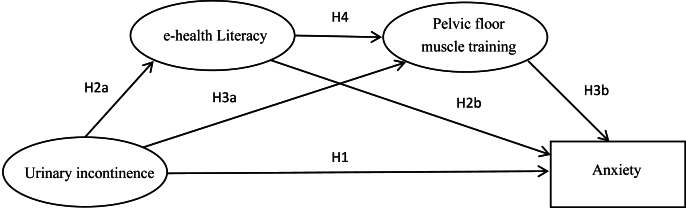 Figure 1
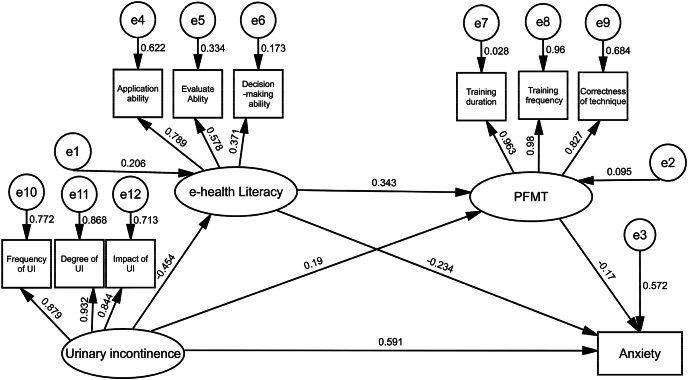 Figure 2
Peer Reviews
No public reviews on file for this paper yet. If you reviewed it on a platform where reviews are public (OpenReview, ICLR, NeurIPS, ICML), you can paste yours below so the community can read it here.
Videos
No videos yet. Explain this paper in a talk, walkthrough, or lecture? Add one.
Taxonomy
TopicsCancer survivorship and care · Pelvic floor disorders treatments · Prostate Cancer Diagnosis and Treatment