Inflammation and fibrosis at pancreatic resection margin and their role in post-operative pancreatic fistula development after pancreaticoduodenectomy: a pilot study from a single institution
Roberto Cammarata, Vincenzo La Vaccara, Alberto Catamerò, Chiara Taffon, Gianluca Costa, Laura Olivieri, Roberto Coppola, Damiano Caputo

TL;DR
This study shows that lack of fibrosis and inflammation at the pancreatic resection margin increases the risk of post-operative pancreatic fistulas after surgery.
Contribution
The study introduces a feasible intraoperative method using frozen sections to assess fibrosis and inflammation as predictors of pancreatic fistulas.
Findings
Absence of fibrosis and chronic lymphomononuclear inflammation at the resection margin independently predicts post-operative pancreatic fistulas.
Combined absence of fibrosis and inflammation significantly elevates the risk of clinically relevant fistulas.
Intraoperative frozen section evaluation of these factors is feasible and could guide surgical decisions.
Abstract
Postoperative pancreatic fistula (POPF) is a major complication after pancreaticoduodenectomy (PD), with significant impact on outcomes. While the absence of pancreatic fibrosis is a known risk factor, its intraoperative assessment is often subjective. Moreover, the potential protective role of chronic inflammation at the pancreatic resection margin (PRM) has not been fully explored. This study aimed to evaluate the histological presence of fibrosis and chronic lymphomononuclear inflammatory infiltrate (CLII) at the PRM as predictors of POPF and clinically relevant POPF (CR-POPF), and to assess their intraoperative feasibility via frozen sections. A retrospective analysis was performed on 141 patients who underwent PD (2014–2022). Intraoperative frozen sections of the PRM were reviewed for fibrosis and CLII using standardized semi-quantitative grading. Univariate and multivariate…
Genes, proteins, chemicals, diseases, species, mutations and cell lines named across the full text — each resolved to its canonical identifier and authoritative record.
Click any figure to enlarge with its caption.
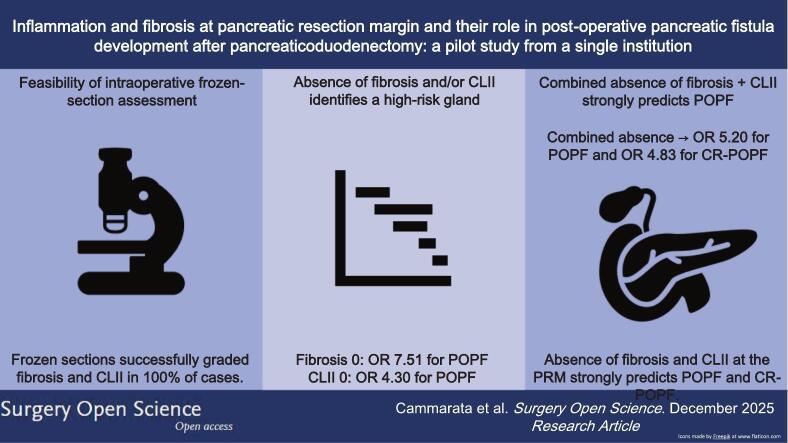 Figure 1
 Figure 2
 Figure 3
Peer Reviews
No public reviews on file for this paper yet. If you reviewed it on a platform where reviews are public (OpenReview, ICLR, NeurIPS, ICML), you can paste yours below so the community can read it here.
Videos
No videos yet. Explain this paper in a talk, walkthrough, or lecture? Add one.
Taxonomy
TopicsPancreatic and Hepatic Oncology Research · Pancreatitis Pathology and Treatment · Gallbladder and Bile Duct Disorders