Pancreatic cancer risk and survival in patients with Lynch syndrome: a nationwide Dutch cohort study
Aleksander M. Bogdanski, Derk C.F. Klatte, Bert A. Bonsing, Lodewijk A.A. Brosens, Evelien Dekker, Lydia G. van der Geest, Joep E.G. Ijspeert, Jan J. Koornstra, Mariëtte C.A. van Kouwen, Alexandra M.J. Langers, Maartje Nielsen, Dewkoemar Ramsoekh, Manon C. Spaander

TL;DR
This study finds that the risk of pancreatic and related cancers in Lynch syndrome patients is below the threshold for recommended surveillance, suggesting current guidelines may need re-evaluation.
Contribution
The study provides new population-based evidence on cancer risk and survival in Lynch syndrome patients, challenging current surveillance recommendations.
Findings
The combined lifetime risk of PDAC, AC, and dCC in Lynch syndrome patients is below 5%, not meeting the threshold for surveillance.
Survival for ampullary carcinoma is better in Lynch syndrome patients compared to sporadic cases.
No familial clustering of cancers was observed among Lynch syndrome patients.
Abstract
Individuals with Lynch syndrome (LS) are advised to undergo pancreatic ductal adenocarcinoma (PDAC) surveillance if their lifetime risk is ≥5%, however, evidence is limited. This study quantifies lifetime risk and survival of three cancers relevant to PDAC surveillance, including PDAC, ampullary carcinoma (AC) and distal cholangiocarcinoma (dCC), to evaluate whether surveillance is justified. This retrospective nationwide Dutch cohort study included individuals with LS pathogenic variants (PVs) in MLH1, MSH2, MSH6, PMS2 or EpCAM (identified between 1985 and 2024) and compared them to sporadic cases from the general population (diagnosed between 2000 and 2022). Cumulative incidence (CI) of PDAC, AC and dCC was estimated using Fine-and-Gray models for LS and a CI formula for sporadic cases. Relative risks (RRs) were calculated by comparing CIs. Survival of the cancers was compared…
Genes, proteins, chemicals, diseases, species, mutations and cell lines named across the full text — each resolved to its canonical identifier and authoritative record.
Click any figure to enlarge with its caption.
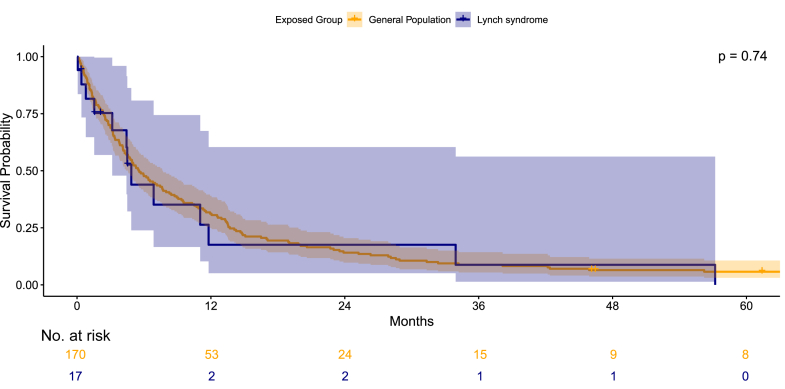 Figure 1
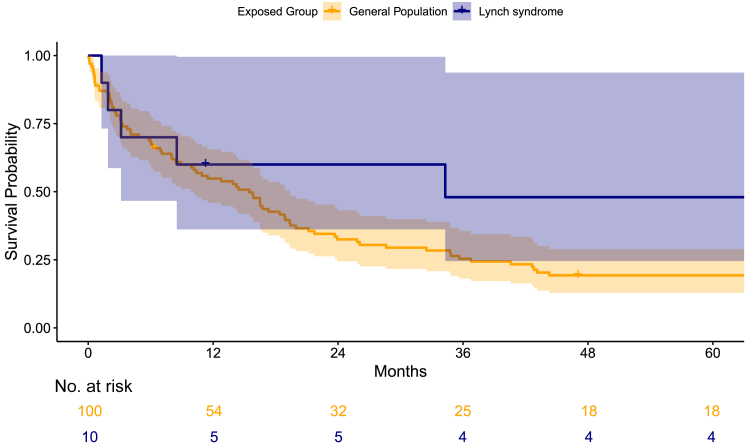 Figure 2
Peer Reviews
No public reviews on file for this paper yet. If you reviewed it on a platform where reviews are public (OpenReview, ICLR, NeurIPS, ICML), you can paste yours below so the community can read it here.
Videos
No videos yet. Explain this paper in a talk, walkthrough, or lecture? Add one.
Taxonomy
TopicsGenetic factors in colorectal cancer · Multiple and Secondary Primary Cancers · Cervical Cancer and HPV Research