Bench‐Stable Boryl Thianthrenium Dication Enables Aziridinyl Boronate Synthesis via Metal‐Free Late‐Stage Aziridination with Diverse Nitrogen Nucleophiles
Veerabhadra R. Vulupala, Disni Gunasekera, Nagarjun R. Mallampudi, Ramy Yousef, Yusif I. Gyasi, Gopal R. Ramidi, Ifeoluwa Adedotun, Shiqing Xu

TL;DR
A new bench-stable compound enables metal-free synthesis of aziridinyl boronates using various nitrogen nucleophiles, offering a practical method for drug-like scaffold development.
Contribution
A bench-stable boryl thianthrenium dication enables metal-free, selective aziridination with diverse nitrogen nucleophiles.
Findings
The boryl thianthrenium dication allows transition-metal-free synthesis of aziridinyl boronates.
The MIDA boryl group suppresses deborylation and promotes mono-adduct formation via a [4+2] cycloaddition pathway.
The method is applied to late-stage drug molecule modifications and asymmetric synthesis.
Abstract
Organoboron compounds are indispensable in modern organic synthesis and biomedical research. This study describes the synthesis of bench‐stable boryl thianthrenium dicationic compound via chemical or electrochemical thianthrenation of vinyl MIDA boronate. This unique boryl thianthrenium dication enables a transition‐metal‐free, chemo‐, and diastereoselective synthesis of aziridinyl boronates, utilizing a broad range of nitrogen nucleophiles. The method demonstrates generality, practicality, and functional group tolerance, as evidenced by its application to diverse substrates, including the late‐stage modification of drug molecules. Notably, the MIDA boryl group plays crucial roles in this approach including i) suppressing undesired deborylation, ii) promoting exclusive mono‐adduct formation via a formal [4 + 2] cycloaddition pathway, iii) directing regioselective vinyl boryl…
Genes, proteins, chemicals, diseases, species, mutations and cell lines named across the full text — each resolved to its canonical identifier and authoritative record.
Click any figure to enlarge with its caption.
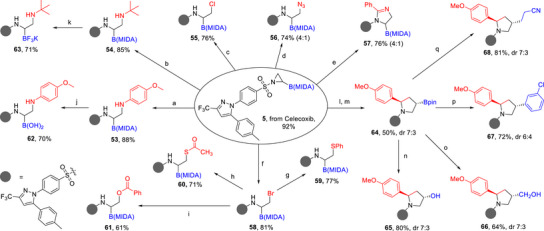 Figure 1
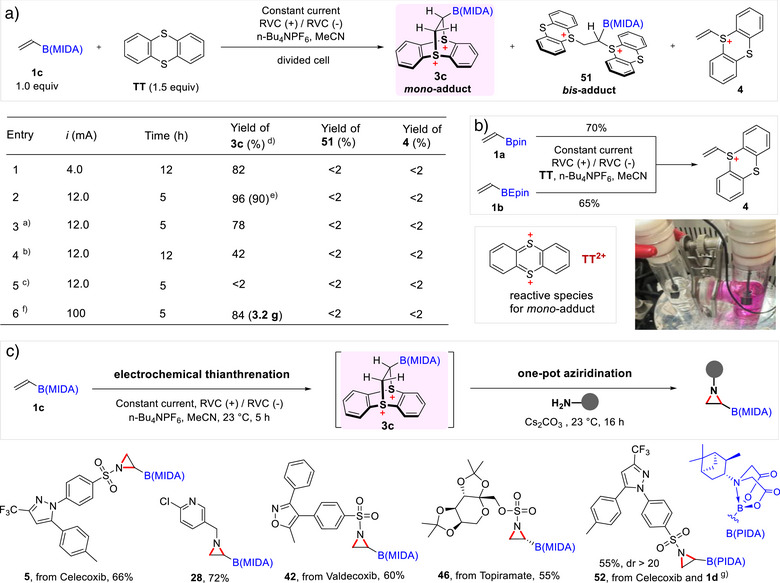 Figure 2
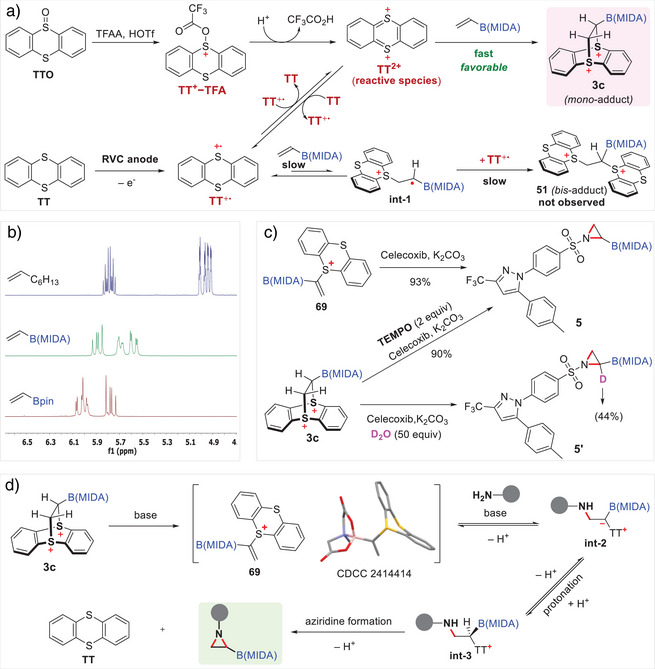 Figure 3
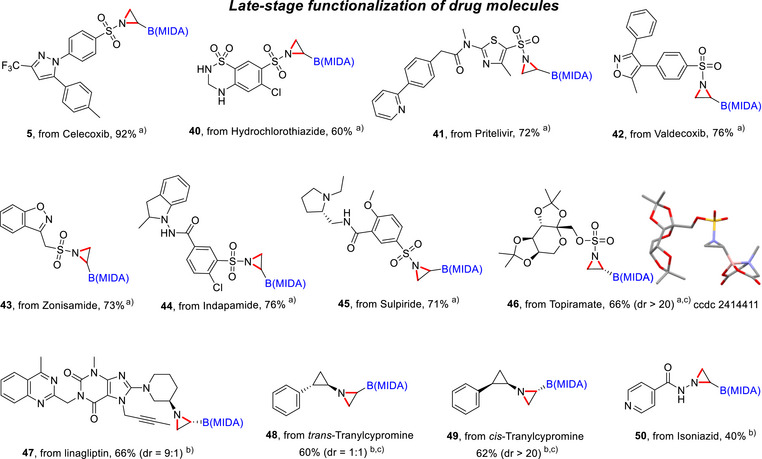 Figure 4
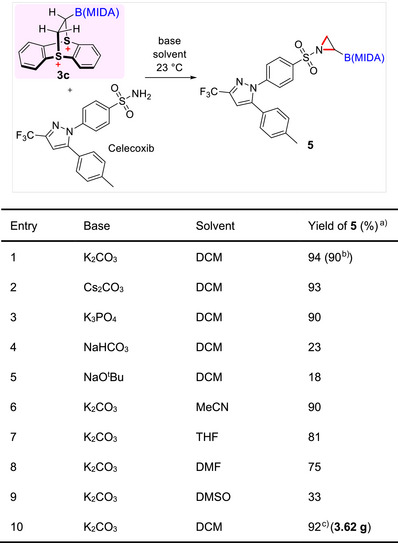 Figure 5
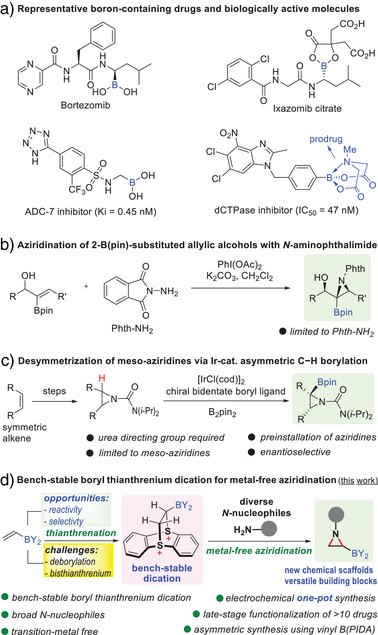 Figure 6
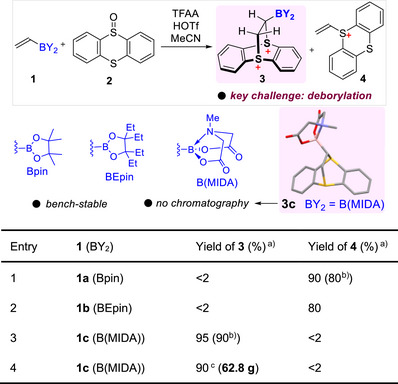 Figure 7
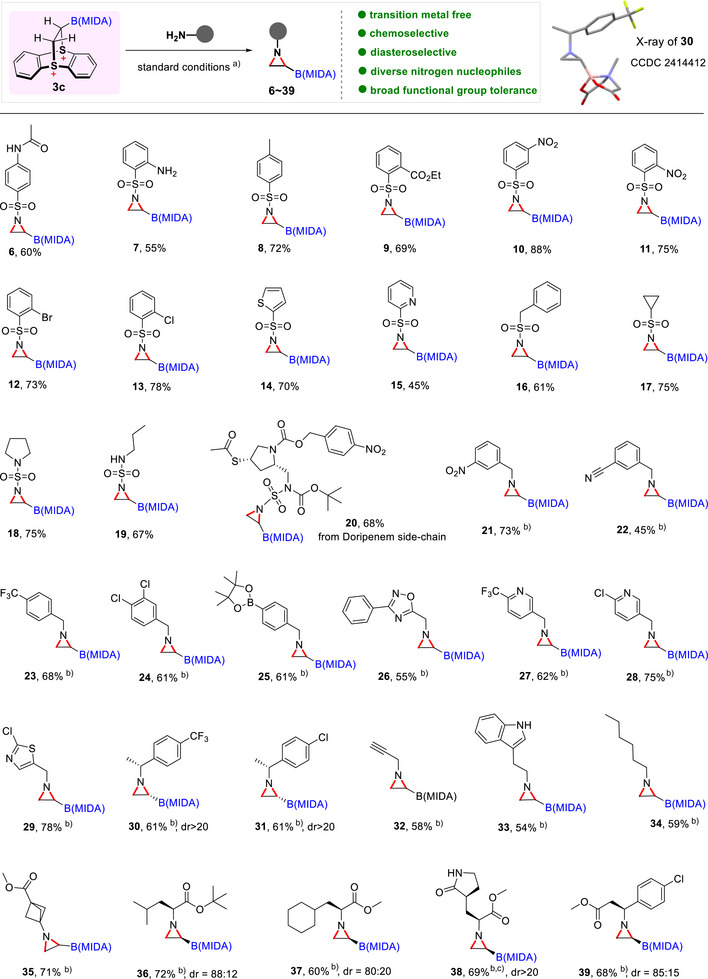 Figure 8
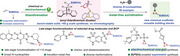 Figure 9
Peer Reviews
No public reviews on file for this paper yet. If you reviewed it on a platform where reviews are public (OpenReview, ICLR, NeurIPS, ICML), you can paste yours below so the community can read it here.
Videos
No videos yet. Explain this paper in a talk, walkthrough, or lecture? Add one.
Taxonomy
TopicsOrganoboron and organosilicon chemistry · Catalytic C–H Functionalization Methods · Radical Photochemical Reactions