Genetic Ancestry Reveals Historical Diversity of Formation Across Three Brazilian Communities of African Descent (Quilombos) in Central Brazil
Sabrina Guimarães Paiva, Anna C. Rivara, Matheus de Castro Nóbrega, Rafaela de Cesare Parmezan Toledo, Maria de Nazaré Klautau‐Guimarães, Sidney Emanuel Batista dos Santos, Lorena Madrigal, Silviene Fabiana de Oliveira

TL;DR
This study explores the genetic diversity of three Brazilian quilombo communities, revealing how their histories of isolation and location influence their ancestry.
Contribution
The study provides new insights into the genetic ancestry of recently settled Central Brazilian quilombos, highlighting regional and sociodemographic variations.
Findings
Average African ancestry varied significantly among the three quilombo communities, with Kalunga having the highest at 63.17%.
Communities closer to urban areas showed higher European and Indigenous ancestry contributions.
The study reveals how historical and environmental factors shape the genetic makeup of quilombo populations.
Abstract
Characterized as relatively isolated communities, many Brazilian quilombos were formed during the period of slavery in Brazil when enslaved persons (most of African descent) ran away or were abandoned by their enslavers. Quilombos in Central Brazil, whose settlement was more recent due to the relative isolation of the region, remain understudied. To address this gap, this study estimated the genetic ancestry of three quilombo communities in Central Brazil. A cross‐sectional study was performed among three Central Brazilian quilombos, Cocalinho (N = 54) and Pé do Morro (N = 58) located in the Brazilian state of Tocantins, and Kalunga (N = 132) located in the state of Goiás. Genetic ancestry was estimated from 61 Ancestry‐informative INDEL biallelic markers collected from blood samples and analyzed using STRUCTURE v 2.3. Statistical analyses were performed using SAS statistical software,…
Click any figure to enlarge with its caption.
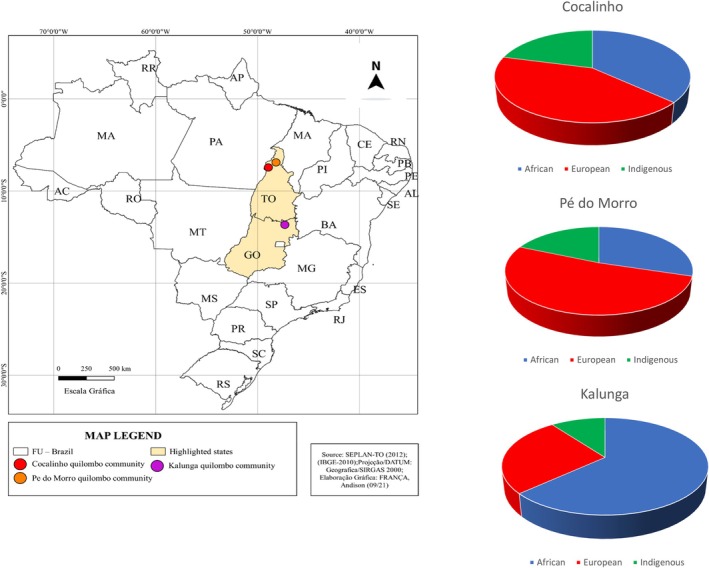 Figure 1
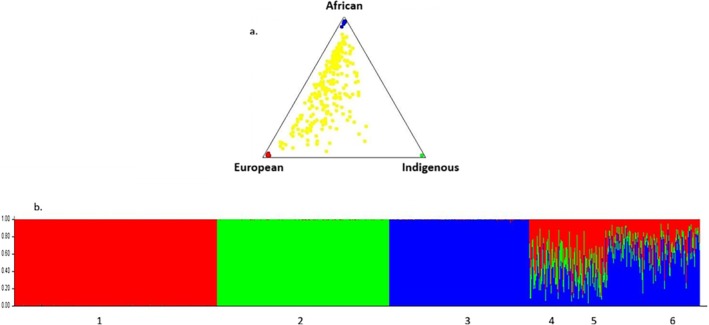 Figure 2
Peer Reviews
No public reviews on file for this paper yet. If you reviewed it on a platform where reviews are public (OpenReview, ICLR, NeurIPS, ICML), you can paste yours below so the community can read it here.
Videos
No videos yet. Explain this paper in a talk, walkthrough, or lecture? Add one.
Taxonomy
TopicsForensic and Genetic Research · Race, Genetics, and Society · Historical and Cultural Archaeology Studies