Pure Molecular Inorganic Rings: Mixed Group 14/15 Metallacycles
Stefanie Maier, Xiaofei Sun, Lisa Zimmermann, Ralf Köppe, Manfred Scheer, Peter W. Roesky

TL;DR
Scientists created new inorganic rings using silicon, germanium, and heavy elements like antimony, bonded with a molybdenum atom.
Contribution
The paper reports the first examples of three- to five-membered pure inorganic heterocycles with mixed group 14/15 atoms and a transition metal.
Findings
Novel Si–Sb and Ge–Sb ring systems were synthesized, including three- and four-membered rings.
The ring size depends on the combination of tetrel and pnictogen atoms used in the reaction.
These metallacycles offer new reactivity possibilities for heavy group 14/15 chemistry.
Abstract
A systematic study on the reactivity of the homodipnictogen tetrahedrane complexes [{Cp‘Mo(CO)2}2(μ,η2:2‐E2)] (E ═ P, As, Sb; Cp‘ = η5‐C5H4 tBu) towards the disilylene [LPhSi]2 and digermylene [LPhGe]2 (LPh = PhC(NtBu)2) is presented. Depending on the specific combination of tetrel and pnictogen atom, a variety of novel silicon‐pnictogen and germanium‐pnictogen heterocycles in different bonding situations were obtained. This is a significant development, as these metallacycles are unprecedented and offer new possibilities for further reactivities. These three‐ to five‐membered pure inorganic heterocycles include one Mo, one or two tetrel, and one or two pnictogen atoms in each case. Especially for the heavier pnictogen Sb, this cyclization behavior forming novel three‐ and four‐membered Si–Sb as well as five‐membered Ge–Sb ring systems has not been observed so far. These results present…
Genes, proteins, chemicals, diseases, species, mutations and cell lines named across the full text — each resolved to its canonical identifier and authoritative record.
Click any figure to enlarge with its caption.
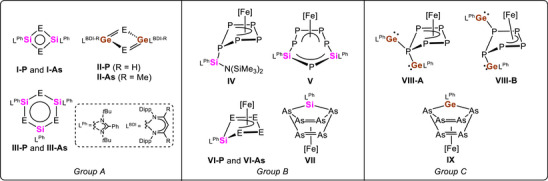 Figure 1
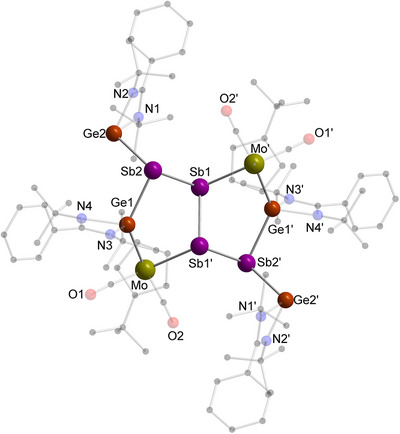 Figure 2
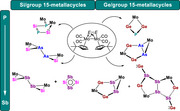 Figure 3
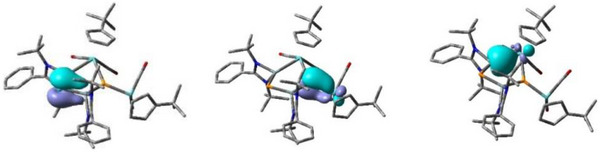 Figure 4
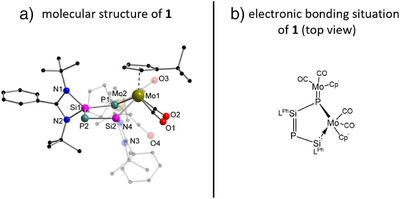 Figure 5
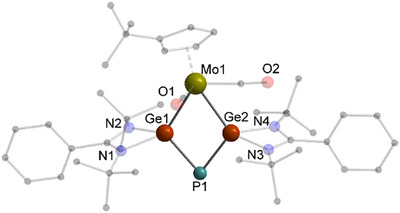 Figure 6
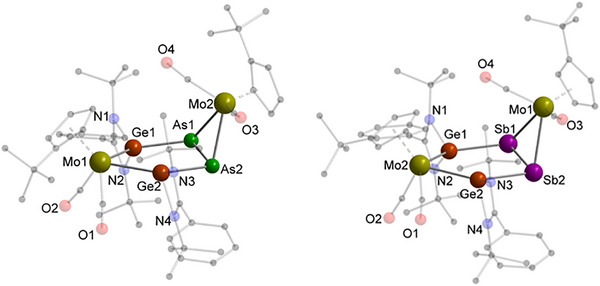 Figure 7
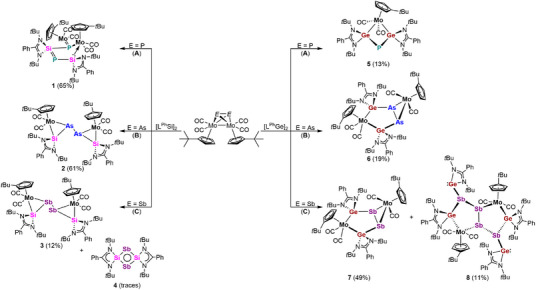 Figure 8
 Figure 9
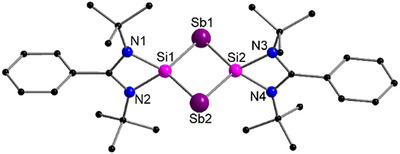 Figure 10
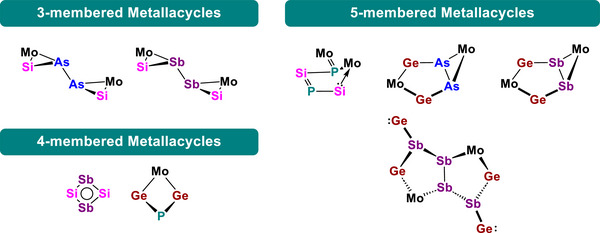 Figure 11
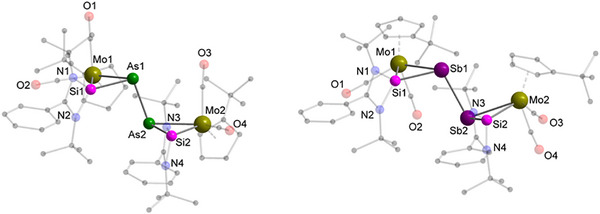 Figure 12
Peer Reviews
No public reviews on file for this paper yet. If you reviewed it on a platform where reviews are public (OpenReview, ICLR, NeurIPS, ICML), you can paste yours below so the community can read it here.
Videos
No videos yet. Explain this paper in a talk, walkthrough, or lecture? Add one.
Taxonomy
TopicsSynthesis and characterization of novel inorganic/organometallic compounds · Organometallic Complex Synthesis and Catalysis · Organoboron and organosilicon chemistry