Rigidifying Qubit Candidates in a Cu‐Porphyrin Nanohoop: Dipolar Coupling in Spin Pairs and Spin‐Polarized Ground State
Xingmao Chang, Ashley J. Redman, Linda Zedler, Louis Blechschmidt, Adriana Sacristán‐Martín, Fabian Schwer, Inhar Imaz, Markus P. B. Wiedmaier, Xavi Ribas, Daniel Maspoch, Benjamin Dietzek‐Ivanšić, Sabine Richert, Max von Delius

TL;DR
Researchers created a rigid nanohoop with copper centers that could be used as molecular qubits, showing unique spin interactions and light-induced polarization.
Contribution
The study demonstrates a novel use of rigid nanohoops to achieve well-defined spin coupling and light-induced polarization in molecular qubit systems.
Findings
The Cu[3]CPTA nanohoop exhibits well-defined dipolar coupling between spin centers.
A rare light-induced polarization of a doublet ground state was observed in frozen solution.
Nanohoop rigidity is shown to significantly influence spin interactions compared to more flexible structures.
Abstract
Assembling molecular qubit candidates with precise control over the position and orientation of spin centers is an important contemporary challenge for synthesis. In this work, we show that the rigidity of highly strained macrocycles from the cycloparaphenylene family gives rise to distinct spin‐spin and light‐spin interactions that make such few‐qubit systems a promising testing ground for future quantum technologies. We synthesized conjugated nanohoop Cu[3]CPTA that comprises three Cu(II)porphyrin centers (S = ½) with a Cu–Cu distance of ca. 18 Å (by single‐crystal X‐ray diffraction). Continuous‐wave (cw) and pulse electron‐paramagnetic resonance (EPR) studies revealed that dipolar coupling in spin pairs is so well defined in this nanohoop that the Cu–Cu distance can be determined accurately via double electron–electron resonance (DEER). By transient cwEPR, we observed a rare case of…
Click any figure to enlarge with its caption.
 Figure 1
 Figure 2
 Figure 3
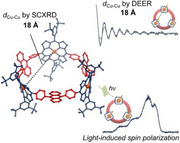 Figure 4
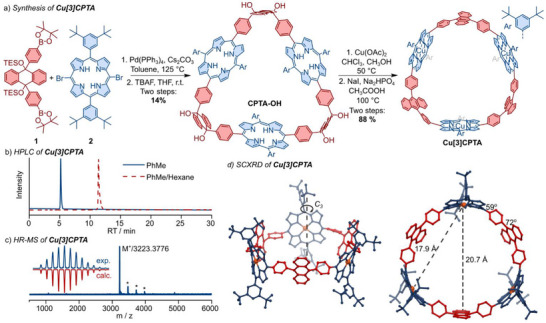 Figure 5
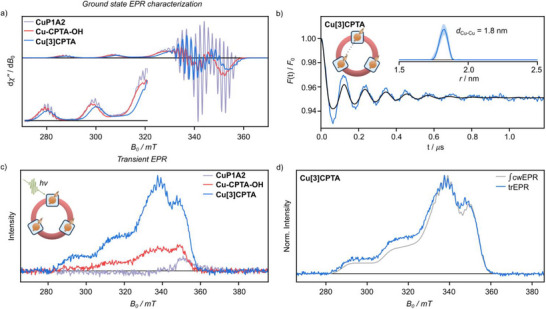 Figure 6
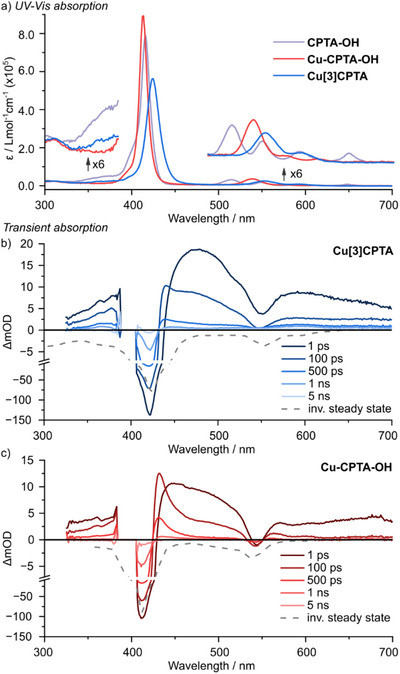 Figure 7
Peer Reviews
No public reviews on file for this paper yet. If you reviewed it on a platform where reviews are public (OpenReview, ICLR, NeurIPS, ICML), you can paste yours below so the community can read it here.
Videos
No videos yet. Explain this paper in a talk, walkthrough, or lecture? Add one.
Taxonomy
TopicsMagnetism in coordination complexes · Synthesis and Properties of Aromatic Compounds · Supramolecular Chemistry and Complexes