Function of the Human Cingulate Cortex: A Brainnetome Atlas‐Based Study via Cortical Electrical Stimulation in Patients With Epilepsy
Qinqin Deng, Mengyang Wang, Guanpeng Chen, Xiongfei Wang, Zhaofen Yan, Huajun Yang, Yujiao Yang, Minghui Wang, Mengyi Guo, Zhonghua Xiong, Nan Guan, Jian Zhou, Yuguang Guan, Guoming Luan, Tianfu Li, Jing Wang

TL;DR
This study maps the functions of the human cingulate cortex using brain stimulation in epilepsy patients, revealing distinct roles in sensory, emotional, and memory processes.
Contribution
The study provides a detailed functional atlas of the cingulate cortex using the Brainnetome Atlas and cortical electrical stimulation.
Findings
Somatosensory responses were widespread, while motor responses were localized to middle-posterior subregions.
Autonomic and emotional responses were broadly distributed, with A24rv as an affective hub.
Pain responses involved both anterior and posterior subregions, indicating dual affective and spatial roles.
Abstract
This study aimed to systematically map the functional organization of the cingulate gyrus using cortical electrical stimulation (CES) guided by the Brainnetome Atlas. We retrospectively analyzed CES data from 234 patients with drug‐resistant epilepsy who underwent stereoelectroencephalography (SEEG) implantation in the cingulate cortex. A total of 1141 stimulation sites across seven cingulate subregions (A23d, A24rv, A32p, A23v, A24cd, A23c, A32sg) were examined. Responses were categorized into somatosensory, motor, autonomic, vestibular, visual, emotional, memory, and pain‐related phenomena. Key findings included: (1) Somatosensory responses (n = 99) were widely distributed, with motor responses localized to middle‐posterior subregions (A23c/A24rv/A24cd); (2) Autonomic (n = 58) and emotional (n = 15) responses showed broad distribution, with ventral MCC (A24rv) as an affective hub;…
Genes, proteins, chemicals, diseases, species, mutations and cell lines named across the full text — each resolved to its canonical identifier and authoritative record.
Click any figure to enlarge with its caption.
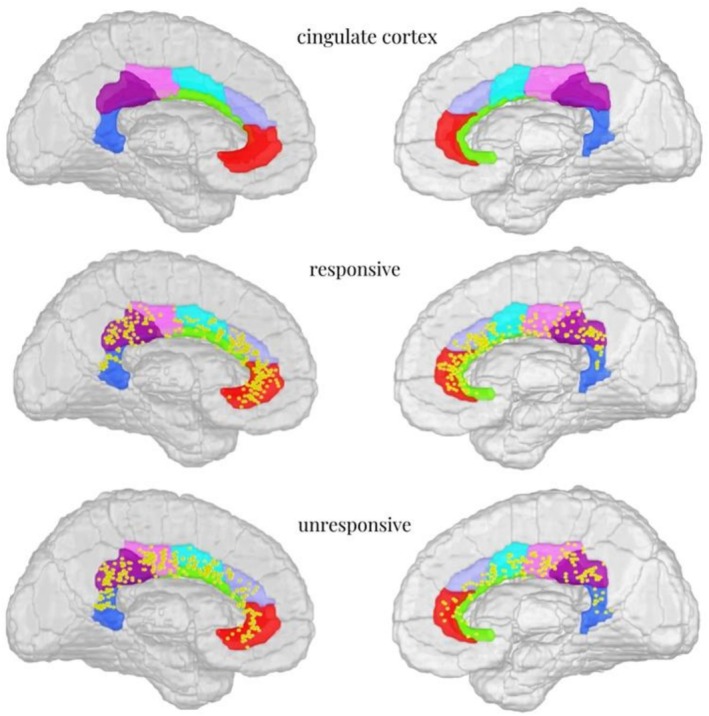 Figure 1
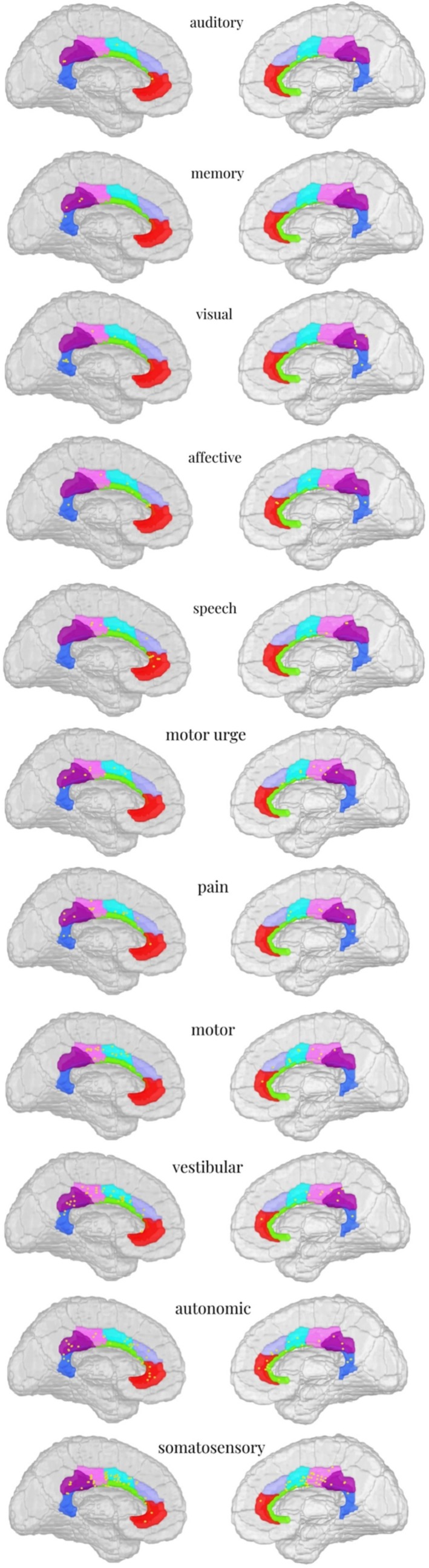 Figure 2
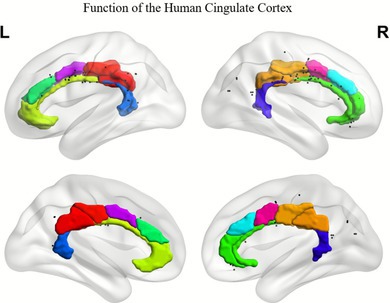 Figure 3
Peer Reviews
No public reviews on file for this paper yet. If you reviewed it on a platform where reviews are public (OpenReview, ICLR, NeurIPS, ICML), you can paste yours below so the community can read it here.
Videos
No videos yet. Explain this paper in a talk, walkthrough, or lecture? Add one.
Taxonomy
TopicsNeurological disorders and treatments · Epilepsy research and treatment · Transcranial Magnetic Stimulation Studies