Developing an AI-Assisted Tool That Identifies Patients With Multimorbidity and Complex Polypharmacy to Improve the Process of Medication Reviews: Qualitative Interview and Focus Group Study
Aseel S Abuzour, Samantha A Wilson, Alan A Woodall, Frances S Mair, Asra Aslam, Andrew Clegg, Eduard Shantsila, Mark Gabbay, Michael Abaho, Danushka Bollegala, Harriet Cant, Alan Griffiths, Layik Hama, Gary Leeming, Emma Lo, Simon Maskell, Maurice O'Connell, Olusegun Popoola

TL;DR
This study explores how AI tools can help healthcare professionals manage complex medication reviews for patients with multiple chronic conditions and many medications.
Contribution
The study identifies user requirements for AI-assisted tools in medication reviews, focusing on multimorbid patients and workflow integration.
Findings
Healthcare professionals see AI potential in identifying high-risk patients and detecting prescribing issues.
User-friendly design and seamless integration with electronic records are critical for AI tool adoption.
Participants emphasized intuitive data visualization and shared decision-making interfaces.
Abstract
Structured medication reviews (SMRs) are an essential component of medication optimization, especially for patients with multimorbidity and polypharmacy. However, the process remains challenging due to the complexities of patient data, time constraints, and the need for coordination among health care professionals (HCPs). This study explores HCPs’ perspectives on the integration of artificial intelligence (AI)–assisted tools to enhance the SMR process, with a focus on the potential benefits of and barriers to adoption. This study aims to identify the key user requirements for AI-assisted tools to improve the efficiency and effectiveness of SMRs, specifically for patients with multimorbidity, complex polypharmacy, and frailty. A qualitative study was conducted involving focus groups and semistructured interviews with HCPs and patients in the United Kingdom. Participants included…
Genes, proteins, chemicals, diseases, species, mutations and cell lines named across the full text — each resolved to its canonical identifier and authoritative record.
Click any figure to enlarge with its caption.
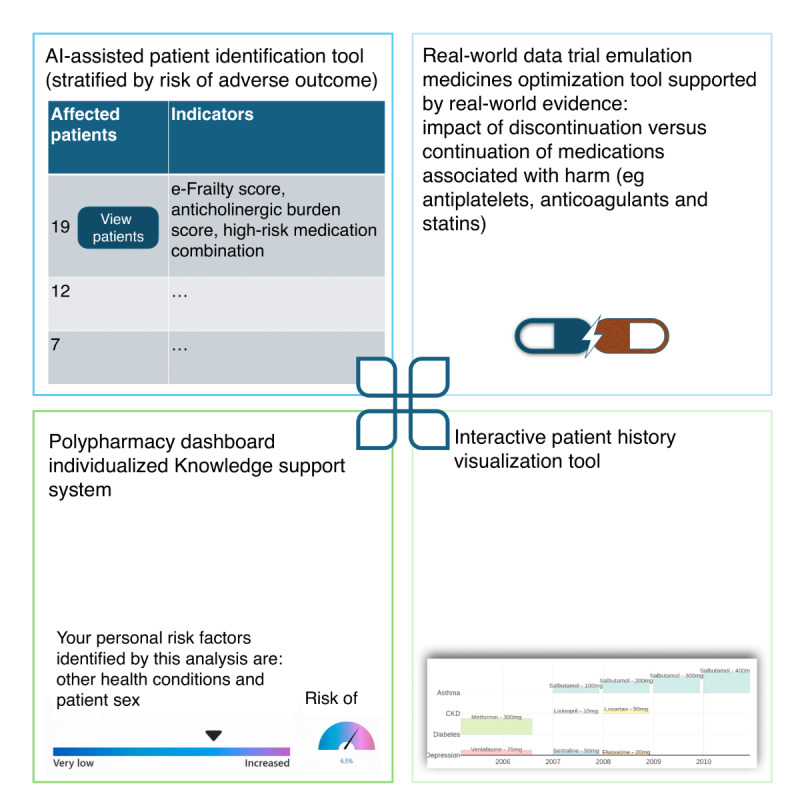 Figure 1
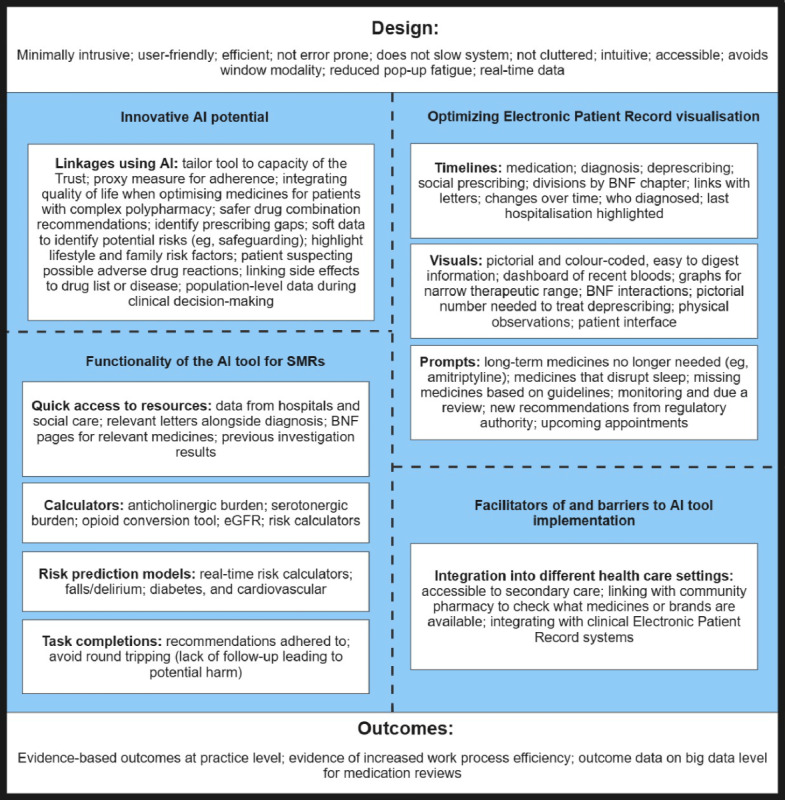 Figure 2
Peer Reviews
No public reviews on file for this paper yet. If you reviewed it on a platform where reviews are public (OpenReview, ICLR, NeurIPS, ICML), you can paste yours below so the community can read it here.
Videos
No videos yet. Explain this paper in a talk, walkthrough, or lecture? Add one.
Taxonomy
TopicsPharmaceutical Practices and Patient Outcomes · Electronic Health Records Systems · Chronic Disease Management Strategies