Axillary Artery Pseudoaneurysm Secondary to Septic Shoulder After Trauma: A Review of Incidence and Outcomes
Kiranjot Kaur, Beshr Mosa Basha, Harleen Kaur, Ahmed M Mohamed, Shashwat Shetty, Shenouda R Shehata Abdelmesih, Nada Rashid, Jideofor Okoye, Miqdad Qandeel, Kiran Ahmed

TL;DR
This review examines rare axillary artery pseudoaneurysms caused by trauma or septic shoulder infections, highlighting the importance of early diagnosis and surgical treatment to prevent severe complications.
Contribution
The study provides a systematic review of incidence, clinical features, and outcomes of axillary artery pseudoaneurysms following trauma or septic shoulder.
Findings
AAP is rare but can lead to limb loss if untreated.
Traumatic AAP is often linked to shoulder dislocation or sports injuries.
Surgical repair is effective for limb salvage and neurological recovery.
Abstract
Axillary artery pseudoaneurysm (AAP) is a rare vascular complication arising from trauma or septic shoulder conditions. Its proximity to the brachial plexus and axillary structures increases the risk for neurovascular compromise, hemorrhage, and limb loss. This review aims to evaluate the incidence, clinical characteristics, and outcomes of AAP secondary to trauma and septic shoulder infection. A systematic literature search was conducted in PubMed, Embase, Scopus, and the Cochrane Library through October 2025 following Preferred Reporting Items for Systematic Reviews and Meta-Analyses guidelines. Eligible studies included case reports and series reporting AAP after trauma or septic shoulder. Data on patient demographics, etiology, diagnostic methods, management, and outcomes were extracted and qualitatively synthesized. Five studies comprising 14 patients met the inclusion criteria.…
Genes, proteins, chemicals, diseases, species, mutations and cell lines named across the full text — each resolved to its canonical identifier and authoritative record.
Click any figure to enlarge with its caption.
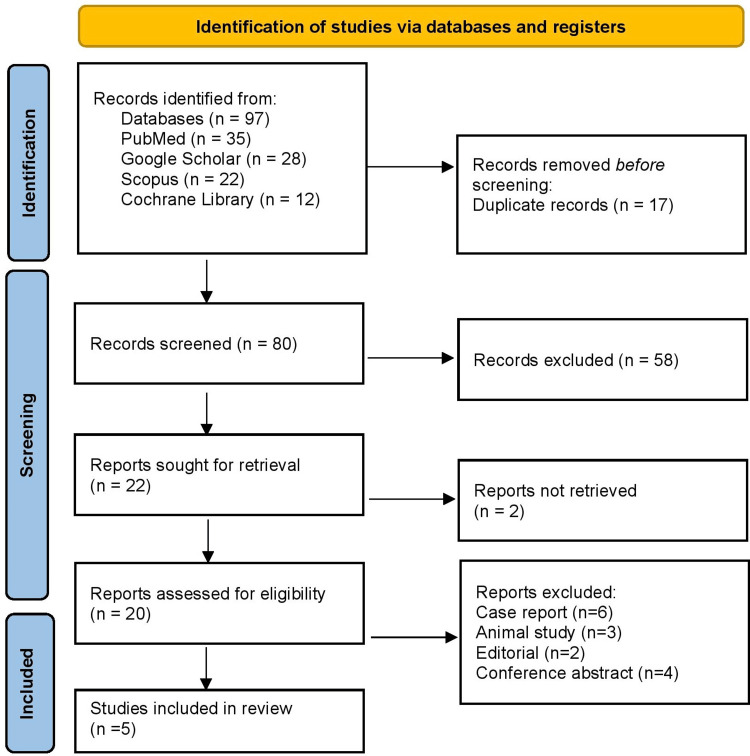 Figure 1
Peer Reviews
No public reviews on file for this paper yet. If you reviewed it on a platform where reviews are public (OpenReview, ICLR, NeurIPS, ICML), you can paste yours below so the community can read it here.
Videos
No videos yet. Explain this paper in a talk, walkthrough, or lecture? Add one.
Taxonomy
TopicsVascular Procedures and Complications · Infectious Aortic and Vascular Conditions · Peripheral Artery Disease Management