Clinical outcome of reverse total shoulder arthroplasty (comprehensive system) after failed rotator cuff repair with a medium-term follow-up: comparison with reverse total shoulder arthroplasty for massive rotator cuff tear without osteoarthritis
Ji Un Kim, Ji Young Yoon, Young Dae Jeon, Hyung Ki Cho, Hyeon Jang Jeong, Joo Han Oh

TL;DR
This study compares the outcomes of reverse shoulder surgery in patients with different shoulder conditions, finding that surgery after failed repair has worse results than primary surgery.
Contribution
The study provides a comparative analysis of clinical outcomes for different types of reverse total shoulder arthroplasty with medium-term follow-up.
Findings
Functional outcomes significantly improved postoperatively in all groups.
The fRCR group had worse outcomes compared to the mRCT and CTA groups.
Postoperative complications and radiologic outcomes were not significantly different between groups.
Abstract
We compared the clinical outcomes of primary reverse total shoulder arthroplasty (rTSA) in patients with massive rotator cuff tears (mRCTs) without osteoarthritis (OA), secondary rTSA in patients with failed rotator cuff repair (RCR), and primary rTSA in patients with cuff tear arthropathy (CTA) as a control group. Among 364 patients who underwent rTSA between March 2014 and August 2019, 153 were included. All patients underwent surgery with a single implant type and were followed for a minimum of 4 years. Patients were categorized into three groups: primary rTSA for mRCT without OA (mRCT group, n = 24), primary rTSA for CTA (CTA group, n = 104), and rTSA for failed rotator cuff repair group (fRCR; fRCR group, n = 25). The mean age was 71.5 ± 6.3 (range, 53-83) years, with a mean follow-up of 54.7 ± 12.9 (range, 48-98) months. Functional outcomes were assessed using the active range of…
Genes, proteins, chemicals, diseases, species, mutations and cell lines named across the full text — each resolved to its canonical identifier and authoritative record.
Click any figure to enlarge with its caption.
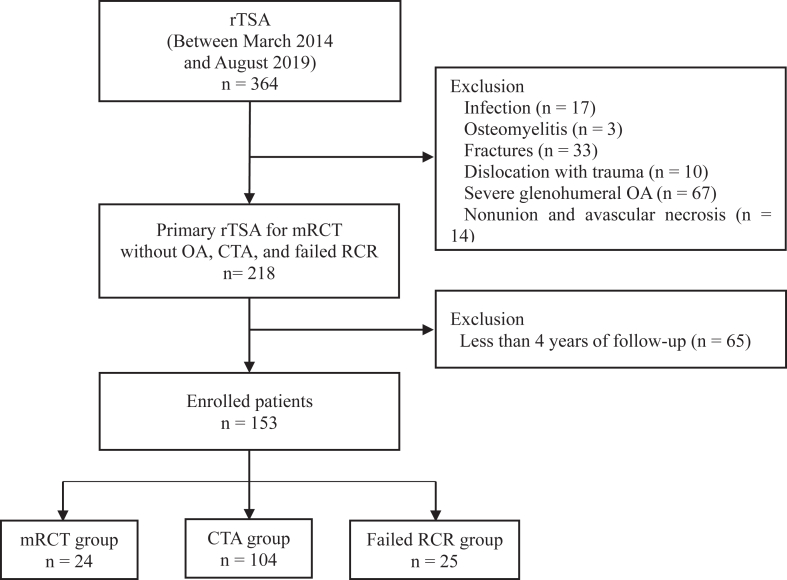 Figure 1
Peer Reviews
No public reviews on file for this paper yet. If you reviewed it on a platform where reviews are public (OpenReview, ICLR, NeurIPS, ICML), you can paste yours below so the community can read it here.
Videos
No videos yet. Explain this paper in a talk, walkthrough, or lecture? Add one.
Taxonomy
TopicsShoulder Injury and Treatment · Shoulder and Clavicle Injuries · Nerve Injury and Rehabilitation