Two-dimensional magnetic resonance imaging sequences correlate to three-dimensional computed tomography for evaluation of glenoid bone loss
Scott M. Feeley, Shankar S. Thiru, Benjamin E. Neubauer, Rachel E. Cherelstein, Christopher M. Kuenze, Udit Rawat, Edward S. Chang

TL;DR
This study shows that 2D MRI sequences can accurately measure glenoid bone loss, similar to 3D CT scans.
Contribution
The study demonstrates that 2D FIESTA MRI is a reliable alternative to 3D CT for evaluating glenoid bone loss.
Findings
2D FIESTA MRI showed excellent agreement with 3D CT for measuring glenoid bone loss.
FIESTA slightly outperformed PD FS sequences in accuracy.
Linear regression models improved the accuracy of both MRI sequences to within 0.6% of CT results.
Abstract
To correlate two-dimensional (2D) fast-imaging employing steady-state acquisition (FIESTA) magnetic resonance imaging protocols with three-dimensional (3D) computed tomography (CT) for calculation of glenoid bone loss (GBL). FIESTA is a high-resolution protocol with high contrast, high signal-to-noise ratio, and sharp edge definition. We included patients who underwent a shoulder stabilization procedure from 2010 to 2023 with 2D FIESTA and 2D proton density fat-saturation (PD FS) magnetic resonance arthrogram sequences as well as 3D CT of the shoulder. We excluded patients with history of prior shoulder surgery or posterior instability, if the CT and magnetic resonance imaging were >90 days apart or if there was a documented instability event between imaging studies. Two raters calculated the primary outcome of GBL by the perfect-circle linear method twice for each modality separated…
Genes, proteins, chemicals, diseases, species, mutations and cell lines named across the full text — each resolved to its canonical identifier and authoritative record.
Click any figure to enlarge with its caption.
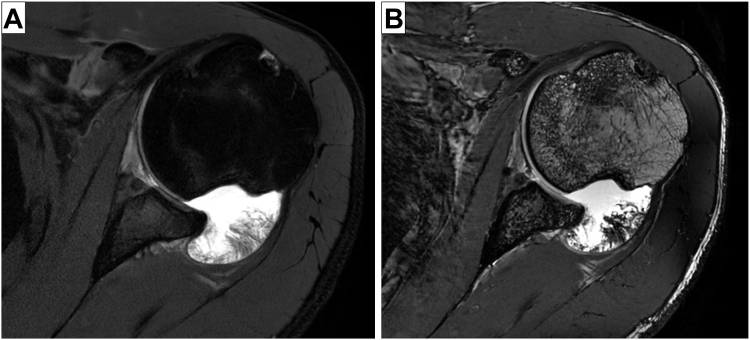 Figure 1
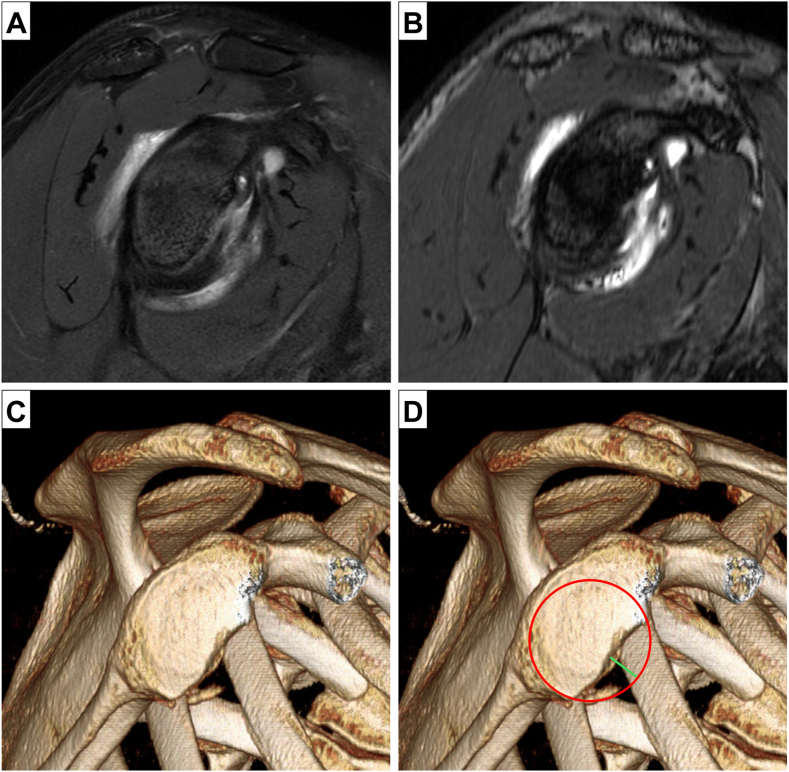 Figure 2
Peer Reviews
No public reviews on file for this paper yet. If you reviewed it on a platform where reviews are public (OpenReview, ICLR, NeurIPS, ICML), you can paste yours below so the community can read it here.
Videos
No videos yet. Explain this paper in a talk, walkthrough, or lecture? Add one.
Taxonomy
TopicsShoulder Injury and Treatment · Shoulder and Clavicle Injuries · Orthopedic Surgery and Rehabilitation