Anti-inflammatory and Antioxidant Effects of Kaempferia galanga Extract in Acute Bacterial Rhinosinusitis: In Vivo Study on MDA, NF-κB, and CRP
Aziza Viquisa Berliana Putri, Paramasari Dirgahayu, Bambangx Purwanto, Soetrisno Soetrisno, Betty Suryawati, Risya Cilmiaty, Hadi Sudrajad

TL;DR
This study shows that Kaempferia galanga extract at 300 mg/kg reduces inflammation and oxidative stress in a mouse model of acute bacterial rhinosinusitis.
Contribution
The study identifies the optimal dose of K. galanga extract for anti-inflammatory and antioxidant effects in acute bacterial rhinosinusitis.
Findings
KG300 group showed significantly lower MDA, NF-κB, and CRP levels compared to other doses.
300 mg/kg K. galanga extract provides optimal therapeutic benefit in ABRS.
The extract's anti-inflammatory and antioxidant effects suggest potential as an adjunct therapy.
Abstract
Acute bacterial rhinosinusitis (ABRS) is an inflammation of the paranasal sinuses caused by bacterial infection, primarily involving inflammatory responses and oxidative stress. While antibiotics are the standard treatment, their effectiveness can sometimes be limited. Kaempferia galanga (K. galanga), a medicinal plant known for its anti-inflammatory and antioxidant properties, has shown potential as a therapeutic agent. This study aimed to evaluate the therapeutic efficacy of K. galanga extract in a mouse model of ABRS. An in vivo experimental study was conducted using Sprague-Dawley rats with induced ABRS. The animals were randomly divided into three treatment groups that received K. galanga extract at doses of 150 mg/kg (KG150), 300 mg/kg (KG300), or 450 mg/kg (KG450) based on body weight. Therapeutic effects were assessed by measuring serum levels of MDA, NF-κB, and CRP. Eighteen…
Genes, proteins, chemicals, diseases, species, mutations and cell lines named across the full text — each resolved to its canonical identifier and authoritative record.
Click any figure to enlarge with its caption.
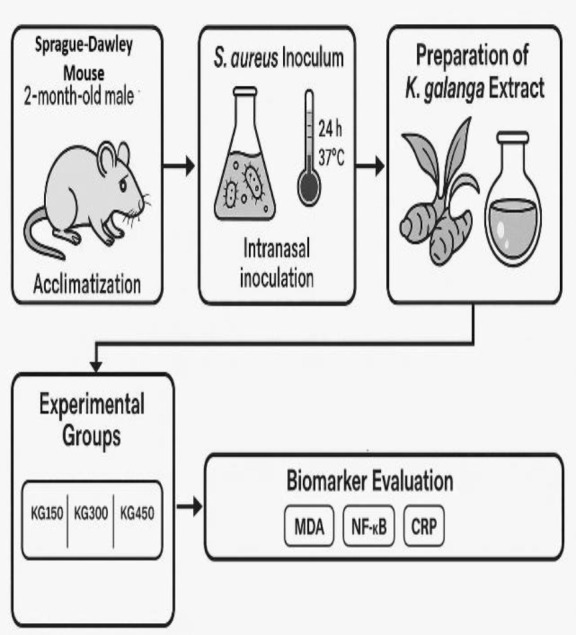 Figure 1
Peer Reviews
No public reviews on file for this paper yet. If you reviewed it on a platform where reviews are public (OpenReview, ICLR, NeurIPS, ICML), you can paste yours below so the community can read it here.
Videos
No videos yet. Explain this paper in a talk, walkthrough, or lecture? Add one.
Taxonomy
TopicsGinger and Zingiberaceae research · Synthesis of Organic Compounds · Microbial Metabolism and Applications