Sequential Event Rate Monitoring
Dong‐Yun Kim, Sung‐Min Han

TL;DR
SERM is a new method for monitoring event rates in clinical trials that improves decision-making while preserving study integrity.
Contribution
SERM is the first practical implementation of the nonlinear renewal theorem for continuous event rate monitoring in clinical trials.
Findings
SERM uses SPRT with improved boundaries for continuous monitoring of event rates.
Blinded data allows SERM to work with various study designs without affecting error rates.
Real-world data from a Phase III trial demonstrates SERM's effectiveness in rapid assessment.
Abstract
Effective monitoring of event rates is essential for maintaining statistical power and study integrity in clinical trials, particularly when the primary endpoint involves time‐to‐event outcomes. We propose Sequential Event Rate Monitoring (SERM), a new and innovative approach for continuous monitoring of event rates. SERM leverages the Sequential Probability Ratio Test (SPRT) with improved boundaries derived from the nonlinear renewal theorem by Kim and Woodroofe (2003). This method represents the first practical implementation of their theoretical work in this area. SERM offers several tangible benefits, including ease of implementation, efficient use of data, and broad applicability to trials. Decision boundaries can be directly obtained from simple formula. A detailed illustration of the method using real‐world data from a large Phase III clinical trial demonstrates its potential for…
Genes, proteins, chemicals, diseases, species, mutations and cell lines named across the full text — each resolved to its canonical identifier and authoritative record.
Click any figure to enlarge with its caption.
 Figure 1
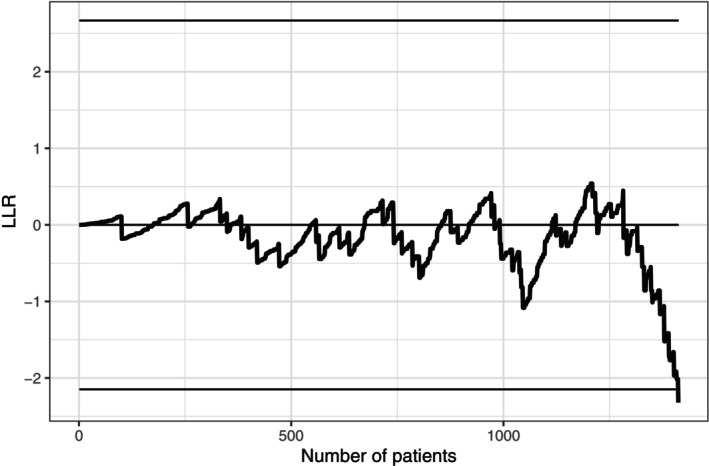 Figure 2
Peer Reviews
No public reviews on file for this paper yet. If you reviewed it on a platform where reviews are public (OpenReview, ICLR, NeurIPS, ICML), you can paste yours below so the community can read it here.
Videos
No videos yet. Explain this paper in a talk, walkthrough, or lecture? Add one.
Taxonomy
TopicsStatistical Methods in Clinical Trials · Advanced Causal Inference Techniques · Pharmacovigilance and Adverse Drug Reactions