Mucilaginibacter aureus sp. nov. and Mucilaginibacter sediminis sp. nov., isolated from wetland soil
Chae Yeong Moon, Jae Kyeong Lee, Dong Min Han, Dae Seung Lee, Byeong Jun Choi, Ju Hye Baek, Che Ok Jeon

TL;DR
Two new bacterial species, Mucilaginibacter aureus and Mucilaginibacter sediminis, were discovered in wetland soil in South Korea.
Contribution
The paper introduces two novel species within the genus Mucilaginibacter based on genomic and phenotypic analyses.
Findings
Strains AW1-3T and AW1-7T show distinct growth conditions and fatty acid profiles.
Genomic analysis confirms the two strains represent separate species with low ANI and dDDH values.
Phylogenetic analysis places the strains close to known Mucilaginibacter species but below species delineation thresholds.
Abstract
Two Gram-stain-negative, non-motile, rod-shaped bacterial strains, designated AW1-3T (strictly aerobic) and AW1-7 T (facultatively aerobic), both catalase- and oxidase-positive, were isolated from a reed wetland in South Korea. Strain AW1-3T grew at 15–35 °C, pH 6.0–7.0 and in 0.0–0.5% (w/v) NaCl, whereas strain AW1-7T grew at 10–35 °C, pH 6.0–7.0 and in 0–0.5% NaCl. The major fatty acids (>10%) were iso-C15:0 and summed feature 3 (C16:1 ω7c and/or C16 :1 ω6c) in strain AW1-3T and C16:0, summed feature 3, C18:0 and iso-C15:0 in strain AW1-7T. Phosphatidylethanolamine was the major polar lipid in both strains, and menaquinone-7 was the sole respiratory quinone. The genomic DNA G+C contents were 43.9 mol% (AW1-3T) and 43.2 mol% (AW1-7T). The two strains shared 94.9% 16S rRNA gene sequence similarity, with ANI and dDDH values of 70.9% and 20.0%, respectively, indicating they represent…
Genes, proteins, chemicals, diseases, species, mutations and cell lines named across the full text — each resolved to its canonical identifier and authoritative record.
Click any figure to enlarge with its caption.
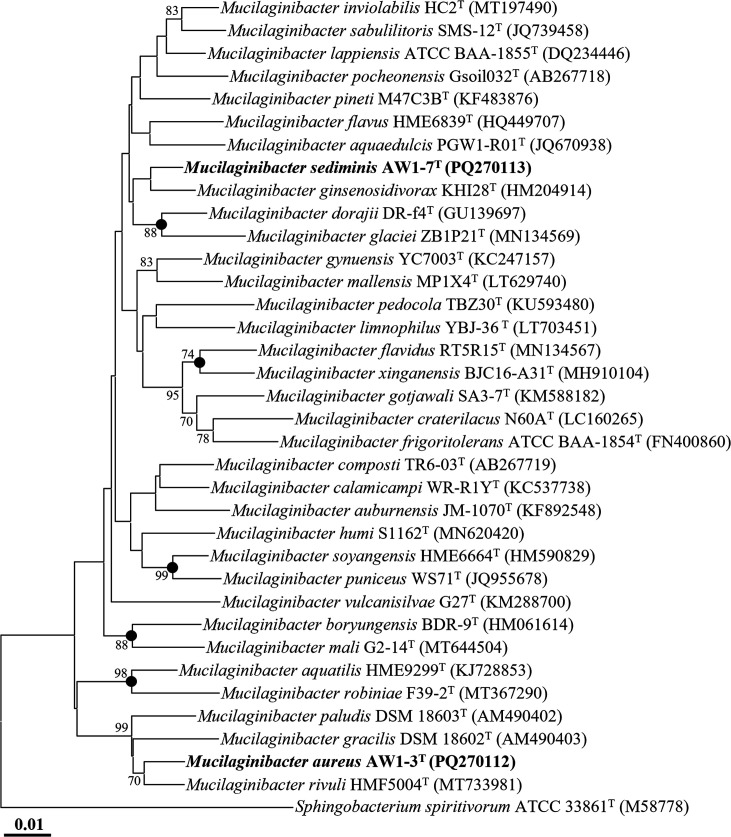 Figure 1
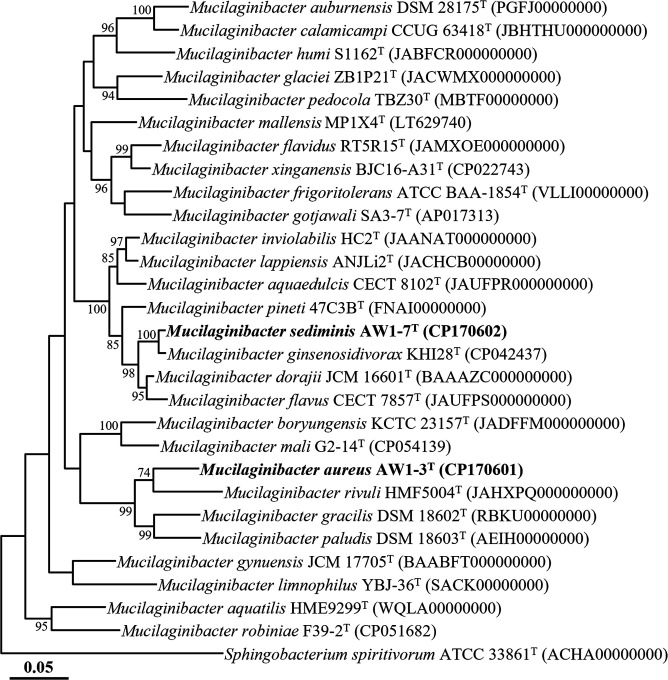 Figure 2
Peer Reviews
No public reviews on file for this paper yet. If you reviewed it on a platform where reviews are public (OpenReview, ICLR, NeurIPS, ICML), you can paste yours below so the community can read it here.
Videos
No videos yet. Explain this paper in a talk, walkthrough, or lecture? Add one.
Taxonomy
TopicsGenomics and Phylogenetic Studies · Anaerobic Digestion and Biogas Production · Microbial Fuel Cells and Bioremediation