Yersinia fenwicki sp. nov., isolated from human clinical cases in Aotearoa | New Zealand and Australia
Lucia Rivas, Hugo Strydom, Hilary Miller, David Winter, Angela Cornelius, Jing Wang, Rikki Graham, Asha Kakkanat, Gino Micalizzi, Jacqueline (Jackie) Wright

TL;DR
A new species of Yersinia bacteria, Yersinia fenwicki, was discovered from human clinical cases in New Zealand and Australia.
Contribution
Identification of a novel Yersinia species based on genetic and biochemical characteristics from human clinical isolates.
Findings
The new species utilizes raffinose and melibiose, distinguishing it from other Yersinia species.
Genome analysis confirmed it as a novel species with ANI values below 95% compared to other Yersinia species.
The closed genome was sequenced using Oxford Nanopore and polished with Illumina data.
Abstract
A Gram-negative bacillus isolated from human clinical cases in Aotearoa | New Zealand (NZ) and Australia was identified as a new species within the genus Yersinia based on genetic and phenotypic characteristics. This species demonstrated distinct biochemical differences in comparison to those typically reported for Yersinia enterocolitica (biotypes 1A, 1B, 2, 3, 4 and 5), including the ability to utilise raffinose and melibiose. Whole-genome sequencing data identified a total of 11 strains as a novel multi locus sequence type 598 (using the seven-gene McNally scheme). A closed genome for this species was obtained using Oxford Nanopore long-read sequencing, polished with high-accuracy Illumina short-read sequence data. Analysis of the 16S rRNA showed the closest similarity (98.36%) to Yersinia hibernica and Yersinia artesiana. Average nucleotide identity (ANI) values were below the…
Genes, proteins, chemicals, diseases, species, mutations and cell lines named across the full text — each resolved to its canonical identifier and authoritative record.
Click any figure to enlarge with its caption.
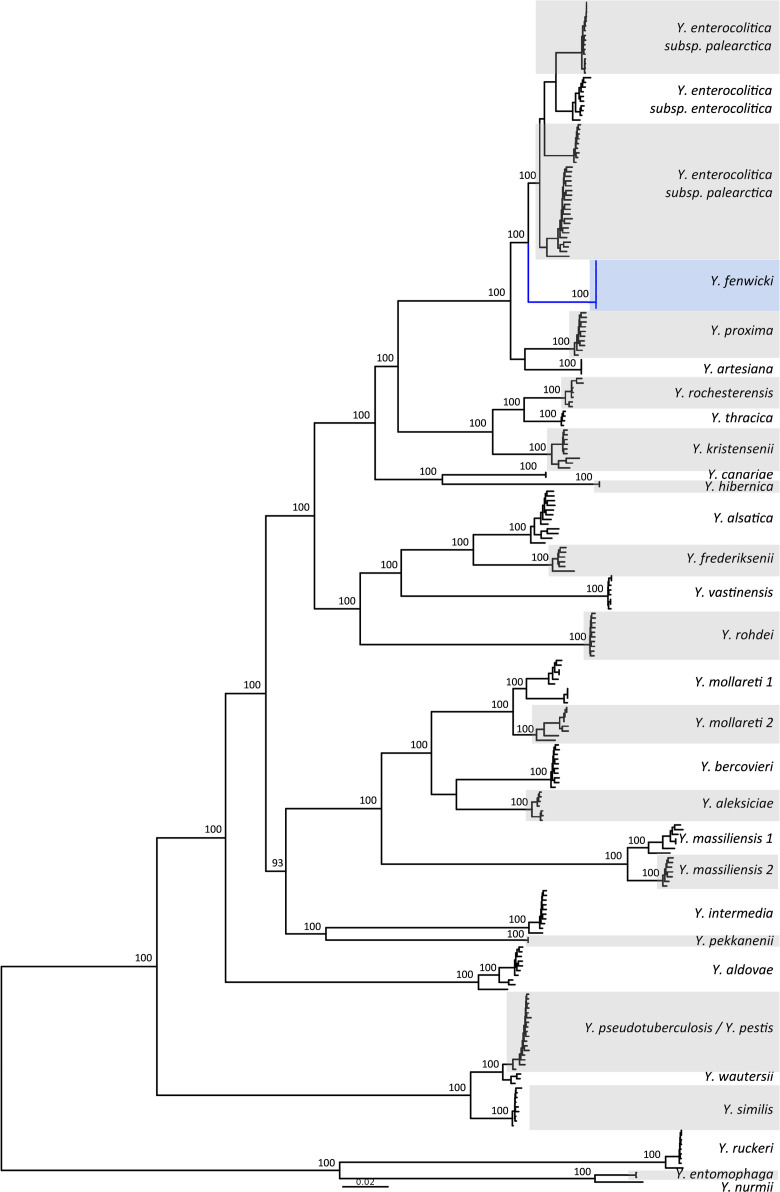 Figure 1
Peer Reviews
No public reviews on file for this paper yet. If you reviewed it on a platform where reviews are public (OpenReview, ICLR, NeurIPS, ICML), you can paste yours below so the community can read it here.
Videos
No videos yet. Explain this paper in a talk, walkthrough, or lecture? Add one.
Taxonomy
TopicsYersinia bacterium, plague, ectoparasites research · Oral microbiology and periodontitis research · Leprosy Research and Treatment