Development of three-colour FRET cascade for force sensing of the putative RIAM-vinculin interaction in fibroblasts
Conor A. Treacy, Tommy L. Pallett, Tam T. T. Bui, Simon P. Poland, Mark A. Pfuhl, Maddy Parsons, Simon M. Ameer‑Beg

TL;DR
The paper introduces a new three-fluorophore FRET system to study how RIAM and vinculin interact in cells, revealing vinculin's role in sensing mechanical forces.
Contribution
A novel three-fluorophore FRET-cascade system was developed and validated to study protein interactions and force sensing in live cells.
Findings
RIAM binds to the N-terminus of vinculin in focal adhesions.
Vinculin tension-sensing constructs report an average force of 3.0 ± 0.3 pN per focal adhesion.
FRET-cascade is effective for studying multicomponent protein interactions and force-sensing dynamics in live cells.
Abstract
Förster resonance energy transfer (FRET) enables the measurement of molecular interactions and conformational dynamics in biological systems. FRET-cascade, a multistep energy transfer system involving three fluorophores, enables spatial and temporal mapping of molecular interactions. Here, we leveraged FRET-cascade with time-correlated single photon counting fluorescence lifetime imaging microscopy (TCSPC-FLIM) to explore the putative interaction between Rap1-interacting Adaptor Molecule (RIAM) and vinculin in focal adhesions. We developed a novel three-fluorophore FRET-cascade system, validated using purified proteins, spectroscopic analysis, structural modelling, and negative-staining transmission electron microscopy (TEM). Putative RIAM-vinculin interactions were explored in vinculin knockout mouse embryonic fibroblasts and revealed that RIAM binds to the N-terminus of vinculin in…
Genes, proteins, chemicals, diseases, species, mutations and cell lines named across the full text — each resolved to its canonical identifier and authoritative record.
Click any figure to enlarge with its caption.
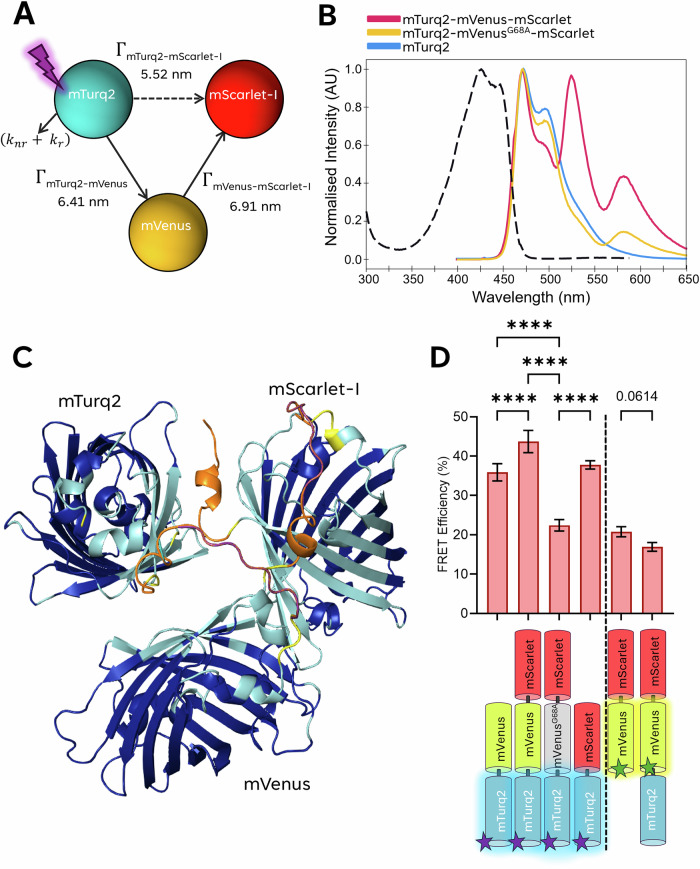 Figure 1
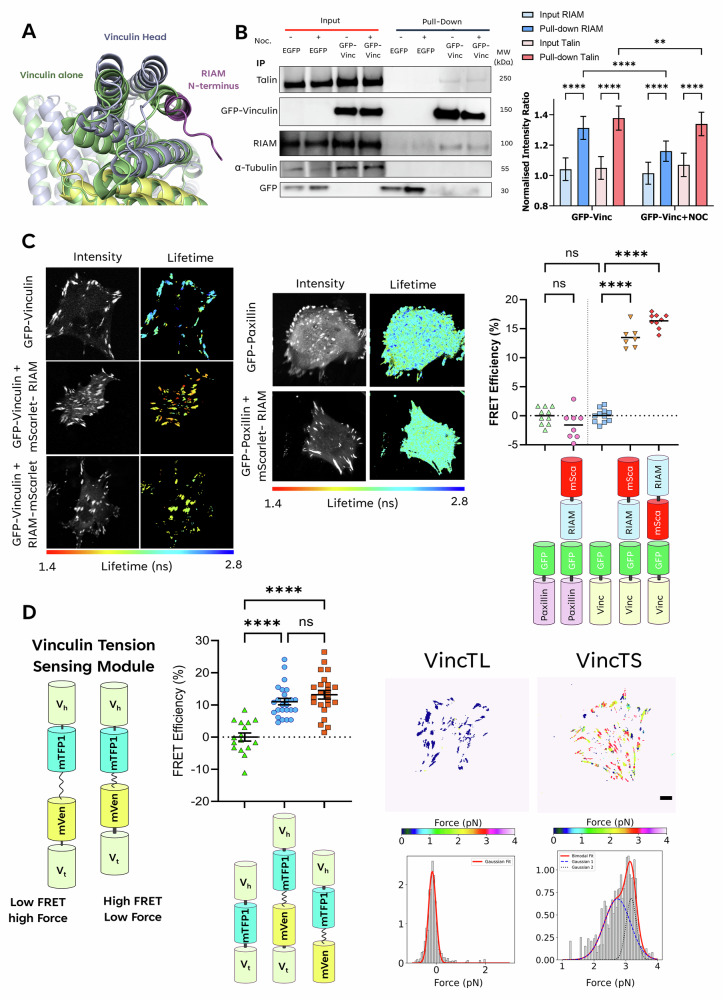 Figure 2
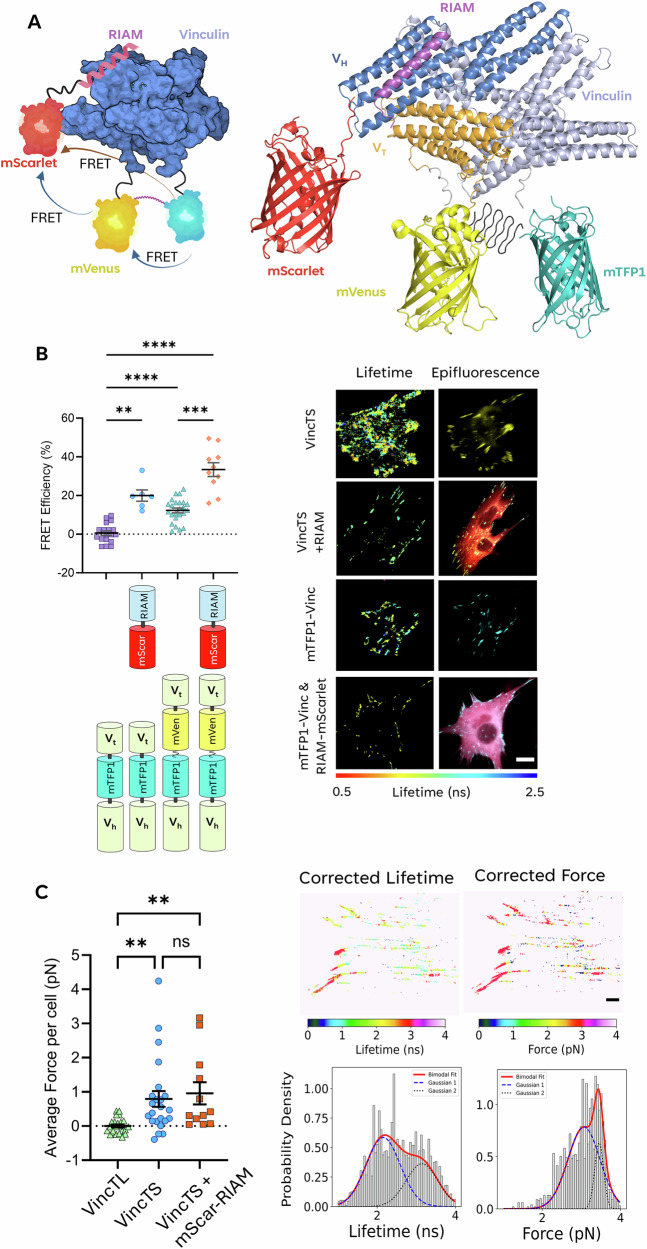 Figure 3
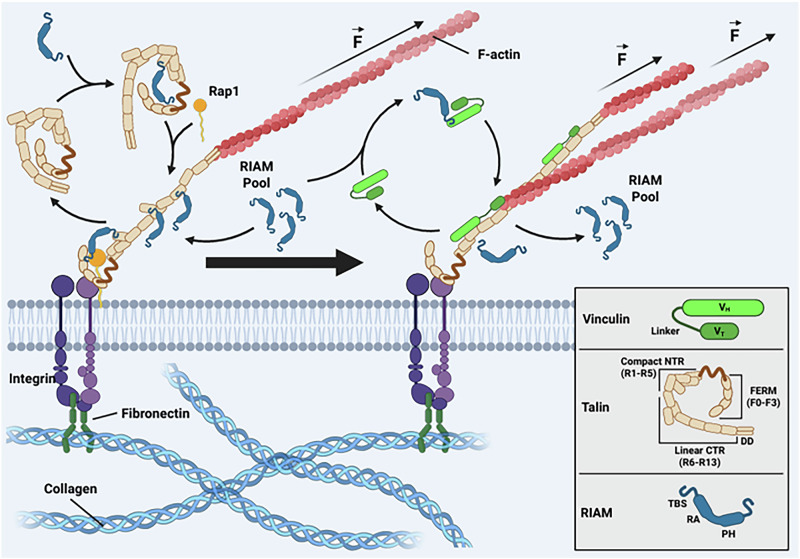 Figure 4
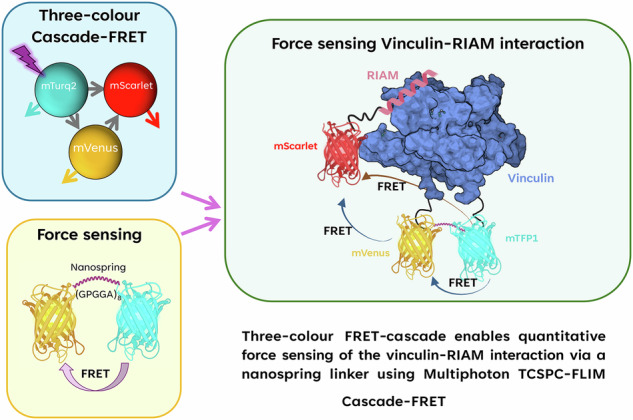 Figure 5
Peer Reviews
No public reviews on file for this paper yet. If you reviewed it on a platform where reviews are public (OpenReview, ICLR, NeurIPS, ICML), you can paste yours below so the community can read it here.
Videos
No videos yet. Explain this paper in a talk, walkthrough, or lecture? Add one.
Taxonomy
TopicsForce Microscopy Techniques and Applications · Cellular Mechanics and Interactions · Advanced Fluorescence Microscopy Techniques