Electroresponsive Strategies to Combat Bacterial Infections
Yanni Song, Bingxiang Li, Heng Dong, Shengke Li, Dongliang Yang

TL;DR
This paper explores how electricity can be used to fight drug-resistant bacterial infections with precise and safe methods.
Contribution
The paper introduces and evaluates electroresponsive antibacterial strategies as a novel and practical approach to combat resistance.
Findings
Electroresponsive methods like electroluminodynamic therapy show potential for precise antibacterial action.
These strategies offer tunable and safe alternatives with minimal side effects.
Current challenges and future research directions are outlined for practical applications.
Abstract
Drug-resistant bacterial infections threaten global health and economies. Stimulus-responsive antibacterial materials are promising for combating resistance and improving treatment precision. Among them, electroresponsive strategies stand out for being practical, economical, tunable, and safe. This perspective examines various strategies, including electroluminodynamic therapy, electrodynamic therapy, and electrocontrolled drug release, which enable precise antibacterial action with minimal side effects and demonstrate strong application potential. Finally, we outline current challenges and future directions to guide further research and practical applications.
Genes, proteins, chemicals, diseases, species, mutations and cell lines named across the full text — each resolved to its canonical identifier and authoritative record.
Click any figure to enlarge with its caption.
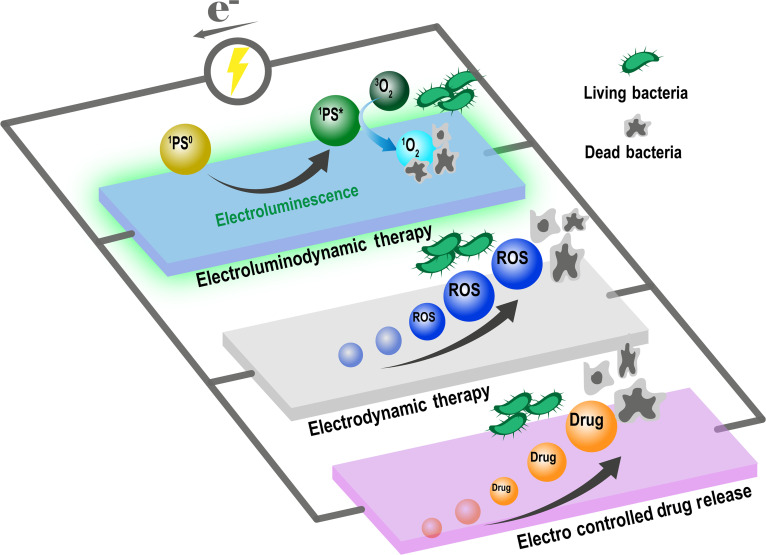 Figure 1
Peer Reviews
No public reviews on file for this paper yet. If you reviewed it on a platform where reviews are public (OpenReview, ICLR, NeurIPS, ICML), you can paste yours below so the community can read it here.
Videos
No videos yet. Explain this paper in a talk, walkthrough, or lecture? Add one.
Taxonomy
TopicsBacterial biofilms and quorum sensing · Nanoplatforms for cancer theranostics · Micro and Nano Robotics