Predictors of social inclusion among adults with severe mental illness: Results of a cross-sectional study
Mara Ohlhoff, Alexander Pabst, Johanna Breilmann, Thomas Becker, Andreas Allgöwer, Reinhold Kilian, Alkomiet Hasan, Peter Falkai, Klemens Ajayi, Theresa Halms, Peter Brieger, Karel Frasch, Stephan Heres, Markus Jäger, Andreas Küthmann, Albert Putzhammer, Steffi G. Riedel-Heller

TL;DR
This study finds that older age, being in a relationship, certain diagnoses, employment status, and living arrangements are linked to higher social inclusion in people with severe mental illness.
Contribution
The study identifies specific psychosocial predictors of social inclusion using a validated measure in individuals with severe mental illness.
Findings
Older age, being in a committed relationship, and diagnosis of schizophrenia are linked to greater social inclusion.
Employment in competitive jobs or education, compared to sheltered work or unemployment, predicts higher inclusion.
Living with others is associated with greater perceived social inclusion among individuals with severe mental illness.
Abstract
Promoting social inclusion is crucial for people living with severe mental illness (SMI), who often experience high levels of social exclusion. However, research that uses a psychometric social inclusion measure to identify factors that determine varying levels of social inclusion in individuals with SMI is scarce. This study aimed to examine to what extent people with SMI feel socially included and to identify factors associated with perceived social inclusion among people with SMI. A cross-sectional multicenter investigation of psychiatric inpatients and day hospital patients with SMI aged 18 to 65 years (n = 358) was conducted. Perceived social inclusion, sociodemographic, and clinical characteristics were assessed using the Measure of Participation and Social Inclusion for Use in People with a Chronic Mental Disorder (F-INK). Hierarchical multiple linear regression was performed…
Genes, proteins, chemicals, diseases, species, mutations and cell lines named across the full text — each resolved to its canonical identifier and authoritative record.
Click any figure to enlarge with its caption.
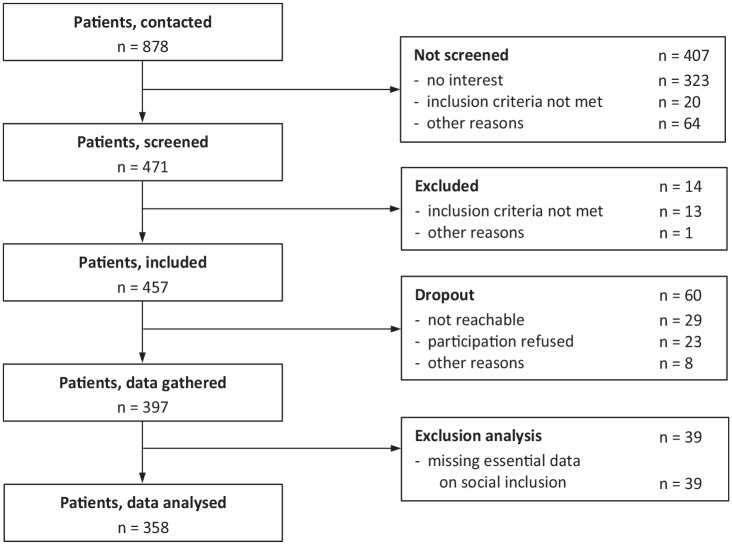 Figure 1
 Figure 2
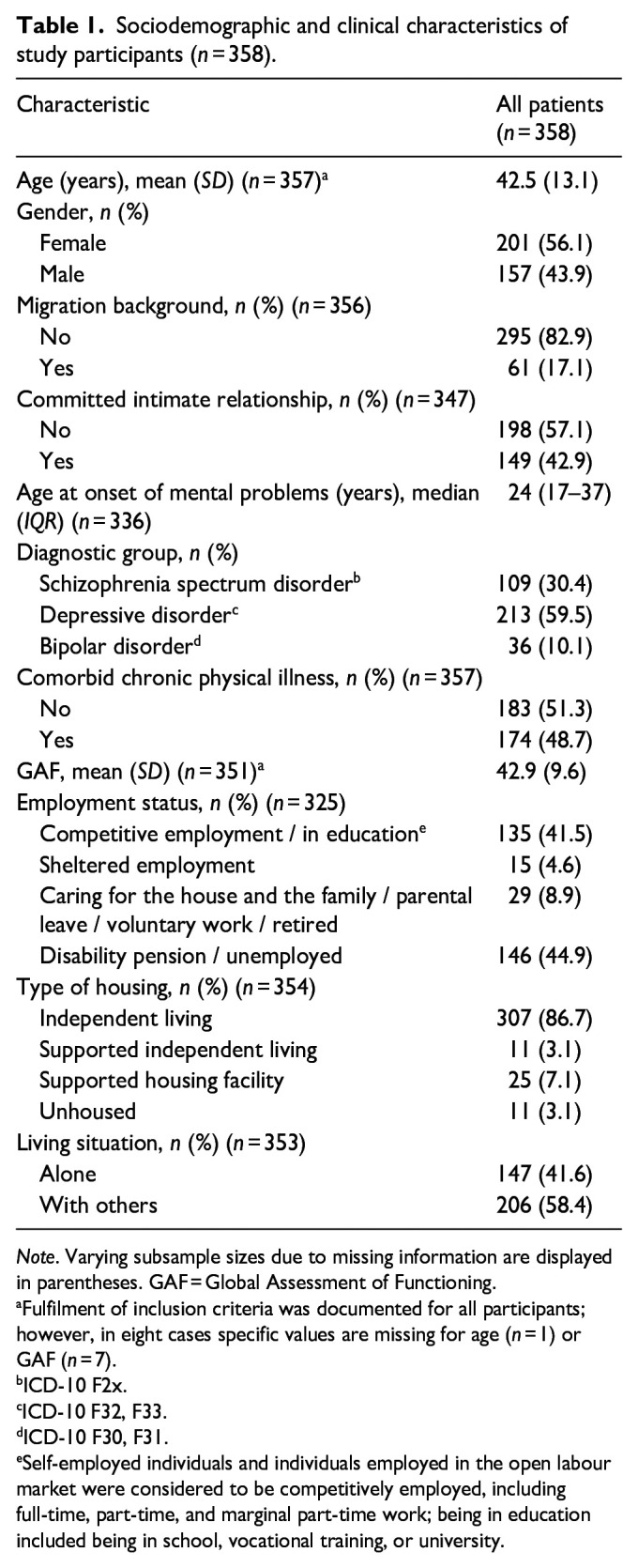 Figure 3
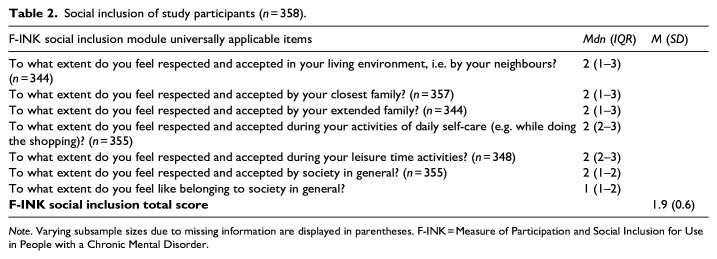 Figure 4
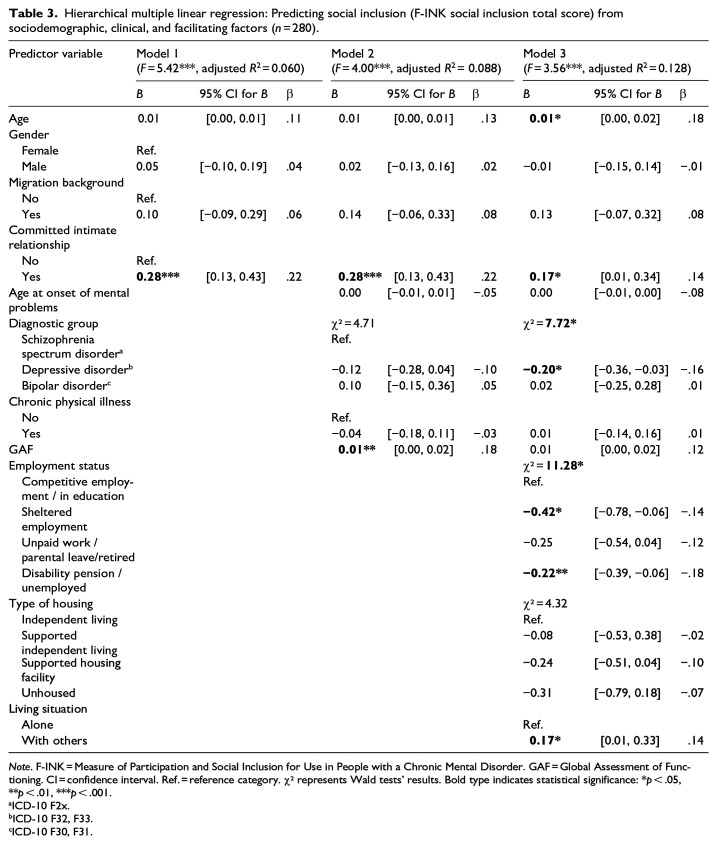 Figure 5
Peer Reviews
No public reviews on file for this paper yet. If you reviewed it on a platform where reviews are public (OpenReview, ICLR, NeurIPS, ICML), you can paste yours below so the community can read it here.
Videos
No videos yet. Explain this paper in a talk, walkthrough, or lecture? Add one.
Taxonomy
TopicsSchizophrenia research and treatment · Health disparities and outcomes · Family Caregiving in Mental Illness